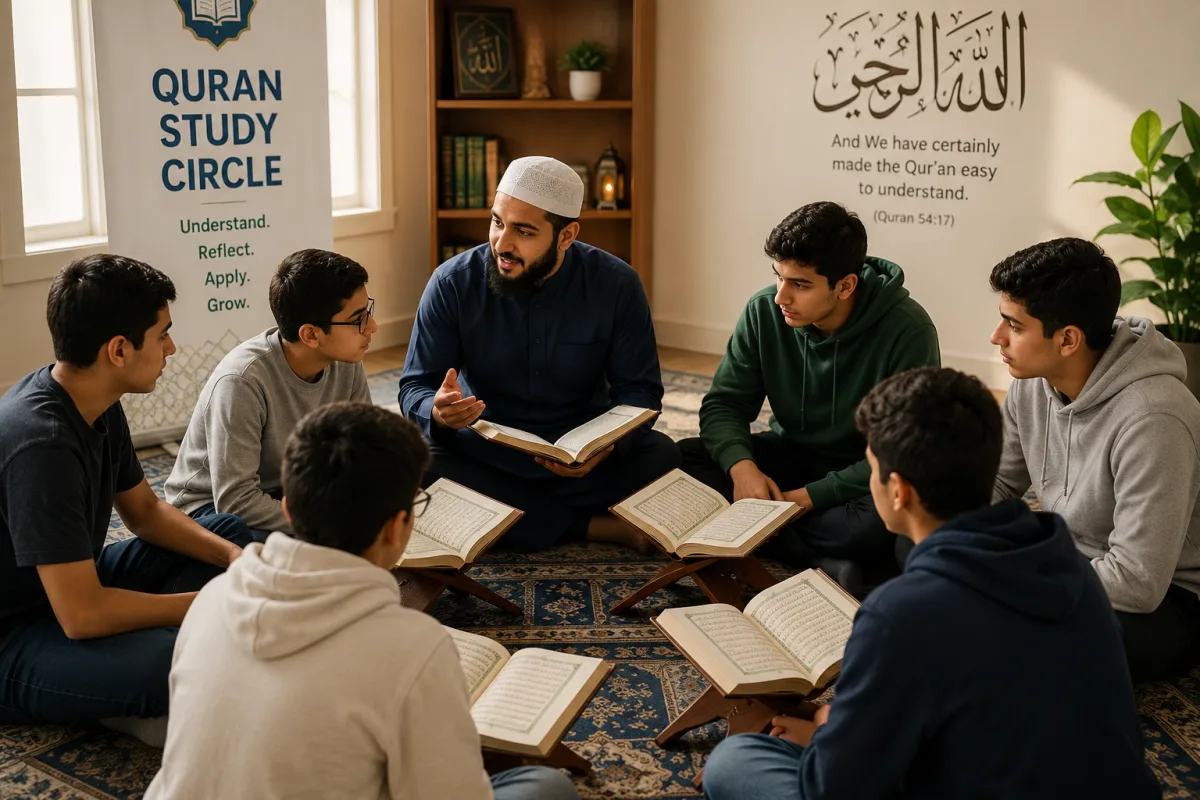
Every parent who wants their child to grow up connected to the Qur'an eventually faces the same crossroads. Should you enrol them at the local weekend or evening madrasah, where they will sit with other children in a familiar community setting? Or should you choose one-to-one online Qur'an classes, where a qualified teacher works with your child alone through a screen? Both paths lead toward the same beautiful goal, and both have shaped generations of confident Muslim readers. The honest answer is that neither is simply "better" — they are different tools for different families.
Allah tells us, "And We have certainly made the Qur'an easy to remember, so is there any who will remember?" (Surah al-Qamar, 54:17). That ease is real, but it still asks something of us: a teacher who cares, a routine that holds, and a learning setting that fits the particular child in front of us. A shy seven-year-old and a lively eleven-year-old may thrive in very different rooms — one physical, one virtual.
This article walks through the real trade-offs between a weekend madrasah and online one-to-one classes, fairly and without spin. We will look at attention, pace, consistency, travel, community, cost, and discipline, then help you match the option to your child. By the end you should feel less pulled between two camps and more able to choose — or blend — with confidence.
Reading time: about 11 minutes.
Reviewed by the Tayseerul Quran Teaching Team Qualified Quran teachers helping children and adults learn Quran reading, Tajweed, Noorani Qaida, Hifz, and Arabic through one-on-one online classes.
What You'll Learn
- What each option really looks like
- Individual attention and one-to-one focus
- Pace and steady progress
- Consistency and routine
- Travel, time and convenience
- Islamic community and friendships
- Cost and value
- Discipline, environment and screen time
- What qualified teachers watch for
- Which option suits which child
- A balanced verdict
What each option really looks like
A weekend or evening madrasah is usually run out of a mosque, a community hall, or a teacher's home. Children attend in groups, often on Saturday mornings or a couple of weekday evenings, and study Qur'an reading alongside other subjects such as basic fiqh, du'as, seerah, and sometimes Arabic. The heart of it is togetherness: your child is one of many, learning shoulder to shoulder with peers from the neighbourhood.
Online one-to-one Qur'an classes flip the setting. Your child sits at home with a headset and a device, and a qualified teacher joins them for a scheduled session — often several short lessons across the week. The teacher sees and hears only your child, shares the page on screen, and listens closely to every letter. You can read more about how this model works in our overview of online Qur'an classes for kids.
Neither picture is complete without the caveat that quality varies within each. There are outstanding madrasahs and stretched ones; there are excellent online academies and weaker ones. The comparison below assumes both are run with care.
Individual attention and one-to-one focus
This is where online classes hold a clear structural advantage. In a one-to-one lesson, the teacher hears every syllable your child pronounces. A slipping makhraj (point of articulation), a rushed madd (elongation), a swallowed letter — all of it is caught in the moment and corrected gently before it hardens into a habit.
A madrasah teacher, by contrast, may be responsible for ten, twenty, or more children at once. Skilled teachers manage this remarkably well, rotating through the room and giving each child a turn to recite. But the arithmetic is unavoidable: in an hour, a child in a large group may recite aloud for only a few minutes. A child in a one-to-one lesson recites for most of the session.
For the precise, listen-and-correct work of Tajweed, that difference compounds over months. If your child has a specific sticking point, individual attention tends to resolve it faster. Allah instructs, "and recite the Qur'an with measured recitation" (Surah al-Muzzammil, 73:4) — and measured, accurate recitation is largely built through close, patient listening.
Pace and steady progress
Group learning moves at the pace of the group. That is not a flaw; it is simply how a classroom works. A child who grasps a lesson quickly may wait for others to catch up, while a child who needs longer may feel hurried along before a concept has settled.
One-to-one online classes move at the pace of your child. A fast learner can push ahead into new letters, rules, or memorisation without waiting. A child who needs to revisit the same page three times can do so without embarrassment and without holding anyone up. For memorisation especially, this flexibility matters — Hifz rewards a rhythm tuned to the individual.
The madrasah offers something valuable in return, though: the gentle motivation of seeing a friend move ahead, and the reassurance of not being singled out. Some children learn best when the pace is shared. Our guide on how a young child learns to read the Qur'an explains why the right pace is often more important than raw speed at the early stages.
Consistency and routine
A madrasah brings a built-in rhythm. Class is on Saturday morning, full stop. That fixed anchor can be a gift for busy families — the routine exists whether or not you feel organised that week, and the child knows exactly what is expected.
Online classes offer flexibility that can cut both ways. Lessons can be scheduled around school, naps, sports, and different time zones, and shorter sessions spread across the week often beat one long weekly block for retention. But flexibility only helps if you protect the slots. Without a firm family habit, "we'll do it later" can quietly erode progress. If keeping Qur'an study consistent is your challenge, our article on balancing school and a Qur'an routine offers practical structures that work for either option.
Travel, time and convenience
Here online classes win plainly for many families. There is no drive across town, no parking, no waiting in the car, no lessons missed because of rain, illness in the family, or a clashing weekend commitment. For households far from a good madrasah — or in towns with none at all — online access opens a door that geography had closed.
The madrasah's travel, however, is not purely a cost. The walk or drive to the mosque, the arrival among familiar faces, the shared space of learning — these rituals carry meaning. For some children, physically going somewhere to learn the Qur'an signals its importance in a way that logging in from the sofa does not. Convenience is a genuine benefit of online study, but it is worth naming what the journey itself can offer.
Islamic community and friendships
This is the madrasah's greatest strength, and it deserves to be said plainly. A local madrasah gives your child a circle of Muslim friends, a sense of belonging, and an environment saturated with Islamic manners and shared identity. They celebrate Eid together, learn nasheeds together, and see with their own eyes that they are part of something bigger than their own family. These bonds often last for years and quietly anchor a child's faith through adolescence.
One-to-one online classes, for all their focus, cannot fully replicate this. A caring online teacher builds a warm and real relationship with a child, and that connection matters. But a screen does not give your child a friend sitting beside them who is also memorising Surah al-Mulk. If communal belonging and in-person Islamic friendship are high on your list — and for many parents they rightly are — the madrasah delivers something online study simply is not designed to.
Cost and value
Costs vary widely by country, city, and institution, so treat any figure with caution. Broadly, community madrasahs are often subsidised by the mosque or run on modest fees, which can make them very affordable — sometimes the most affordable structured option available. That accessibility is part of their service to the community.
Online one-to-one classes usually cost more per hour than a group madrasah, because you are paying for a teacher's undivided attention rather than sharing that teacher across a room. Whether that premium is "worth it" depends on what you value: if targeted, efficient progress matters most, the higher per-hour cost may buy faster results and fewer wasted minutes. If budget is the deciding factor, a good local madrasah is hard to beat on price. Neither choice is extravagant or stingy — they simply price different things.
Discipline, environment and screen time
A physical classroom carries its own discipline. Being among peers, under a teacher's direct eye, in a dedicated space, naturally sharpens focus for many children. There is no home distraction, no sibling wandering past, no temptation to glance at another tab. The environment does some of the parenting for you.
Online study asks the home to provide that structure instead. It also means more screen time, which some parents are actively trying to reduce. The upside is that the screen is being used for something purposeful, and a quiet corner with a parent nearby can become a focused, even peaceful, learning space. But it is fair to acknowledge the trade: online classes lean on your household to supply the discipline that a madrasah room supplies by design. A well-run after-school Qur'an program can offer a helpful middle setting for families who want more structure than home study alone.
What qualified teachers watch for
From a teaching standpoint, the format matters less than the quality of feedback the child receives. The Prophet ﷺ said, "The best among you are those who learn the Qur'an and teach it" (Sahih al-Bukhari 5027) — and good teaching, in any setting, shares the same markers: accurate correction, patience, encouragement, and a clear progression that the child can feel.
When our teaching team assesses a child's recitation, we listen for the foundations first — correct letter articulation, secure vowel sounds, and the early Tajweed rules — before pushing for pace or volume of memorisation. Rushing a child past shaky basics tends to create problems that take far longer to unpick later. This is true whether the child learns online or in a madrasah.
For any decision that touches on religious rulings — for example, questions about the etiquette of reciting, handling the mushaf, or specific obligations — please ask a qualified scholar rather than relying on a general article. Our role is teaching recitation and building skill, and we are glad to point families toward reliable scholarly guidance when it is needed. If you want a fuller picture of the online model itself, our overview of online Qur'an classes walks through how qualified teachers structure lessons and track progress.
Which option suits which child
Some patterns tend to hold. A shy or easily distracted child, or one with a specific recitation weakness, often blossoms in one-to-one online lessons where they are neither rushed nor exposed. A child who is bored in a group, or far ahead of peers, may also do better with the tailored pace of online study.
A sociable child who thrives on friendship, or one who needs the external structure of "going somewhere to learn," often does beautifully at a madrasah. A younger child who craves belonging, or a family that deeply wants their child rooted in the local Muslim community, will find the madrasah gives something no screen can.
And many children fit both descriptions at once — which is exactly why so many families stop treating this as an either/or.
A balanced verdict
Weighing everything honestly: the madrasah wins on community, in-person friendship, and an immersive Islamic environment, and it is often the most affordable structured option. Online one-to-one classes win on individual attention, tailored pace, and convenience, and they open access for families with no strong local option. Both are legitimate, faithful choices, and a good version of either will serve your child well.
For many families, the wisest answer is not to choose but to combine. Keep your child at the weekend madrasah for the community, the friendships, and the belonging — and add one or two short online one-to-one sessions each week to sharpen their reading and Tajweed with focused correction. The madrasah feeds the heart and the sense of ummah; the online lessons refine the skill. Together they cover what neither does alone.
Frequently Asked Questions
Is online Qur'an learning as effective as a madrasah?
For the skill of accurate recitation, well-run one-to-one online classes are often more effective because of the individual attention. For community, belonging, and in-person Islamic friendship, a good madrasah is stronger. Effectiveness depends on what you are measuring.
Can my child do both at the same time?
Yes, and many families find this the best of both worlds. The madrasah provides the community and routine, while a short online session or two each week gives focused correction. Just be mindful not to overload the child's week.
Which is better for very young children?
Young children often benefit from the belonging and gentle group energy of a madrasah, but they also respond well to a warm one-to-one teacher who moves at their pace. The right teacher matters more than the format at this age.
Are online classes more expensive?
Usually yes, per hour, because you are paying for undivided attention rather than a shared group setting. Community madrasahs are often subsidised and very affordable. Weigh the cost against the faster, more targeted progress one-to-one lessons can bring.
How do I keep online lessons consistent?
Protect fixed slots in the weekly schedule as firmly as you would a madrasah class, keep sessions short and regular rather than long and occasional, and sit nearby, especially for younger children. Consistency, not format, is the real driver of progress.
Does online learning mean too much screen time?
It adds screen time, but for a purposeful reason. You can offset it by keeping sessions short, using a distraction-free corner, and reducing recreational screen use elsewhere. Many parents find a focused Qur'an lesson a worthwhile use of a screen.
What if there is no good madrasah near us?
This is where online classes shine. They give your child access to qualified teachers regardless of where you live, so geography no longer limits their Qur'an learning. You can still nurture community through the mosque, family, and local events.
Continue Learning
- Online Qur'an classes for kids
- After-school Qur'an program
- Online Qur'an classes
- How a young child learns to read the Qur'an
- Balancing school and a Qur'an routine
Final Thoughts
There is no single right answer to weekend madrasah versus online Qur'an classes — there is only the right answer for your child, your family, and your circumstances. Honour what the local madrasah gives: community, friendship, and an Islamic environment that shapes a child from the inside out. Value what online one-to-one lessons give: attention, pace, and convenience that meet your child exactly where they are. And remember that combining the two is not a compromise but often the strongest plan of all. Whatever you choose, what matters most is that your child keeps meeting the Qur'an with a teacher who cares and a routine that holds.
See how one-to-one online lessons work — book a free trial →
References
- Surah al-Qamar (54:17)
- Surah al-Muzzammil (73:4)
- Sahih al-Bukhari 5027