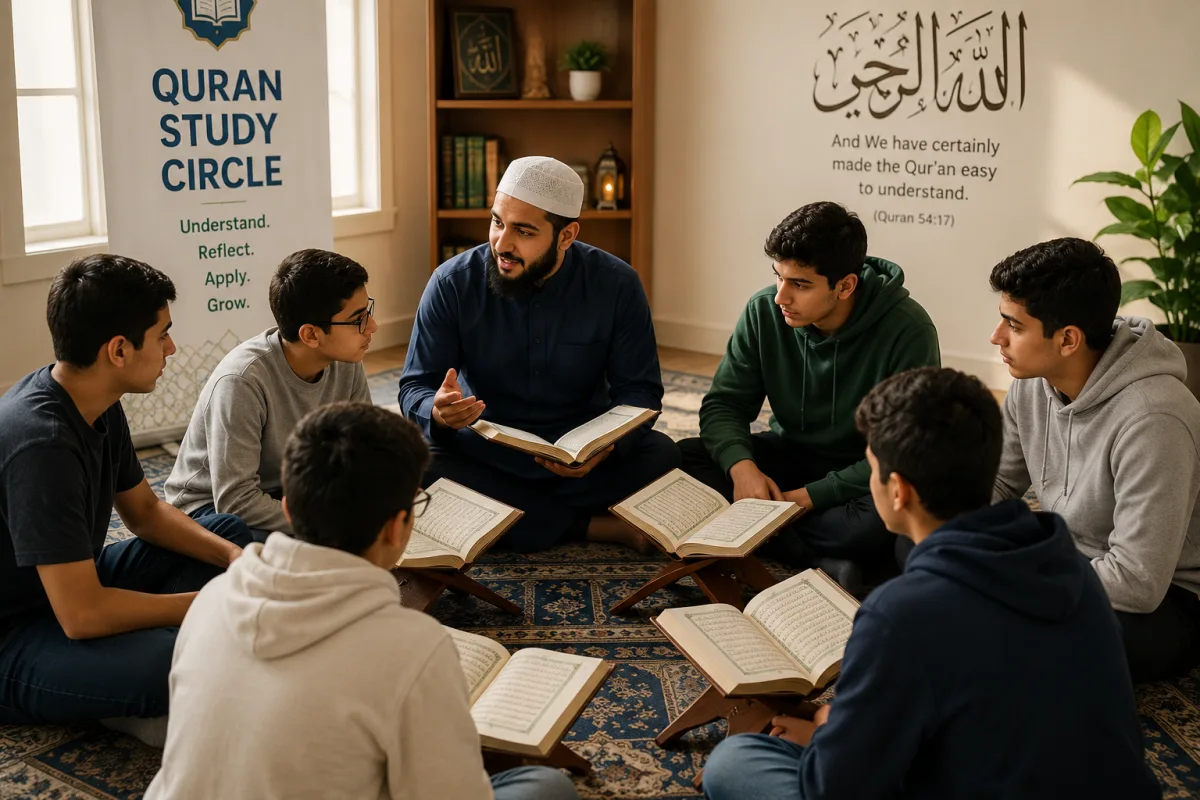
If you are a parent thinking about starting Qur'an lessons once the school day ends, you are already asking the right questions. When is the best time to fit them in? How many lessons a week is realistic? Will one more thing on the calendar tire my child out, or will it become the calm, grounding part of their week? These are not small worries. They come from wanting to give your child something lasting without pushing them past what they can carry.
The good news is that after-school Qur'an learning, done thoughtfully, tends to fit into family life more gently than most parents expect. A single one-to-one lesson is short, focused, and built around your child rather than a room full of other students. There is no travel, no waiting for a group to catch up, and no rigid timetable you have to bend your evening around. The Qur'an itself was revealed to be learned in exactly this patient, repeated way. Allah says, "And We have certainly made the Qur'an easy for remembrance, so is there any who will remember?" (Surah al-Qamar 54:17). Ease is written into the promise.
This guide gathers the questions parents ask us most often about after-school classes, and answers them plainly, without pressure. Wherever a religious ruling is involved, the honest answer is to ask a qualified scholar you trust. But for the practical, everyday concerns of scheduling, cost, pacing, and choosing the right academy, here is what we have learned from teaching children around the world.
Reading time: about 11 minutes.
Reviewed by the Tayseerul Quran Teaching Team Qualified Quran teachers helping children and adults learn Quran reading, Tajweed, Noorani Qaida, Hifz, and Arabic through one-on-one online classes.
What You'll Learn
- Timing And Frequency
- Will It Overload My Child
- Online Classes Versus The Local Madrasah
- Keeping Going Through Exam Season
- Choosing A Trustworthy Academy
- Progress Siblings And Teachers
- Cost And Value
- A Qualified Teacher's Perspective
- Frequently Asked Questions
- Continue Learning
- Final Thoughts
- References
Timing And Frequency
The two questions that come first for almost every family are when to hold the lesson and how often. There is no single right answer, but there are patterns that work well.
What is the best time for lessons after school?
The best time is the one your child can show up to with a little energy left. For many families that is late afternoon, after a snack and a short break, but before dinner and before tiredness sets in. Your child has just come home, so give them room to breathe first. A rushed lesson at the moment they walk through the door rarely goes well.
Because our classes are one-to-one and online, you are not fixed to a class slot that suits everyone else. You choose the time that fits your household. Families in different time zones often find a rhythm that would be impossible with a local group, whether that means straight after school, in the early evening, or even before school for households where mornings are calmer than nights. The key is consistency. A lesson that happens at the same time each day quietly becomes a habit, and habits carry children far further than motivation does. Our after-school Qur'an program is built around exactly this kind of steady, repeatable slot.
How many lessons a week does my child need?
For a child who is reading and building Tajweed, three to five short lessons a week is a strong, sustainable rhythm. Frequency matters more than length. A child who reads for twenty minutes five times a week will almost always progress faster than one who does a single long session, because the Qur'an is learned through gentle repetition rather than intensity.
That said, start where your child is. If your family is new to a daily routine, begin with two or three lessons a week, let it settle, and add more once it feels natural. A child memorising Hifz will usually need more frequent contact to hold new lines and revise old ones. A child simply learning to read fluently can progress beautifully on a lighter schedule. A good teacher will recommend a frequency based on your child's goal and stamina, not a one-size-fits-all package. You can read more about structuring this in our guide to balancing school and Qur'an routine.
Will It Overload My Child
This is the worry that keeps many parents from starting at all. Nobody wants to be the reason their child feels stretched thin. It is a loving concern, and it deserves a real answer.
Will Qur'an classes tire or overload my child?
Honestly, they can, if they are stacked on top of an already overloaded week without any thought. But a well-run one-to-one lesson is usually far lighter than parents fear. A focused session is short, often twenty to thirty minutes, and it is a completely different kind of activity from a school day full of tests and transitions. Many children find it calming rather than draining. There is no competition, no being called on in front of classmates, no keeping pace with anyone else. It is quiet, personal, and moves at their speed.
The difference between a lesson that refreshes and one that tires almost always comes down to timing and pacing. Slotted in when your child is exhausted, anything feels like too much. Placed in a reasonable window with a break beforehand, and kept short, Qur'an learning often becomes the part of the day a child looks forward to. Watch your own child. If they are consistently drained, adjust the time or reduce the frequency rather than dropping the habit entirely. A one-to-one format makes that kind of adjustment easy, because the lesson bends to your child instead of the other way around.
How do I keep it from feeling like extra homework?
Keep it distinct from schoolwork. Let there be a small ritual around it, a clear start, a familiar teacher, a warm greeting, so it feels like its own space rather than another assignment. When a child connects the Qur'an with steadiness and a kind teacher rather than pressure, they carry that association for life. Short, regular, and unhurried beats long and forced every single time.
Online Classes Versus The Local Madrasah
Many parents weigh online lessons against the madrasah down the road. Both have real value, and the right choice depends on your family.
How do online classes compare to the local madrasah?
A local madrasah offers community, in-person presence, and the sense of belonging that comes from learning alongside other children. Those are genuine benefits, and for some families they matter deeply. The trade-offs are usually the travel, the fixed group timetable, and the larger class sizes where one teacher divides attention among many students. A shy child, or one who has fallen a little behind, can sometimes get lost in a group.
Online one-to-one classes flip that. Your child has the teacher's full attention for the whole lesson. Mistakes are caught and corrected the moment they happen, which matters enormously for Tajweed, where a small habit repeated wrongly is hard to undo later. There is no travel, the timing is yours, and the teacher builds a genuine relationship with your child over time. Neither option is simply better than the other; they suit different needs. We compare the two in detail in our piece on weekend madrasah versus online Qur'an classes, which may help you decide.
Can online lessons really hold a young child's attention?
Yes, more easily than many parents expect, precisely because they are one-to-one. A teacher speaking directly to your child, using their name, responding to their pace, is far more engaging than being one face in a crowded room. Young children also tend to be comfortable on a screen. The teacher's job is to keep the lesson lively and short enough to match a small attention span, and experienced teachers are good at reading when to move on. You can learn more about how this works for younger learners in our guide to online Qur'an classes for kids.
Keeping Going Through Exam Season
Exam periods test every good routine. Parents often ask whether they should pause Qur'an lessons entirely while school pressure peaks.
How do we keep going during exam periods?
You do not have to stop, and usually you should not. Stopping entirely often means the habit never fully returns, because starting again from cold is harder than keeping a small flame alive. The better approach is to shrink the routine rather than end it. Drop from five lessons to two, or shorten each session, or switch temporarily to gentle revision of what your child already knows rather than new material.
There is wisdom in this. A short daily connection with the Qur'an during a stressful season can steady a child rather than burden them. Many families tell us the ten quiet minutes of recitation became the calmest part of an anxious exam week. Talk to your teacher before exam season begins so they can plan a lighter phase in advance. A good academy will happily reduce and then rebuild the schedule with you, rather than treating your plan as fixed. Protecting the habit through the hard weeks is what lets your child pick straight back up afterwards, without that heavy feeling of having to start over.
Should Qur'an revision come before or after study?
Many children find that a few minutes of recitation before sitting down to study helps them settle and focus, almost like a warm-up for the mind. Others prefer it as a calming close to the day. There is no rule here, so try both and let your child tell you what helps. The point is simply to keep the thread unbroken.
Choosing A Trustworthy Academy
With so many options online, choosing well matters. Your child's teacher will shape their relationship with the Qur'an, so this decision deserves care.
How do I choose a trustworthy academy?
Look first at the teachers. Are they qualified, and can the academy tell you clearly about their training and their approach to Tajweed? A trustworthy academy is transparent about who will teach your child and how progress is tracked. Ask for a trial lesson before committing, because nothing tells you more than watching how a teacher actually speaks to your child.
Beyond credentials, look at how the academy treats your family. Do they listen to your goals, or push a fixed package? Do they communicate clearly about scheduling, missed lessons, and pace? Is there someone you can reach if a concern comes up? A good academy feels like a partner in your child's learning, not a subscription you signed up for. Trust your instinct after that first lesson. If your child feels at ease and you feel heard, that is a strong sign.
What questions should I ask before I enroll?
Ask about teacher qualifications, whether lessons are truly one-to-one, how they handle rescheduling, whether you can request a female teacher, and how they report your child's progress. Ask what happens if the match with a particular teacher does not feel right, because a good academy will happily find a better fit rather than leave you stuck. Clear, patient answers to these questions tell you a great deal about how the academy will treat you once you have enrolled.
Progress Siblings And Teachers
A cluster of practical questions comes up again and again once parents are ready to begin.
How long until my child reads the Qur'an?
This depends on your child's starting point, age, and how regularly they attend, so any exact promise would be dishonest. As a general picture, a child beginning with the letters and their sounds through Noorani Qaida often moves to reading words and short verses within a few months of steady lessons, and to reading the Qur'an with growing fluency over the following months. Foundations first pays off later. The Noorani Qaida online stage builds the letter recognition and pronunciation that make fluent reading possible, so it is worth not rushing. Consistency shortens the road more than anything else; a child who attends regularly will always outpace one who attends in bursts, whatever their natural ability.
Can siblings learn together?
They can, though how depends on their ages and levels. Siblings close in level sometimes enjoy a shared lesson, which can also be lighter on a family budget. But children often progress at different speeds, and a child who is racing ahead or lagging behind a sibling can feel it keenly. For that reason many families choose separate one-to-one lessons so each child moves at their own pace, and simply schedule them back to back. Talk to the academy about what suits your children; a good teacher will help you weigh the closeness of a shared lesson against the tailored progress of individual ones.
Is a female teacher available?
Yes. A reputable academy will offer female teachers, and many families prefer one, especially for daughters or for a parent who wishes to sit in on lessons. Simply ask when you enroll, and it should be arranged without fuss. If an academy cannot accommodate a reasonable request like this, that itself tells you something.
Cost And Value
Cost is a fair and practical question, and you deserve a straight answer rather than a sales pitch.
How much does it cost?
Pricing varies by academy, by the length and number of weekly lessons, and by region, so the honest answer is that it depends. One-to-one online lessons are generally very affordable compared with private in-person tutoring, because there is no travel and no premises to fund, and because online academies can offer flexible plans built around how many lessons you actually want each week.
Rather than chasing the lowest number, weigh the value. A slightly higher fee for a qualified, patient teacher who truly connects with your child is worth far more than a cheap package your child dreads. Ask for clear pricing with no hidden costs, find out whether there are sibling or multi-lesson discounts, and use a free trial to judge quality before you commit. The best measure of value is simple: does your child look forward to the lesson, and are they steadily improving?
A Qualified Teacher's Perspective
After years of teaching children from many countries, one lesson stands out above the rest: the Qur'an rewards gentleness and consistency far more than intensity. Parents sometimes arrive anxious to see fast results, and we understand that love completely. But the children who flourish are almost never the ones pushed hardest. They are the ones who show up a little each day, with a teacher who knows them, in a routine that fits their life.
There is a reason we teach Tajweed slowly and carefully. Allah instructs, "And recite the Qur'an with measured recitation" (Surah al-Muzzammil 73:4). Measured means unhurried, deliberate, given its proper due. That same spirit belongs in how a child learns. Rushing to finish a page teaches speed; reciting a few lines beautifully teaches love and precision that lasts a lifetime.
We also hold on to the honour of this work. The Prophet, peace be upon him, said, "The best of you are those who learn the Qur'an and teach it" (Sahih al-Bukhari 5027). Every lesson is a small part of that chain, passed from teacher to child. When a matter of religious ruling arises, whether about recitation practices or family circumstances, we always encourage parents to ask a qualified scholar they trust. Our role is to teach the reading and the Tajweed with care, and to make the experience one your child associates with warmth. Do that patiently, and the results come on their own.
Frequently Asked Questions
What is the best time for after-school Qur'an lessons?
Usually late afternoon or early evening, after a short break and a snack but before your child is worn out. Because one-to-one online lessons let you choose the slot, pick whatever time your child can attend with a little energy, and keep it consistent so it becomes a habit.
How many Qur'an lessons a week should my child take?
Three to five short lessons a week is a strong, sustainable rhythm for most children, since frequency matters more than length. Families new to a routine can begin with two or three and build up. Children doing Hifz usually need more frequent contact.
Will after-school Qur'an classes overload my child?
They rarely do when kept short and well-timed. A focused one-to-one lesson of twenty to thirty minutes is a calmer, different kind of activity from a school day, and many children find it grounding. Adjust the timing or frequency if your child seems consistently tired.
Are online Qur'an classes better than a local madrasah?
Neither is simply better; they suit different needs. A madrasah offers in-person community, while online one-to-one classes offer full teacher attention, no travel, and flexible timing. Choose based on your child's temperament and your family's schedule.
How long will it take my child to read the Qur'an?
It depends on their starting point, age, and consistency, so no exact promise is fair. Children often move from the letters through Noorani Qaida to reading short verses within a few months, and to growing fluency over the following months, with regular attendance being the biggest factor.
Can I request a female Qur'an teacher for my child?
Yes. Reputable academies offer female teachers, which many families prefer for daughters or when a parent wishes to attend. Simply ask when you enroll and it should be arranged easily.
Should we stop Qur'an lessons during exam season?
It is usually better to shrink the routine than to stop it. Reduce the number or length of lessons, or switch to gentle revision, so the habit stays alive and your child can pick straight back up afterwards without starting from cold.
Continue Learning
- After-School Qur'an Program
- Online Qur'an Classes for Kids
- Weekend Madrasah vs Online Qur'an Classes
- Balancing School and Qur'an Routine
- Noorani Qaida Online
Final Thoughts
Starting after-school Qur'an lessons does not have to mean overloading your child or upending your evenings. Kept short, timed with care, and taught by someone who truly knows your child, these lessons often become the steady, calming thread that runs through a busy week. Frequency over intensity, consistency over pressure, warmth over rush, these are the quiet principles that carry a child from the first letters all the way to reading the Book of Allah with confidence.
You do not have to decide everything today. Begin small, watch how your child responds, and adjust as you go. The most important step is simply to begin, gently and without fear. If you would like to see how it feels for your own child, there is no better way than to try.
Book a free after-school trial lesson for your child →
References
- Surah al-Qamar (54:17)
- Surah al-Muzzammil (73:4)
- Sahih al-Bukhari 5027