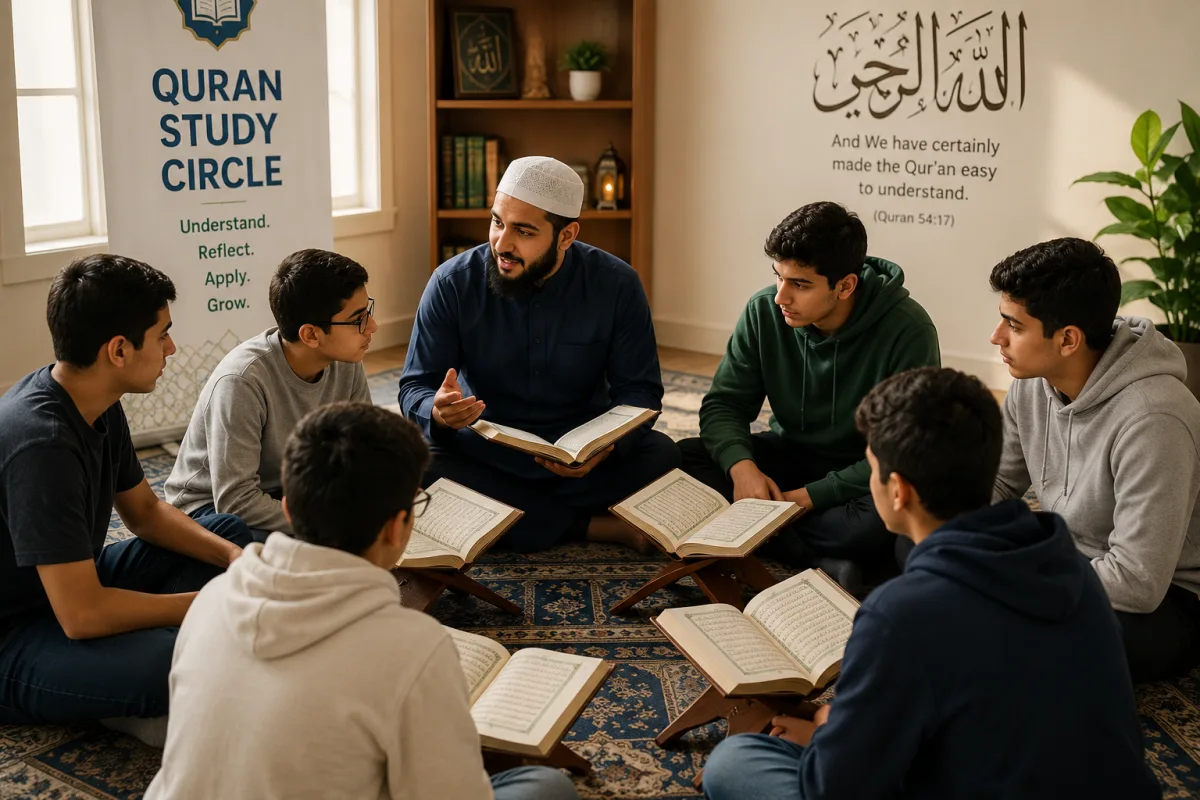
Every year, as summer fades and the new school term looms on the calendar, families around the world feel the same quiet shift in the air. The lazy mornings give way to alarm clocks. The relaxed evenings fill up again with homework, packed lunches, and the endless hunt for a missing shoe. And somewhere in the middle of all that beautiful chaos, many Muslim parents ask themselves a question that carries real weight: how do we keep the Qur'an at the centre of our children's lives when the school year is about to swallow every spare hour?
If that question feels familiar, you are in good company. Building a back to school Quran routine is one of the most common challenges parents bring to us, and it is also one of the most rewarding to solve. The good news is that it can be done — not by cramming more into an already-full day, but by finding a rhythm that fits naturally alongside school, homework, and rest.
To show you what that can look like, this article follows one family through a single school year. Please read it as an illustrative, representative journey — a composite that reflects the typical path many families walk, not a testimonial about one specific real family. There are no named people here and no invented quotes. Instead, this is the honest, everyday shape of what starting and sustaining a Qur'an routine tends to feel like, so you can picture your own family's version of it. As Allah reminds us of the Qur'an itself, "And We have certainly made the Qur'an easy to remember" (Surah al-Qamar 54:17) — a verse many parents hold onto when the schedule feels anything but easy.
Reading time: about 11 minutes.
Reviewed by the Tayseerul Quran Teaching Team Qualified Quran teachers helping children and adults learn Quran reading, Tajweed, Noorani Qaida, Hifz, and Arabic through one-on-one online classes.
What You'll Learn
- The September Scramble Every Parent Knows
- Deciding to Add Qur'an Lessons to the Mix
- Finding the Right After School Slot
- The First Few Weeks of Adjustment
- What to Do When a Child Is Tired After School
- Building a Rhythm That Actually Sticks
- Getting Through Exam Season Without Losing the Thread
- Looking Back at the Progress by Year's End
- What Made the Real Difference
- A Teacher's Perspective
- Frequently Asked Questions
- Continue Learning
- Final Thoughts
- References
The September Scramble Every Parent Knows
Picture the last week of the summer break. The uniforms are half-bought, one child has outgrown last year's shoes, and there is a form due for a school trip that nobody remembers agreeing to. The parents in our illustrative family are doing what parents everywhere do at this time of year: mentally rehearsing the new timetable and quietly bracing for it.
Amid the shopping lists and the school emails, a familiar worry surfaces. Over the summer the children had time for Qur'an — a relaxed session after breakfast, a bit of revision before bed. But once term begins, all of that easy space disappears. Last year, if they are honest, the Qur'an slipped. It became the thing they got to "when things calmed down," and things never quite calmed down.
This year they want it to be different. Not because they feel guilty, but because they have seen what happens when the Qur'an becomes an afterthought: it quietly drifts to the edge of the week and then off the page entirely. So before the term even starts, they make a small but important decision. This year, the Qur'an is going on the timetable first — before clubs, before extra tutoring, before anything optional gets a claim on the calendar.
That single reframe is where most successful routines begin. The families who keep the Qur'an alive during the school year are rarely the ones with the most free time. They are the ones who decided, in advance, that it was non-negotiable — and then built everything else around it.
Deciding to Add Qur'an Lessons to the Mix
The next question our family faces is a practical one. Both parents work. The nearest weekend maktab is a thirty-minute drive each way, and Saturday mornings are already crowded with sport and family visits. Teaching the children themselves is an option in theory, but in practice one parent's Tajweed is rusty and the other's Arabic reading is slow. They want their children to learn properly, with correct pronunciation, not to inherit the same gaps they carry.
This is the moment many families arrive at online Quran classes for kids. The appeal is simple: the teacher comes to you. There is no drive, no traffic, no waiting in a car park. The lesson slots into the household's real schedule instead of demanding the household reshape itself around a commute. For a family already stretched thin by the school run, that difference is not a luxury — it is often the deciding factor between a routine that survives and one that collapses by October.
What tips the balance, though, is the one-to-one format. In a class of twenty, a quiet child can hide, and a struggling child can fall behind unnoticed. In a one-on-one lesson, the teacher hears every letter, corrects every slip, and paces the lesson to the child in front of them. For a parent who wants to know their child is genuinely progressing — not just attending — that individual attention is worth a great deal. The family books a free trial, watches the first lesson from the kitchen doorway, and by the end of it the decision has more or less made itself.
Finding the Right After School Slot
Deciding to start is one thing. Finding the actual half-hour in the week is another. This is where many good intentions quietly die, so it deserves real thought.
The family sits down with the week laid out in front of them and looks honestly at the shape of each day. Mornings are out — they are already a sprint to get everyone dressed and fed. Straight after school, the children are hungry and frazzled. Very late evening, they are too tired to absorb anything. But there is a pocket of time, roughly an hour after the children get home, once they have eaten a snack and shed the worst of the school-day fog, that looks promising.
They land on a rhythm familiar to any household that has built an after-school Quran program that lasts: come home, snack and a short break, then the Qur'an lesson, then homework and dinner. Crucially, the Qur'an comes before homework, not after. Homework expands to fill whatever time you give it; if the lesson waits until homework is done, it will always be squeezed. By putting it first, they protect it.
They also make a decision that seems small but matters enormously: they pick the same days each week and treat them like any other fixed appointment. Tuesday and Thursday become "Qur'an days" in the family's mind as firmly as Monday is swimming. When a slot is genuinely fixed, nobody has to negotiate it every week, and a routine you don't have to re-decide every day is a routine that survives. If you want to go deeper on this, our guide to balancing school and Quran routine walks through the same planning process in detail.
The First Few Weeks of Adjustment
Here is the honest part that glossy success stories tend to skip: the first few weeks are bumpy. They are supposed to be.
The first lesson goes beautifully because it is new and exciting. The second still rides that novelty. But by the second or third week, reality sets in. One evening a child has a headache. Another evening there is a birthday party that runs late. A third evening everyone is simply grumpy and the lesson is a battle from start to finish. The parents start to wonder whether they have taken on too much.
This is the make-or-break window, and it helps enormously to expect it in advance. Almost every new routine passes through a valley somewhere between week two and week five, where the initial excitement has worn off but the habit has not yet formed. Families who quit usually quit right here, mistaking the normal difficulty of a new habit for proof that it "isn't working."
Our illustrative family gets through it by lowering the stakes rather than the standard. On a rough evening, they let the lesson be shorter and gentler instead of cancelling it entirely — a little Qur'an on a hard day still counts, and still keeps the chain unbroken. They also lean on the teacher, who has guided many children through exactly this stage and knows how to keep a tired learner engaged. Slowly, without any single dramatic moment, the Tuesday-and-Thursday lesson stops feeling like an imposition and starts feeling like part of what the week simply is.
What to Do When a Child Is Tired After School
Of all the obstacles, the tired child is the most predictable and the most misunderstood. A six-year-old who has held it together all day at school often falls apart the moment they get home. That is not defiance — it is a genuinely depleted little person who has spent every drop of their focus elsewhere.
The instinct is to push through: "We agreed to do this, so sit down and read." The wiser move is to work with the tiredness rather than against it. Our family learns a few adjustments that make an enormous difference. First, the snack and downtime before the lesson are protected fiercely — a child who has eaten and decompressed for twenty minutes is a different child from the one who walked through the door. Second, on the hardest days, the lesson leans on lighter work: revision of something already familiar rather than a demanding new page.
There is real wisdom in keeping the sessions short and consistent rather than long and occasional. A tired child can give you ten focused minutes far more easily than forty exhausted ones, and ten good minutes on a Tuesday beat a heroic hour that ends in tears and never gets repeated. Our article on how a young child learns to read Quran explores this pacing in more depth, because the way small children build the skill is genuinely different from how adults do.
The parents also discover something reassuring: the online, one-to-one format is unusually forgiving of a tired child. There is no class to keep pace with and no peers to perform in front of. If the child needs the lesson to slow down, it slows down. That flexibility, invisible on a good day, becomes priceless on a bad one.
Building a Rhythm That Actually Sticks
By around the halfway point of the first term, something has shifted in the household, and it is worth naming because it is the whole goal.
The Qur'an lesson is no longer a thing the parents have to remember, enforce, and defend every single week. It has become automatic. The children know that Tuesday means Qur'an the same way they know Friday means the weekend is close. Nobody argues about it because there is nothing left to argue — it is simply what happens on those days. This is what a real routine feels like: not constant willpower, but a groove the week naturally falls into.
Several small habits hold that groove together. The lesson lives in a fixed place at a fixed time. There is a consistent little ritual around it — the same corner of the room, the same tidy space, the Qur'an ready before the teacher arrives. The parents keep light, warm involvement: a quick "how did it go?" and genuine delight at a new page, which tells the child this matters to the whole family, not just to them.
The Prophet ﷺ said, "The best among you are those who learn the Qur'an and teach it" (Sahih al-Bukhari 5027) — a hadith that reframes the effort of building this routine as one of the most honourable things a family can pour its energy into. When the small daily discipline is anchored to a purpose that large, it becomes far easier to protect on the days it would be easy to let slide. If you would like a fuller picture of how these programmes are structured, our overview of online Quran classes lays out the options.
Getting Through Exam Season Without Losing the Thread
Then comes the test of any routine: exam season. The homework doubles, the stress rises, and every optional activity is suddenly under review. This is the point where, in previous years, the Qur'an would have been the first casualty.
This year the family handles it differently, and their approach is one worth borrowing. They do not abandon the routine — they shrink it, deliberately and temporarily. During the most intense weeks, the lessons stay in place but ease off on demanding new memorisation and lean into gentle revision and reading the child already knows. The goal shifts from making progress to simply keeping the connection alive and the habit unbroken. Allah instructs us to "recite the Qur'an with measured recitation" (Surah al-Muzzammil 73:4), and a slow, calm, unhurried session is exactly the kind of Qur'an time a stressed child can still manage.
The insight here is that a routine kept alive at a low simmer is infinitely easier to bring back to full strength than one that has been switched off completely. A family that stops the Qur'an entirely during exams faces the whole painful task of restarting from scratch afterwards — the resistance, the rustiness, the lost momentum. A family that keeps even a light version running simply turns the dial back up when the pressure lifts. By the time exams end, the Qur'an is still woven into the week, waiting to grow again rather than needing to be rebuilt.
Looking Back at the Progress by Year's End
When the school year finally closes and summer returns, the family does something it is easy to forget to do: it looks back.
The progress, viewed across a whole year, is striking in a way it never was week to week. A child who began the year haltingly sounding out letters is now reading with growing confidence. Pronunciation that used to be approximate has been patiently corrected into something accurate. Perhaps a few short surahs have been memorised, or a section of the Qur'an that once looked impossibly far away now sits comfortably behind them. None of it happened in a single dramatic leap. It happened the way real learning always happens — a little at a time, on Tuesdays and Thursdays, across a year that also contained a full load of school.
That is the quiet power of a routine. Any single lesson looks modest, even forgettable. Two half-hours a week does not feel like much on any given evening. But stretched across thirty-something weeks, those modest half-hours compound into something a parent can genuinely be proud of. Consistency, not intensity, is what carries a child forward, and consistency is precisely what a fixed routine is built to deliver.
The family also notices a benefit they did not plan for. The children have absorbed something beyond the reading itself — a sense that the Qur'an is simply part of who they are and how their week works, not a special-occasion activity. That quiet sense of belonging may, in the long run, matter even more than the pages turned.
What Made the Real Difference
Looking back, our illustrative family could point to several things that made the year work, and they are worth gathering in one place because any family can apply them.
The first was deciding in advance and protecting the time. By putting the Qur'an on the timetable before the term began, they never had to win the argument mid-week. The second was the fixed after-school slot before homework, which shielded the lesson from being endlessly squeezed. The third was expecting the difficult weeks instead of being ambushed by them, so the normal dip between weeks two and five did not read as failure. The fourth was shrinking rather than stopping during the hard stretches, keeping the chain unbroken through exams and busy patches.
Underneath all of these sat the fifth and quietest factor: the one-to-one online format itself. Because the lesson came to the home, it survived the winter evenings when nobody wanted to drive anywhere. Because it was individual, it could flex around a tired child, a hard week, or an exam season without the child falling behind a class. The format did not just teach the Qur'an — it made the routine sustainable, and a sustainable routine is the only kind that ever produces results a year later.
None of these depended on the family having unusual amounts of time, money, or energy. They depended on a handful of sound decisions, made early and held gently. That is genuinely within reach for almost any family willing to start.
A Teacher's Perspective
From the teaching side, the pattern in this journey is one we see again and again, and it shapes how we approach every new student.
Children rarely struggle with the Qur'an because they lack ability. They struggle when the learning is inconsistent — a burst of enthusiasm, a long gap, a guilty restart, another gap. What transforms a child's progress is almost never a dramatic intervention. It is the unglamorous magic of showing up regularly, with a teacher who knows exactly where that particular child is and what they need next. In a one-to-one setting, we hear every letter and catch small errors before they harden into habits that take months to undo.
This is also why we take the human side of the routine so seriously, not just the curriculum. We would rather a child do a calm, correct ten minutes on a hard day than a stressful, error-filled forty, because the child who ends the lesson feeling capable comes back willingly next time, and the one who ends it in tears begins to dread it. Sustaining the love of the Qur'an is part of teaching it well. Our teachers are qualified in Tajweed and experienced in guiding children specifically — which is a distinct skill from knowing the Qur'an oneself — and much of that expertise goes into keeping a young learner engaged, encouraged, and moving forward at a pace that respects both the sacred text and the small person learning it.
One note of honesty belongs here too: for questions of Islamic ruling — what is obligatory, how to handle a specific situation of practice — please consult a qualified local scholar who can weigh your circumstances. Our role is to teach your child to read, pronounce, and memorise the Qur'an beautifully and consistently, and to make that achievable inside a real family's busy week.
Frequently Asked Questions
How much time does a back to school Quran routine actually need?
Less than most parents fear. Two or three short lessons a week — often just half an hour each — is enough to produce steady, visible progress across a school year. Consistency matters far more than length. A dependable half-hour twice a week will carry a child further than an occasional marathon session that happens only when everyone remembers.
When is the best time of day for lessons during term?
For most children, the sweet spot is after school once they have had a snack and a short break, but before homework begins. Homework tends to expand to fill the evening, so placing the Qur'an first protects it. Avoid the very tired late-evening hours where little is absorbed. The exact slot matters less than choosing one and keeping it fixed.
What if my child is too tired after school to focus?
This is completely normal and very manageable. Protect a proper snack-and-downtime break before the lesson, keep sessions short, and on hard days lean on revision of familiar material rather than demanding new work. The one-to-one format helps enormously here, because the teacher can slow the pace to match the child rather than dragging them to keep up with a class.
How do we keep the routine going during exams?
Shrink it rather than stopping it. During the busiest weeks, keep the lessons in place but ease into gentle revision instead of intensive new memorisation. The aim is simply to keep the connection alive and the habit unbroken, then turn the effort back up once exams pass. A routine kept at a low simmer is far easier to revive than one switched off entirely.
My child has never studied Qur'an before — is it too late to start?
It is almost never too late, and the beginning of a school year is a natural moment to begin. Good programmes start wherever your child is, whether that means the very first steps of Noorani Qaida or building fluency in reading. A one-to-one teacher will assess your child gently and set a pace that fits, so a complete beginner is never left behind.
Will online lessons really work for a young child?
Yes, and often better than parents expect. Young children adapt to a screen-based lesson quickly, and the individual attention keeps them engaged in a way a large class cannot. The absence of a commute also means the routine survives on the evenings when leaving the house would be the final straw. A free trial is the easiest way to see how your own child responds.
How soon will we see progress?
You will usually notice small wins within the first few weeks — a letter pronounced correctly, a line read more smoothly. The larger, more satisfying progress reveals itself across months rather than days. This is why keeping the routine going through the whole year matters so much: the gains compound quietly, and the view from June looks nothing like the view from September.
Continue Learning
- After-School Quran Program
- Balancing School and Quran Routine
- Online Quran Classes for Kids
- How a Young Child Learns to Read Quran
- Online Quran Classes
Final Thoughts
The story we have followed here is not extraordinary, and that is exactly the point. It is the ordinary path of an ordinary family who made a few thoughtful decisions and held to them through a full school year. Remember, as we said at the start, that this is an illustrative, representative journey rather than an account of one specific family — but it reflects, faithfully, the shape of what starting a Qur'an routine tends to feel like.
If there is one thing to carry away, it is this: you do not need more hours in the day, and you do not need to be a perfect parent. You need a fixed slot, a good teacher, and the willingness to keep going gently through the weeks that feel hard. The Qur'an is made easy for those who turn to it consistently, and a routine is simply the vessel that carries that consistency through a busy life.
This new term can be the one where the Qur'an finally finds a settled home in your family's week. The easiest first step is the smallest one — see how a single lesson fits into your own household before committing to anything more.
Start your family's Qur'an routine this term — book a free trial →
References
- Surah al-Qamar (54:17)
- Surah al-Muzzammil (73:4)
- Sahih al-Bukhari 5027