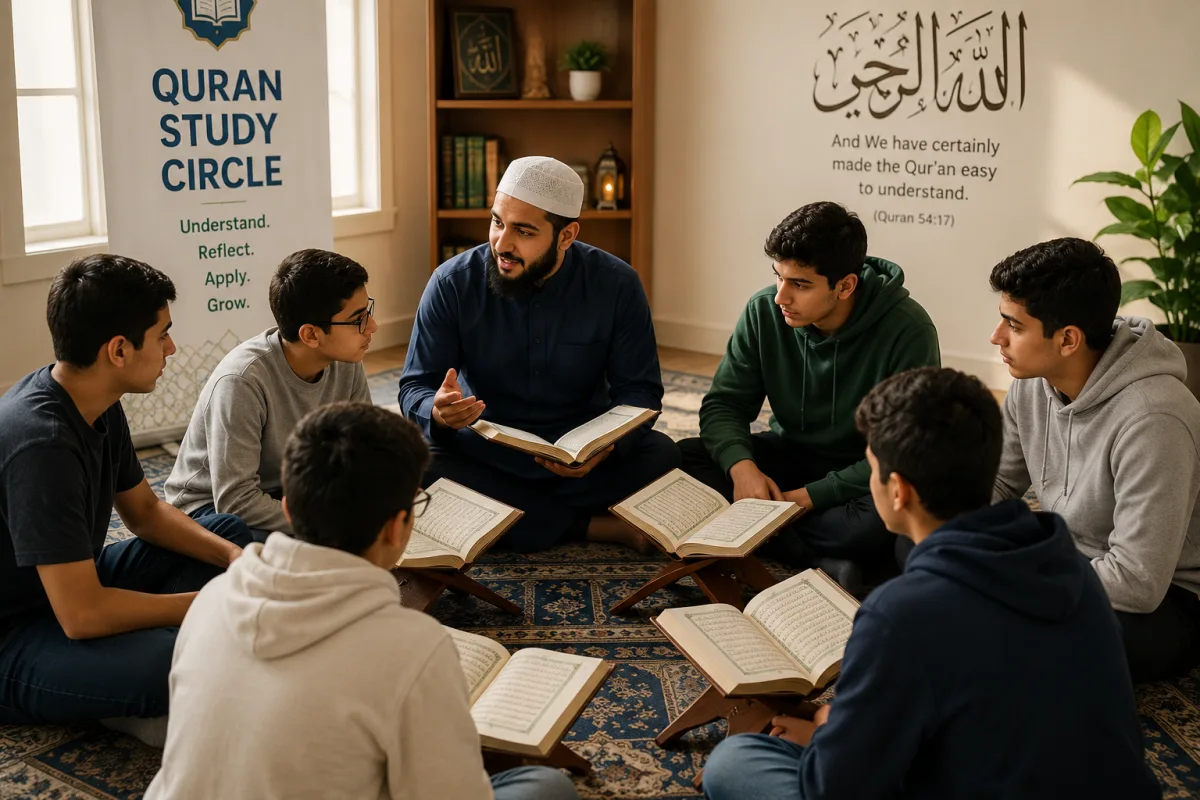
For most of history, learning the Qur'an meant sitting on a mat beside a teacher in a local mosque or study circle. That path is still beautiful, but it is no longer the only one. Today a child in Toronto, a nurse working night shifts in London, and a revert learning her first Arabic letters in Sydney can all open a laptop and study, face to face, with a qualified teacher thousands of miles away. Online Quran classes have quietly become one of the most practical ways for Muslims around the world to build a real, lasting relationship with the Book of Allah.
If you have been thinking about starting — for yourself or for your children — you probably have questions. How do the lessons actually work? Is one-to-one online teaching as good as in person? What will you learn first, how long does it take, and how do you tell a trustworthy academy from a weak one? This guide is designed to answer all of that in one place. It is the pillar page we point families to when they are just beginning.
There is deep reassurance in knowing that this journey is meant to be within reach. Allah says in Surah al-Qamar (54:17): "And We have certainly made the Qur'an easy to remember, so is there any who will be reminded?" The Qur'an was made accessible on purpose. Online classes are simply one more door that Allah has opened in our time, letting sincere learners cross distance, schedules, and circumstances that once made study impossible.
Reading time: about 11 minutes.
Reviewed by the Tayseerul Quran Teaching Team Qualified Quran teachers helping children and adults learn Quran reading, Tajweed, Noorani Qaida, Hifz, and Arabic through one-on-one online classes.
What You'll Learn
- What Online Quran Classes Are
- What You Can Learn
- How a Live Lesson Works, Step by Step
- A Typical Weekly Structure
- Who Online Quran Classes Are For
- Benefits of Learning Online
- Common Concerns and Myths
- A Qualified Teacher's Perspective
- How Progress Is Measured
- How Much It Costs
- How to Choose a Trustworthy Academy
- How to Get Started
What Online Quran Classes Are
An online Quran class is a live, scheduled lesson between a student and a qualified teacher, held over a video call. It is not a pre-recorded course or an app you tap through alone. A real teacher sees you, hears your recitation, corrects your pronunciation in the moment, and adjusts the pace to how you are actually doing that day.
Most reputable academies teach one-to-one. That means the full attention of the teacher is on a single student, rather than split across a crowded classroom. Lessons are usually 30 to 60 minutes, held once, twice, or several times a week depending on your goals. The teacher shares the page you are working on, listens as you read, and demonstrates the correct sound so you can imitate it.
The tools are simple and familiar: a stable internet connection, a device with a camera and microphone, and a video app such as Zoom, Google Meet, or Skype. Everything else — the curriculum, the teaching skill, the patience — comes from the human being on the other side of the screen.
What You Can Learn
Online academies typically cover the full journey, from the very first letter to fluent, beautiful recitation and memorization. The main tracks are:
- Qur'an reading from scratch — For learners who cannot yet read Arabic script. This usually begins with the Noorani Qaida, a foundational primer that builds letter recognition, joining letters, and basic sounds before you ever open the Mushaf.
- Tajweed — The rules of correct pronunciation and recitation: the proper points of articulation, elongations, nasalization, and the pauses that protect the meaning. Beginners can start with Tajweed for beginners and refine over time.
- Hifz (memorization) — Structured memorization of the Qur'an, from short surahs up to the entire Book, with daily new lessons and regular revision. See how to memorize the Qur'an online for how this is organized.
- Arabic language — Reading, understanding, and eventually grasping the meaning of what you recite.
- Classes for children — Age-appropriate, patient teaching designed for short attention spans and steady encouragement. Many parents start with dedicated online Quran classes for kids.
- Classes for sisters and women — Many families prefer a female Quran tutor online, and good academies make this straightforward to arrange.
You do not need to choose everything at once. Most students begin with one clear goal and grow from there.
How a Live Lesson Works, Step by Step
If you have never taken an online class, here is what a typical session looks like:
- You join the call a few minutes before the scheduled time using a link the academy provides. No special software beyond a common video app.
- The teacher greets you and briefly reviews what you covered last time, often asking you to recite the previous lesson so both of you can hear how it settled.
- You read the new material aloud while the teacher listens closely. The moment a letter or rule slips, the teacher stops you, models the correct sound, and has you repeat it until it is right.
- The teacher demonstrates, then you imitate. This back-and-forth — listen, repeat, correct — is the heart of Quran learning and always has been.
- You get a small assignment to practice before the next lesson: a few lines to review, a page to prepare, or a passage to memorize.
- The teacher notes your progress so the next session starts exactly where you need it to.
The rhythm is calm and personal. Because it is one-to-one, there is no waiting your turn and no hiding at the back — every minute is yours.
A Typical Weekly Structure
Consistency matters far more than long, occasional bursts. A common and sustainable pattern looks like this:
- Beginners: 2 to 3 lessons per week, 30 minutes each, focused on the Qaida or early reading.
- Tajweed students: 2 to 4 lessons per week, mixing new rules with applied recitation.
- Hifz students: 5 lessons per week is common, because memorization depends on daily new portions plus continuous revision of what came before.
Between lessons, short daily practice — even ten focused minutes — does more than a single marathon session. The teacher builds revision into the schedule so that old material is never left to fade. A good weekly structure balances three things: new learning, revision, and correction.
Who Online Quran Classes Are For
One of the quiet strengths of online learning is how many different lives it fits into:
- Children whose parents want structured, patient teaching without weekly commutes to a distant class.
- Busy adults and professionals who can only study early mornings, late evenings, or around shifting work hours.
- Reverts and new Muslims who want a judgment-free, from-the-very-beginning start.
- Sisters who prefer a female teacher and the comfort of learning from home.
- Families in areas with no local Quran teacher, including many living as minorities where in-person options are scarce.
- Adults returning to study who once learned as children and want to correct old habits and rebuild fluency.
If any of these describe you, online classes were practically designed for your situation.
Benefits of Learning Online
Beyond simple convenience, one-to-one online study offers real advantages:
- Full personal attention. The lesson moves at your pace, not the average pace of a group.
- Flexible scheduling across time zones. You can find a teacher awake and available whenever you are free.
- Learn from home in comfort and safety — especially valued by parents and by sisters.
- Access to qualified teachers you could never reach locally, including specialists in Tajweed and Hifz.
- No travel time or cost, which makes consistency far easier to maintain.
- A steady, recorded sense of progress, since the teacher tracks exactly where you are.
The goal is never speed for its own sake. Allah instructs in Surah al-Muzzammil (73:4): "...and recite the Qur'an with measured recitation." Online lessons, done well, protect that measured, careful spirit rather than rushing past it.
Common Concerns and Myths
"Online can't be as good as in person." The core method of Quran teaching — the teacher recites, the student imitates, the teacher corrects — transfers fully to video. A microphone captures your recitation clearly, and a skilled teacher hears the same mistakes they would hear across a table.
"My child won't focus on a screen." Good children's teachers keep sessions short, interactive, and encouraging. One-to-one attention actually holds focus better than a busy classroom.
"The teachers aren't really qualified." This varies by academy, which is exactly why choosing carefully matters (see below). Reputable schools employ teachers with genuine training and ijazah where relevant.
"It's too expensive." Online often costs less than local private tuition, and free trial lessons let you test before committing.
For any question of religious ruling — such as specific rules of recitation in a difficult case — a good teacher will teach the well-established method and, where scholars differ, encourage you to ask a qualified scholar rather than improvise.
A Qualified Teacher's Perspective
From a teacher's chair, the difference between students who flourish and those who stall rarely comes down to talent. It comes down to consistency, correction, and connection with a teacher who knows them.
The Prophet ﷺ said, as recorded in Sahih al-Bukhari 5027: "The best of you are those who learn the Qur'an and teach it." That teaching relationship — knowledge passed from one reciter to the next, mouth to ear — is the thread that has carried the Qur'an intact across fourteen centuries. Online tools do not replace that thread; they extend it to homes that could never have reached a teacher before.
A qualified teacher does more than mark mistakes. They diagnose why a sound is off — an untrained tongue position, a rushed breath, a habit picked up from reciting alone — and they build the correction patiently. They know when to push a Hifz student and when to slow down. This is why a real, trained human at the other end matters so much, and why we encourage families to look beyond apps and recordings toward genuine one-to-one instruction. Whether your path runs through the Noorani Qaida, Tajweed for beginners, classes for kids, Hifz online, or study with a female Quran tutor, the teacher is the heart of it.
How Progress Is Measured
Progress in the Qur'an is real and observable, and a good academy makes it visible rather than vague. Common markers include:
- Curriculum milestones — finishing the Qaida, completing a level of Tajweed rules, or memorizing a set number of surahs or juz.
- Fluency checks — reading a new passage cold, with fewer stops and corrections than a month ago.
- Revision retention — for Hifz students, how solidly older portions hold up when tested.
- Teacher notes and reports — many academies keep a running record and share regular updates with parents.
- Ijazah pathways — for advanced students, working toward a certified chain of recitation.
The most honest measure is simply this: are you reading better today than last month? With steady lessons, the answer is almost always yes.
How Much It Costs
Pricing varies by academy, teacher qualification, lesson length, and how many lessons you take per week, so treat any figure as a range rather than a fixed rule. In general:
- Lesson length and frequency are the biggest cost drivers — more or longer lessons cost more.
- Monthly plans are common, often billed by the number of weekly sessions.
- Family discounts are widely offered when multiple children enroll.
- Free trial lessons are standard at reputable academies, letting you assess a teacher before paying anything.
When comparing prices, look at value rather than the lowest number. A slightly higher fee for a well-trained, consistent teacher who genuinely moves your child forward is money far better spent than a bargain rate with high turnover and weak correction.
How to Choose a Trustworthy Academy
Not all academies are equal. Before you commit, check for these signs of quality:
- Qualified teachers with real training in Tajweed and, ideally, ijazah — and transparency about their credentials.
- A clear curriculum with defined levels, not just open-ended sessions.
- A genuine free trial so you can judge teaching quality first-hand.
- Progress tracking and communication, especially updates for parents.
- Flexible scheduling that fits your time zone reliably, with dependable substitute cover.
- The option of a female teacher for sisters and daughters who prefer one.
- Honest, no-pressure enrollment rather than aggressive upselling.
Read how they speak about the Qur'an itself. A trustworthy academy treats it as an amanah — a trust — not merely a product.
How to Get Started
Getting started is simpler than most people expect:
- Set one clear goal. Reading from scratch, improving Tajweed, starting Hifz, or classes for a child.
- Check your setup. A device with a camera and microphone, and a stable internet connection.
- Book a free trial lesson. Meet a teacher, let them assess your current level, and see how the format feels.
- Pick a realistic weekly schedule you can actually keep — consistency beats intensity.
- Begin, and trust the process. Small, steady steps compound into fluency and, in time, memorization.
The hardest part is usually just starting. Once the first lesson is behind you, the path forward becomes clear.
Frequently Asked Questions
Are online Quran classes as effective as in-person lessons?
Yes, when taught one-to-one by a qualified teacher. The essential method — recite, listen, correct, repeat — works fully over video, and the personal attention often makes online lessons more effective than a crowded classroom.
What age can children start online Quran classes?
Many children begin around ages 4 to 6 with short, playful sessions focused on letters and sounds. The key is a patient teacher and brief, frequent lessons rather than long ones.
Do I need to know Arabic before I start?
No. Complete beginners start with the Noorani Qaida, which teaches the letters and sounds from zero. You learn to read Arabic script step by step before opening the Mushaf.
How many lessons per week do I need?
For general reading and Tajweed, 2 to 3 lessons a week works well. Hifz students usually need around 5, because memorization depends on daily new material plus revision.
Can my daughter or I have a female teacher?
Yes. Reputable academies readily arrange a qualified female teacher for sisters and girls who prefer one, offering both comfort and privacy.
What equipment do I need?
A laptop, tablet, or phone with a working camera and microphone, a reliable internet connection, and a common video app such as Zoom or Google Meet. That is all.
How long does it take to learn to read the Qur'an?
It varies with age, practice, and consistency, but many beginners read fluently within several months to about a year of regular lessons. Steady weekly practice is the deciding factor.
Continue Learning
- Noorani Qaida online: your first step to reading the Qur'an
- Tajweed for beginners: rules made simple
- Online Quran classes for kids: a parent's guide
- How to memorize the Qur'an online
- Choosing a female Quran tutor online
Final Thoughts
Learning the Qur'an is one of the most rewarding journeys a person can take, and it has never been more accessible. Whether you are a parent seeking a patient teacher for your child, an adult returning to study, or a beginner about to learn your very first letter, a qualified teacher and a steady weekly rhythm are all you truly need. The distance that once stood between sincere learners and good teachers has largely fallen away.
Do not wait for the perfect moment — the best time to begin is now, with a single lesson. Book your free trial lesson today →
References
- Surah al-Qamar (54:17): "And We have certainly made the Qur'an easy to remember, so is there any who will be reminded?"
- Surah al-Muzzammil (73:4): "...and recite the Qur'an with measured recitation."
- Sahih al-Bukhari 5027: "The best of you are those who learn the Qur'an and teach it."