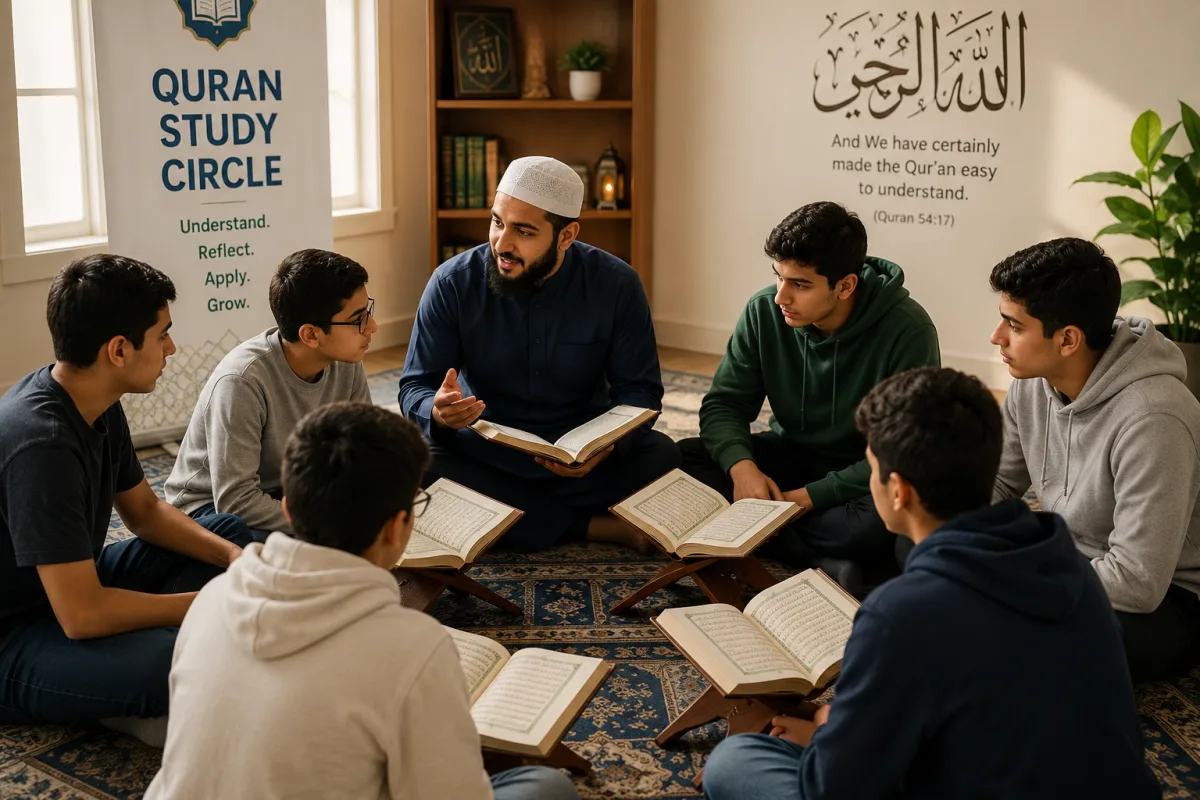
There is a particular kind of quiet frustration that many learners know well. You open the Qur'an, you want to read it beautifully and correctly, and you try your best on your own — following an app, copying a recording, guessing at the sounds. For a while it feels like progress. Then, somewhere along the way, a small doubt creeps in. Am I actually saying this right? Would a teacher wince if they heard me? That doubt is not a sign of failure. It is often the first sign that you are ready for something better: learning with a certified Qur'an teacher.
This article follows one learner's path from self-study to guided, one-to-one learning with a qualified teacher. Please read it as an illustrative, representative journey rather than a real testimonial. The student here is not a specific named person, and nothing below is a direct quote from an individual. Instead, this is a composite of the very common experiences we see again and again — written in a general and second-person way so you can see your own story in it, whatever stage you are at.
The reason this journey matters so much is that the Qur'an was never meant to be learned in isolation. It was given to be received, corrected, and passed on person to person. Allah tells us, "And We have certainly made the Qur'an easy for remembrance, so is there any who will remember?" (Surah al-Qamar, 54:17). The ease is real — but it is an ease that unfolds most fully when someone who truly knows is guiding you.
Reading time: about 11 minutes.
Reviewed by the Tayseerul Quran Teaching Team Qualified Quran teachers helping children and adults learn Quran reading, Tajweed, Noorani Qaida, Hifz, and Arabic through one-on-one online classes.
What You'll Learn
- The Comfort and the Trap of Learning Alone
- The First Hint That Something Was Off
- Finding a Qualified Teacher
- The First Corrections
- Learning the Proper Method Step by Step
- The Chain That Connects You to the Tradition
- When Progress Slowed Down
- What Actually Changed
- A Teacher's Perspective
- Choosing the Right Teacher for You
- Frequently Asked Questions
- Continue Learning
- Final Thoughts
The Comfort and the Trap of Learning Alone
Self-study feels safe. There is no one watching, no one to correct you, no appointment to keep. You can move at your own pace, repeat a verse a hundred times, and never feel embarrassed. For many learners this is exactly where the journey begins — with a phone, a recitation on repeat, and a sincere desire to connect with the Book of Allah.
And to be clear, that beginning is beautiful. Wanting to learn is itself a gift. The problem is not the sincerity; it is the silence. When you learn alone, mistakes have no way of being caught. You might be shortening a long vowel, hardening a soft letter, or missing a rule of Tajweed entirely — and because nothing pushes back, the mistake feels correct. It becomes a habit. And habits, once settled, are far harder to undo than to build.
This is the quiet trap. The comfort of learning alone slowly becomes the reason progress stalls. You reach a ceiling you cannot see, because the very tool you would need to see it — a trained ear — is exactly what self-study cannot give you.
The First Hint That Something Was Off
For most learners, the turning point is a small, almost accidental moment. Maybe you recited a short surah in front of a friend who had studied properly, and you noticed them pause. Maybe you heard a qualified reciter pronounce a word you thought you knew, and it sounded different in a way you could not explain. Maybe you simply felt, deep down, that your recitation was flat — technically "there," but missing something.
That unsettled feeling is worth honouring. It is your own sincerity refusing to settle for "good enough." Many people push it away and carry on, telling themselves that at least they are reading. But some pause and ask the harder question: what if I have been building on a shaky foundation? What if the letters I am so confident about are not quite right?
Allah commands, "...and recite the Qur'an with measured recitation" (Surah al-Muzzammil, 73:4). That measured, careful recitation — tarteel — is not a bonus for the advanced. It is part of how the Qur'an is meant to be read. And it is almost impossible to reach on your own, precisely because you cannot hear your own errors.
Finding a Qualified Teacher
Deciding to find a teacher is one thing. Finding the right one is another. This is often where learners feel overwhelmed. There are countless options online, and it is not always obvious who is truly qualified and who simply speaks Arabic or memorised the Qur'an as a child.
The key distinction is training and authorisation, not just fluency. A native speaker is not automatically a teacher of Tajweed, and someone who recites beautifully may not know how to diagnose and fix your specific mistakes. What you are looking for is someone with formal grounding — ideally a teacher connected to a recognised institution or holding an Ijazah, the traditional teaching licence that certifies both their recitation and their permission to teach it. If you are weighing this up, our guide on certified vs uncertified Quran teachers walks through exactly what to look for.
For many learners, this search leads to teachers trained in established centres of learning. Our overview of Al-Azhar online Quran teachers explains why graduates of such institutions bring a depth of grounding that is hard to match — years of study, rigorous testing, and a living connection to how the Qur'an has been taught for centuries.
The First Corrections
The first lesson with a qualified teacher can be humbling — in the best possible way. You recite something you have said a thousand times, and gently, warmly, the teacher stops you. "Let's look at that letter again." And suddenly a sound you were certain about is opened up: the correct point of articulation, the right weight, the proper length.
It is common to feel a flush of embarrassment here. How did I not know? Why did no one tell me? But a good teacher never makes you feel small. They know that every serious student passes through this door, and that being corrected is not a mark against you — it is the whole point. The mistakes you had no way of catching alone are exactly what the teacher is there to catch.
There is often a strange relief in this moment too. The vague doubt you carried for so long finally has a name and a fix. You are no longer guessing. Someone who genuinely knows is now walking beside you, and the ceiling you could not see is beginning to lift.
Learning the Proper Method Step by Step
One of the biggest differences a qualified teacher makes is structure. Self-study tends to be scattered — a bit of this surah, a rule you half-remember, a video you watched once. A trained teacher replaces that scatter with a clear, tested path.
Usually this means going back to foundations, even for learners who thought they were past them. Many students begin or revisit the Noorani Qaida, mastering the letters and their sounds before building up to full recitation. From there, the rules of Tajweed are introduced in a deliberate order, each one practised until it becomes natural. If you are early in this process, Tajweed for beginners gives a sense of how those rules are layered.
What makes this work is not just the content but the feedback loop. You try, the teacher listens, they correct, you try again — every single lesson. This is why the online Quran classes format has become so effective: one-to-one attention means the method is not generic, it is shaped around your exact strengths and struggles.
The Chain That Connects You to the Tradition
Here is something self-study can never offer, no matter how good the app: connection to the chain. The Qur'an has been transmitted from teacher to student, generation after generation, in an unbroken line stretching back to the Prophet Muhammad ﷺ. When you learn from a properly authorised teacher, you are not just learning information. You are being handed something that was handed to them.
This is the deeper meaning of the Ijazah. It is not a certificate on a wall; it is a documented link in that living chain, testifying that this person received the recitation correctly and has permission to pass it on. When you sit with such a teacher, you are joining a tradition, not just a class. Our Ijazah Quran teacher FAQ explains how this works and why it carries such weight.
There is a quiet dignity in this that changes how learning feels. You begin to sense that your careful practice is not a small private effort but part of something vast and continuous. The Prophet ﷺ said, "The best of you are those who learn the Qur'an and teach it" (Sahih al-Bukhari 5027). Being taught by someone who lives that hadith — and who may one day authorise you to teach — gives your effort a horizon far beyond yourself.
When Progress Slowed Down
No honest journey is a straight line upward. At some point, most learners hit a plateau. The early corrections came fast and felt exciting; then things slow. A rule refuses to stick. Life gets busy and lessons get missed. Motivation dips, and the old temptation returns — maybe this was good enough already.
This is exactly where a teacher proves their worth beyond the technical. A good teacher notices when your energy fades and adjusts — breaking a hard concept into smaller pieces, revisiting something you enjoyed, or simply reminding you how far you have already come. They hold the long view when you cannot.
If you are in a slow season right now, take heart. Plateaus are not the end of progress; they are usually the last stretch before a breakthrough. The learners who arrive at real fluency are rarely the fastest — they are the ones who kept showing up, especially when it stopped feeling easy. For any question about religious rulings that comes up along the way, remember to ask a qualified scholar; your recitation teacher's role is to perfect how you read, and they will happily point you to the right people for the rest.
What Actually Changed
Look back after months of guided learning and the change is striking. The letters that once felt uncertain are now second nature. Rules you had never heard of are woven into your recitation without conscious effort. The flatness is gone; there is rhythm and care where there used to be guesswork.
But the deepest change is often internal. The nagging doubt — am I saying this right? — has been replaced by quiet confidence. Not arrogance, but peace. You know that what you are reading has been checked, corrected, and confirmed by someone who truly knows. When you stand in prayer, you are no longer hoping your recitation is acceptable; you are reciting with settled certainty.
That shift — from anxious guessing to grounded confidence — is the single most valuable thing a qualified teacher gives. And it is precisely the thing that self-study, however sincere, can almost never provide.
A Teacher's Perspective
From the other side of the screen, teachers see this transformation constantly, and it never gets old. A good teacher does not measure success only by how fast a student advances, but by the moment the fear leaves their voice — when a nervous, apologetic reciter becomes someone reading with calm ownership.
Experienced teachers will also tell you something reassuring: they were once corrected too. Every qualified teacher sat where you sit now, mispronouncing letters, being gently stopped, trying again. Their authority does not come from never having made mistakes; it comes from having made them, corrected them under proper guidance, and been formally authorised to guide others. That is what real expertise looks like — not perfection from the start, but a verified, tested path that they can now walk you along.
This is why grounding matters so much. When your teacher corrects you, they are not offering an opinion. They are transmitting a standard they themselves received and were certified in. You can trust it, and that trust is the foundation everything else is built on.
Choosing the Right Teacher for You
If this journey feels like yours, the practical next step is finding a teacher who fits — not just in qualification, but in personality and schedule. The best learning happens when you feel comfortable enough to make mistakes freely, so warmth and patience matter as much as credentials.
Look for genuine qualifications and, ideally, a connection to the traditional chain. Look for one-to-one attention so the teaching is truly yours. And look for someone whose manner puts you at ease, because you will learn far more from a teacher you are not afraid of. The good news is that you do not have to gamble. A free trial lets you experience a real lesson — feel the first corrections, see the structure, and sense whether this is the person to walk the path with you — before committing to anything.
Frequently Asked Questions
Is it too late for me to start learning with a teacher as an adult?
Not at all. Adults bring focus, patience, and clear motivation that often make them excellent students. Teachers work with learners of every age, and the one-to-one format is easily paced for a beginner or a busy adult returning after years away.
Will a teacher make me feel embarrassed about my mistakes?
A good teacher does the opposite. Correcting mistakes gently is their entire craft, and every serious student — including the teacher themselves once — has been through it. The atmosphere in a well-run lesson is warm and encouraging, never shaming.
Do I really need a certified teacher, or is an app enough?
Apps are useful for exposure and practice, but they cannot hear you and cannot correct you. Only a qualified teacher can catch the specific errors you are unable to notice yourself. For understanding the difference in depth, see our guide on certified vs uncertified Quran teachers.
What is an Ijazah, and why does it matter?
An Ijazah is a traditional teaching licence certifying that a teacher received the recitation correctly through an unbroken chain and has permission to teach it. It connects your learning to a living tradition. Our Ijazah Quran teacher FAQ explains more.
How long before I see real improvement?
Many learners notice early corrections making a difference within the first few lessons. Deeper fluency takes months of steady practice, but the sense of finally reading correctly, rather than guessing, often arrives surprisingly quickly.
Can I ask my teacher about Islamic rulings too?
Your recitation teacher's role is to perfect how you read the Qur'an. For religious rulings and fiqh questions, it is best to ask a qualified scholar, and a good teacher will happily point you toward reliable sources.
What if I have already built bad habits from self-study?
This is very common and entirely fixable. A qualified teacher will identify the habits, explain the correct form, and patiently retrain them. It takes a little humility and repetition, but undoing old mistakes is a normal, expected part of the journey.
Continue Learning
- Al-Azhar online Quran teachers
- Certified vs uncertified Quran teachers
- Ijazah Quran teacher FAQ
- Tajweed for beginners
- Online Quran classes
Final Thoughts
The journey from self-study to a certified teacher is really a journey from doubt to certainty. It begins with the quiet frustration of not knowing whether you are reading correctly, passes through the humbling and freeing experience of being properly corrected, and arrives at a place of grounded, peaceful confidence in your recitation.
You do not have to keep guessing. The Qur'an was meant to be received from someone who knows, and that door is open to you at any age and any level. Wherever you are right now — a nervous beginner, a returning learner, or someone who suspects their foundation needs work — a qualified teacher can meet you exactly there and walk the rest of the path with you.
Experience the difference a qualified teacher makes — book a free trial →
References
- Sahih al-Bukhari 5027
- Surah al-Qamar (54:17)
- Surah al-Muzzammil (73:4)