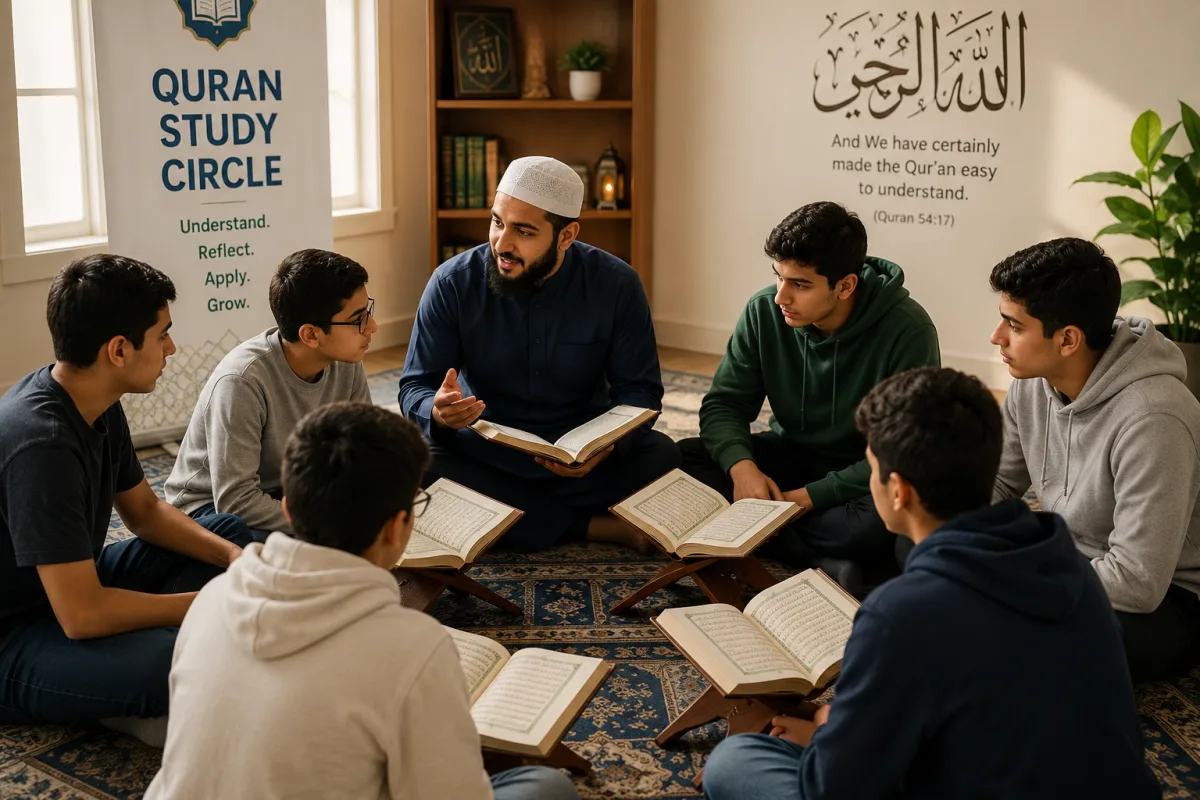
When parents and adult learners begin searching for Qur'an classes online, one phrase comes up again and again: "Al-Azhar online Qur'an teachers." It appears in adverts, on school websites, and in the recommendations friends pass along. But what does it actually mean? Is it a guarantee of quality, a marketing label, or something in between? And how does it connect to the older, deeper idea of a certified Qur'an teacher — someone who has been formally licensed to teach the Book of Allah?
This pillar guide is written to answer those questions honestly and without exaggeration. We will explain who Al-Azhar-trained teachers are, what an Ijazah is, and why the qualifications behind your teacher matter more than most people realise. We will also look at the traditional chain of transmission that connects a good teacher back through the generations, and how a well-run online lesson can preserve that method faithfully.
The goal is not to impress you with grand claims. The Prophet ﷺ said, "The best of you are those who learn the Qur'an and teach it" (Sahih al-Bukhari 5027). Learning and teaching the Qur'an is a sacred trust, and choosing the right teacher is part of honouring that trust. By the end of this article, you should be able to read a teacher's credentials with clear eyes and ask the right questions before you commit.
Reading time: about 11 minutes.
Reviewed by the Tayseerul Quran Teaching Team Qualified Quran teachers helping children and adults learn Quran reading, Tajweed, Noorani Qaida, Hifz, and Arabic through one-on-one online classes.
What You'll Learn
- Who Al-Azhar Teachers Are
- What an Ijazah Actually Is
- Why Teacher Qualifications Matter
- The Unbroken Chain (Sanad) Explained Simply
- Qualifications for Reading vs Tajweed vs Hifz vs Ijazah
- How Online Lessons Preserve the Traditional Method
- What to Look for in a Certified Teacher
- Do Beginners Really Need a Certified Teacher
- A Teacher's Perspective
- Red Flags and Honest Cautions
- Bringing It Together for Your Family
Who Al-Azhar Teachers Are
Al-Azhar is one of the most respected centres of Islamic learning in the world. Based in Cairo, Egypt, it is a centuries-old institution that has shaped Islamic scholarship across generations and continents. When a teacher is described as "Al-Azhar-trained," it usually means they studied within the broader Al-Azhar system of education, which is known for its rigour in Arabic language, Qur'anic sciences, and the traditional disciplines of Islamic study.
It helps to understand what this label does and does not tell you. It signals that a teacher has passed through a demanding academic environment with a strong reputation for scholarship. That is genuinely meaningful. At the same time, "Al-Azhar-trained" is a description of a teacher's background, not an automatic certificate in every single skill. A graduate may be an outstanding reciter, a gifted Arabic instructor, or a specialist in Tajweed — or all three — but the specific competencies still deserve to be checked rather than assumed.
So the honest way to read this phrase is as a strong and encouraging signal that invites a second look, not a final verdict. A good school will be happy to tell you exactly what a particular teacher studied, what they specialise in, and what formal certifications they hold. If you want a practical framework for confirming those details, our guide on how to verify a Qur'an teacher's qualifications walks through the questions step by step.
What an Ijazah Actually Is
An Ijazah is a traditional certification, or licence, that grants a person permission to teach or transmit something they have themselves mastered. In the context of the Qur'an, an Ijazah typically certifies that a teacher has recited the Qur'an accurately — often the entire Qur'an — to a qualified master, who then authorises them to teach and to pass that same permission on to others.
What makes an Ijazah distinctive is that, ideally, it comes with a connected chain of teachers, known as a sanad, reaching back through the generations. In other words, the licence is not simply a piece of paper stating that someone is competent; at its best it is a link in a long, documented line of transmission from teacher to student, tracing back across the centuries. This is one of the ways the Muslim community has cared for the precise recitation of the Qur'an with remarkable discipline.
Because the word "Ijazah" carries real weight, it is worth understanding it properly rather than treating it as a slogan. Not every Ijazah covers the same scope — some are for a specific narration or recitation, others are broader. If you would like a fuller, plain-language explanation, our dedicated Ijazah Qur'an teacher FAQ answers the most common questions in detail, including what an Ijazah does and does not promise.
Why Teacher Qualifications Matter
It is tempting to think that reciting the Qur'an is simply a matter of reading Arabic letters aloud. But the Qur'an has a precise system of pronunciation and rhythm, and small errors can change meaning or break the beauty and correctness of the recitation. Allah instructs the believers in Surah al-Muzzammil (73:4) to recite the Qur'an with measured, careful recitation. A qualified teacher is the person who helps you meet that instruction in practice, letter by letter.
Qualifications matter because the ear and the mouth learn from a model. A student naturally imitates the teacher's articulation, pacing, and habits. If the teacher's own recitation is sound and their method is trained, the student inherits something reliable. If the teacher has picked up errors that were never corrected, those errors are quietly passed on too. This is why the tradition has always insisted on learning from a living, qualified teacher rather than from books or apps alone.
There is also the matter of trust and character. Teaching the Qur'an is not only a technical task; it is a form of guardianship over a sacred text and, in the case of children, over young hearts forming their relationship with their faith. Qualifications give you a reasonable, evidence-based confidence that the person guiding your child or yourself is equipped for that responsibility. To see how this plays out concretely, compare the trade-offs in our article on certified vs uncertified Qur'an teachers.
The Unbroken Chain (Sanad) Explained Simply
The idea of a sanad — a chain of transmission — can sound intimidating, but it is really quite intuitive. Imagine learning a family recipe. You could read it from a card, but you would learn it far better by cooking alongside your grandmother, who learned it from hers. Each generation corrects the next, preserving the taste exactly. The Qur'anic sanad works on the same principle, only with far greater care and formality.
In this chain, a student recites to a teacher until the teacher is satisfied that the recitation is faithful. That teacher had, in turn, recited to their own teacher, who recited to theirs, and so on. The Qur'an itself testifies that Allah has made it easy to remember: "And We have certainly made the Qur'an easy to remember" appears in Surah al-Qamar (54:17). The tradition of memorisation and careful oral transmission is one of the means through which that ease has been realised across history.
For a learner today, the sanad is reassuring because it means your recitation is being measured against a standard that has been guarded meticulously, not reinvented in each generation. You do not need to master the technical genealogy to benefit from it. What matters is that your teacher stands within that living tradition and teaches you accordingly. When you eventually reach an advanced level, the same chain is what makes a formal Ijazah possible.
Qualifications for Reading vs Tajweed vs Hifz vs Ijazah
One of the most useful things a family can understand is that different goals call for different levels of qualification. Not every learner needs a fully licensed master from day one, and pretending otherwise can make Qur'an learning feel more daunting and expensive than it needs to be. Matching the teacher to the goal is a mark of a well-run school.
For basic reading — learning the letters and building fluency, often through the Noorani Qaida — you need a teacher who is patient, methodical, and reliably correct in their own pronunciation. This is the foundation stage, and it deserves a competent, caring teacher even if formal licensing is not the headline requirement. Our beginner-friendly overview of online Qur'an classes explains how this early stage is usually structured.
For Tajweed, the rules that govern correct pronunciation and recitation, the bar rises. Here you want a teacher with solid, verifiable training in Tajweed specifically, because they will be correcting subtle points of articulation that a general reader might miss. Beginners can start this journey gently; see our guide to Tajweed for beginners for what to expect. For Hifz, or memorisation, you want a teacher experienced in structured memorisation and revision methods, which is a distinct skill; our guide on how to memorise Qur'an online covers that pathway. Finally, for an Ijazah, you need a teacher who themselves holds an Ijazah with a connected sanad and is authorised to grant one — the most specialised tier of all.
How Online Lessons Preserve the Traditional Method
A fair question many parents ask is whether the traditional, face-to-face method survives on a screen. It is a reasonable concern, because Qur'an learning has always been an oral, relational craft. The encouraging answer is that the essential mechanics of the method translate very well to a well-designed one-to-one online lesson — often better than to a crowded classroom.
The heart of the traditional method is talaqqi: the student recites, the teacher listens closely and corrects in real time, and the student repeats until the passage is sound. A live one-to-one video lesson preserves this exactly. The teacher hears every letter, catches errors immediately, and models the correct sound for the student to imitate. Because the class is individual rather than group-based, the student often receives more focused correction than they would sitting among twenty others.
What matters is not the medium but the discipline behind it. Screen sharing lets a teacher mark up the exact word a student stumbled on. Recorded lessons let a learner revisit a correction later in the week. A structured curriculum keeps progress orderly. None of this dilutes the tradition; it carries the same teacher-to-student transmission into a format that fits modern family life. The sanad does not weaken because it travels over the internet — it is the human relationship and the accuracy of correction that carry it, and both are fully present in a good online class.
What to Look for in a Certified Teacher
When you are evaluating a teacher or a school, it helps to have a short mental checklist. The aim is not to interrogate anyone, but to make an informed choice with the same care you would apply to any important decision for your family. A trustworthy school will welcome these questions rather than deflect them.
First, ask what specific qualifications the teacher holds and in what area — reading, Tajweed, Hifz, or a formal Ijazah with a sanad. Second, ask whether those credentials can be described or evidenced; genuine qualifications can always be explained plainly. Third, ask about the teacher's experience with your particular type of learner, whether that is a young child, an adult beginner, or a revert starting from the Arabic alphabet. Fourth, ask how progress is tracked and how corrections are recorded between lessons.
Finally, pay attention to the trial lesson itself. Does the teacher listen patiently? Do they correct kindly but clearly? Do they explain the "why" behind a correction, not just the "what"? Qualifications on paper matter, but they should be visible in the actual teaching. For a structured way to confirm all of this before you commit, our step-by-step guide to verifying a Qur'an teacher's qualifications is designed exactly for this moment.
Do Beginners Really Need a Certified Teacher
This is one of the most common — and most sensible — questions parents and adult learners ask. If someone is just starting to recognise Arabic letters, do they truly need a formally certified teacher, or would any capable helper do? The honest answer sits in the middle, and it is worth being clear about.
A complete beginner does not necessarily need a teacher holding a full Ijazah to learn the alphabet and basic reading. What a beginner absolutely does need is a teacher whose own pronunciation is correct and who teaches with a sound method, because the foundation stage is precisely where lifelong habits — good or bad — are formed. An error learned at the beginning is far harder to unlearn later. In that sense, the beginning is where a qualified teacher arguably matters most, even if the highest certification is not yet required.
The practical wisdom, then, is to seek a competent, verifiably trained teacher from the very first lesson, and to move toward more specialised certification as your goals grow — for instance when you progress from reading to serious Tajweed or memorisation. Starting well protects everything that comes after. If you are weighing this decision, our comparison of certified vs uncertified Qur'an teachers lays out the real-world consequences of each path.
A Teacher's Perspective
Speaking from years of teaching experience across our team, one truth surfaces again and again: what students remember most is not a certificate on a wall but the moment a patient teacher helped a difficult letter finally click into place. Qualifications are the foundation, but the daily work of teaching the Qur'an is deeply human. It is built on repetition, gentle correction, and genuine care for each learner's journey with the Book of Allah.
Our teachers include those trained within the Al-Azhar system and those holding Ijazah with connected chains of transmission. But we would gently caution any family against choosing a teacher on a label alone. A credential tells you that a teacher was tested and passed; it does not, by itself, tell you whether they will be the right guide for your particular child or for you. That fit is discovered in the lessons themselves, which is exactly why a trial class matters so much.
From the inside, the greatest responsibility we feel is accuracy paired with encouragement. It is possible to be technically strict yet cold, or warm yet careless — and neither serves a learner well. The tradition we inherited insists on both: precise transmission and a heart that wants the student to succeed. When you look for a teacher, look for that combination. On any question of religious ruling that arises during your studies, we always encourage learners to consult a qualified scholar, as teaching recitation and issuing rulings are two different responsibilities.
Red Flags and Honest Cautions
Just as there are signs of a strong teacher, there are signs worth pausing over. None of these is necessarily proof of a problem, but together they are worth weighing. A little healthy caution at the start saves a great deal of correction later.
Be wary of vague or shifting claims. If a school advertises certifications but cannot describe them when asked, that gap deserves a second look. Be cautious, too, of promises that sound too good — guarantees of memorising the entire Qur'an in an unrealistically short time, or claims that no correction or effort will be needed. Genuine Qur'an learning is a rewarding process, but it is a process, and honest teachers will tell you so.
Finally, watch how a teacher or school responds to your questions. Defensiveness is a small but telling signal; openness is reassuring. The Qur'an deserves teachers who are confident enough in their qualifications to explain them plainly and humble enough to welcome a parent's due diligence. You are not being difficult by asking — you are honouring the trust involved in learning the Book of Allah.
Bringing It Together for Your Family
If you have read this far, you now have a far clearer picture than the average learner who simply searches for "Al-Azhar online Qur'an teachers" and hopes for the best. You understand that the phrase points to a respected educational background, that an Ijazah is a traditional licence ideally backed by a connected chain of teachers, and that the right level of qualification depends on your specific goal.
Most importantly, you understand that qualifications and human quality work together. The finest chain of transmission means little without patience in the lesson, and the warmest teacher does little good without accuracy. The two belong side by side. When you find a teacher who offers both, hold on to them.
Whatever stage you or your child is at — first letters, growing fluency, refining Tajweed, or beginning the journey of Hifz — the principles in this guide will help you choose wisely and with confidence. Take your time, ask your questions, and let a trial lesson show you the teaching in action.
Frequently Asked Questions
What does "Al-Azhar-trained Qur'an teacher" actually mean?
It generally means the teacher studied within the Al-Azhar system of Islamic education, a centuries-old and highly respected institution in Cairo, Egypt. It is a strong signal of a rigorous scholarly background. It is best understood as an encouraging indicator that still invites you to ask about the teacher's specific qualifications and specialisms rather than a blanket certification in every skill.
Is an Ijazah the same as a university degree?
No, they are different kinds of credential. A university degree reflects academic study, while an Ijazah is a traditional licence permitting a person to teach or transmit something they have mastered — in the Qur'anic context, typically accurate recitation certified by a qualified master, ideally with a connected chain of teachers, or sanad, going back through the generations.
Does a beginner need a certified teacher from the very first lesson?
A complete beginner does not necessarily need a fully licensed master, but they do need a teacher whose own pronunciation is correct and whose method is sound. The foundation stage is where habits form, so learning from a competent, verifiably trained teacher from the start is highly advisable, even before the most specialised certifications become relevant.
Can the traditional method really be preserved in online lessons?
Yes, when the lesson is one-to-one and live. The heart of the method — the student reciting while the teacher listens and corrects in real time — translates fully to video. In many cases an individual online lesson offers more focused correction than a large group classroom, while screen sharing and recordings support revision.
What is the difference between qualifications for Tajweed and for Hifz?
Tajweed qualifications concern the rules of correct pronunciation and recitation, so you want a teacher with specific, verifiable Tajweed training. Hifz concerns structured memorisation and revision, which is a distinct skill requiring experience in memorisation methods. A teacher may excel at one, the other, or both, so it helps to match the teacher to your goal.
How can I verify a teacher's qualifications before committing?
Ask what qualifications the teacher holds and in which area, whether they can be described or evidenced, and how progress is tracked. Pay close attention to the trial lesson: listen for patient, clear, well-explained correction. Our guide on verifying a Qur'an teacher's qualifications offers a full step-by-step framework.
Who should I ask about religious rulings that come up during study?
For any question of religious ruling, the right person to ask is a qualified scholar. Teaching Qur'an recitation and issuing religious rulings are two separate responsibilities. A good recitation teacher will happily guide your reading and, on matters of ruling, encourage you to consult a scholar qualified to answer them.
Continue Learning
- Ijazah Qur'an Teacher FAQ
- Certified vs Uncertified Qur'an Teachers
- How to Verify a Qur'an Teacher's Qualifications
- Online Qur'an Classes: A Beginner's Guide
- Tajweed for Beginners
Final Thoughts
Choosing a Qur'an teacher is one of the most meaningful decisions you will make for yourself or your child. The labels — "Al-Azhar-trained," "Ijazah-certified" — point to something real and valuable, but their true worth is revealed in the lesson itself, where accuracy meets patience and a learner's heart begins to open to the Book of Allah. Understand what the credentials mean, ask your questions with confidence, and let a trial lesson show you the teaching in practice. When qualifications and genuine care come together, you have found a teacher worth keeping.
Learn with a qualified, certified teacher — book a free trial →
References
- Sahih al-Bukhari 5027 — "The best of you are those who learn the Qur'an and teach it."
- Surah al-Qamar (54:17)
- Surah al-Muzzammil (73:4)