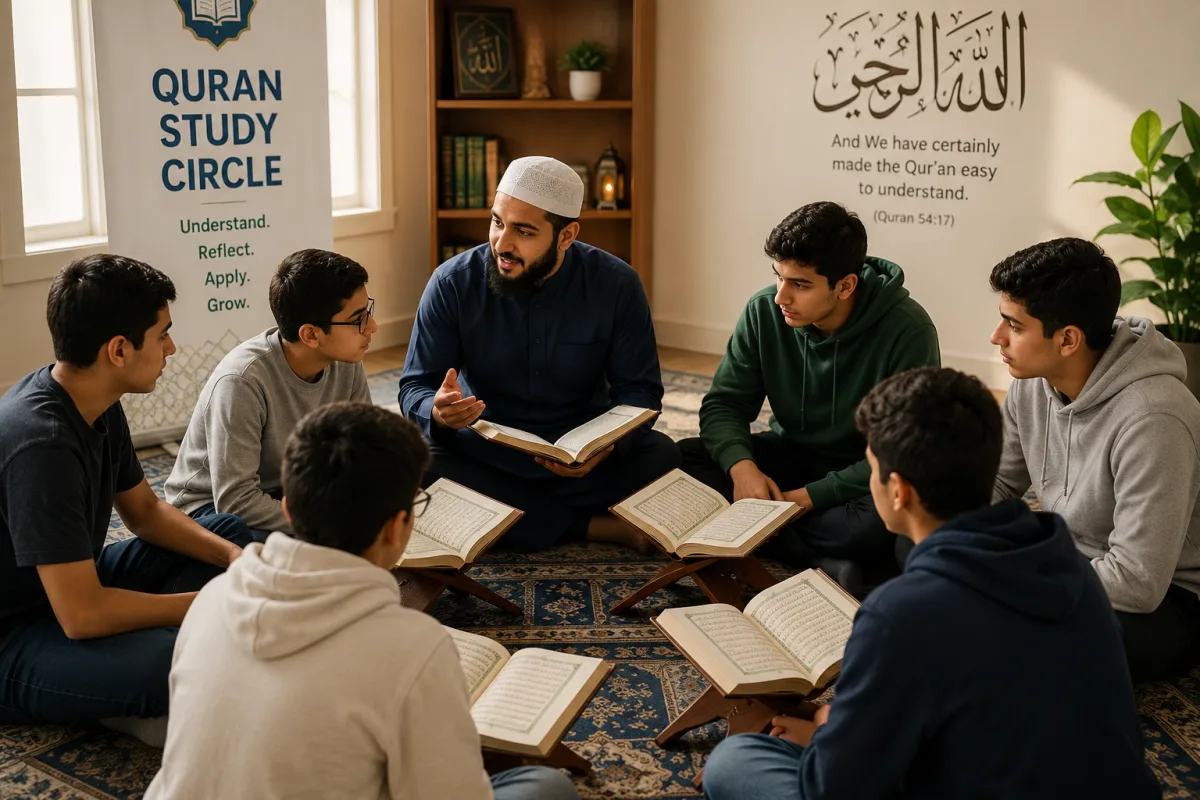
If you have spent any time searching for an online Qur'an teacher, you have probably run into the word Ijazah. It appears on teacher profiles, in academy advertisements, and in the questions parents ask one another. Sometimes it sounds like a formal degree, sometimes like a badge of honour, and often it is left completely unexplained. If you have wondered what it actually means, whether you need a teacher who holds one, and how to tell a genuinely qualified teacher from someone who simply says the right things, you are in good company.
The truth is that the world of Qur'an certification is both simpler and richer than most people assume. At its heart is a beautiful idea: that the Qur'an has been passed carefully from teacher to student, mouth to ear, in an unbroken line stretching back to the Prophet Muhammad (peace be upon him). The Prophet himself learned the Qur'an directly from the angel Jibril, and the practice of reviewing and confirming recitation is woven into the very fabric of how the Qur'an has reached us. As reported in the collections of hadith, "Jibril used to recite the Qur'an to him once a year, and he recited it twice in the year in which he died" (Sahih al-Bukhari 5027). That yearly review is, in a sense, the ancestor of every Ijazah given today.
This article answers the questions learners and parents ask us most often about Ijazah, sanad, Al-Azhar, and certification in general. The goal is not to make certification sound intimidating, but to help you understand it well enough to make a calm, informed choice for yourself or your child.
Reading time: about 10 minutes.
Reviewed by the Tayseerul Quran Teaching Team Qualified Quran teachers helping children and adults learn Quran reading, Tajweed, Noorani Qaida, Hifz, and Arabic through one-on-one online classes.
What You'll Learn
- What Is an Ijazah in the Qur'an
- What Is a Sanad or Chain of Transmission
- Do I Need an Ijazah Certified Teacher as a Beginner
- How Important Is Al-Azhar Training
- How Do Teachers Earn an Ijazah
- Can I Get an Ijazah Myself
- Does Learning Online Affect Certification
- How to Check That a Teacher Is Qualified
- Do Children Need a Certified Teacher
- A Teacher's Perspective on Certification and Trust
- Frequently Asked Questions
- Continue Learning
- Final Thoughts
Understanding Ijazah and Sanad
What Is an Ijazah in the Qur'an?
An Ijazah is a traditional certification, or licence, that authorises a person to teach or transmit the Qur'an to others. Think of it less as a diploma you hang on a wall and more as a formal statement from a qualified teacher that says, in effect, "I have listened to this student recite the Qur'an, I am satisfied that their recitation is sound, and I permit them to teach it and pass it on."
What makes an Ijazah special is that, in its fullest form, it is connected to a sanad, or chain of teachers. The teacher granting the Ijazah received it from their own teacher, who received it from theirs, and so on. This is what people mean when they describe an Ijazah as "connected" or "with a chain." It ties the student to a living tradition rather than to a single individual's opinion.
An Ijazah usually focuses on accurate recitation according to the rules of Tajweed, and it may be granted for a particular way of reciting (a qira'ah) such as the widely used narration of Hafs. Some Ijazahs certify recitation from memory (Hifz), while others certify recitation while reading from the text. It is worth remembering that an Ijazah is a certification of Qur'anic recitation and transmission specifically; it is not a general licence to issue religious rulings.
What Is a Sanad or Chain of Transmission?
A sanad is the chain of names that links a reciter back through generations of teachers. If you picture a family tree, the sanad is the line of teachers rather than the line of ancestors. Each person in the chain learned from the one before, and each confirmed that the next had recited accurately before granting them permission to continue the line.
This concept is deeply rooted in Islamic scholarship. The preservation of knowledge through careful transmission is one of the reasons the Qur'an has remained so consistent across centuries and continents. Allah describes the Qur'an as something made accessible for remembrance: "And We have certainly made the Qur'an easy to remember. So is there any who will remember?" (Surah al-Qamar, 54:17). The sanad is one of the human means through which that ease of preservation has been honoured and protected.
For a beginner, the practical takeaway is this: a teacher with a documented sanad has, at some point, sat before a qualified master and recited the entire Qur'an accurately enough to be trusted with passing it on. That is a meaningful assurance of quality, even if it is not the only measure of a good teacher.
Certification for Everyday Learners
Do I Need an Ijazah Certified Teacher as a Beginner?
This is one of the most common questions we receive, and the honest answer is reassuring: no, you do not strictly need an Ijazah-certified teacher to begin learning. Most beginners start with the fundamentals such as recognising Arabic letters, learning the Noorani Qaida, and building basic reading fluency. These early stages are taught well by any competent, well-trained teacher.
That said, there is real value in learning with a teacher who is either certified or trained by certified teachers, even from the start. A teacher grounded in a sound tradition tends to pronounce letters precisely, correct small errors before they become habits, and model recitation the way it has been transmitted for centuries. Beginners cannot always hear the difference between a slightly off pronunciation and a correct one, so having a teacher whose own recitation is trustworthy matters more than it might seem.
Our general guidance is simple. Choose a teacher whose recitation is accurate and whose teaching is patient and clear. If that teacher also holds an Ijazah, wonderful. If they are working under the supervision of certified teachers within a reputable academy, that is also a strong and reasonable choice. Certification becomes more important the further you progress, especially if you eventually aim to memorise the Qur'an or earn an Ijazah of your own.
How Important Is Al-Azhar Training?
Al-Azhar is a highly respected Islamic university based in Cairo, Egypt, with a long history of scholarship in the Qur'anic sciences, Arabic, and Islamic studies. A teacher trained at Al-Azhar has typically studied within a rigorous academic environment, and many learners understandably feel reassured when they see it mentioned on a profile.
It is fair to say that Al-Azhar training is a strong and credible sign of quality. At the same time, it is important not to treat it as the only mark of a good teacher. There are excellent, fully certified Qur'an teachers who studied at other respected institutions or who earned their Ijazah through private study with recognised masters outside the university system. The tradition of Qur'anic transmission is broader than any single institution.
So how should you weigh it? Treat Al-Azhar training as one valuable data point among several. Combine it with the things you can observe directly, such as the clarity of the teacher's recitation, their patience, and their ability to explain. If you would like to explore this route specifically, our guide to Al-Azhar online Qur'an teachers walks through what to look for and what such training does and does not guarantee.
How Certification Actually Works
How Do Teachers Earn an Ijazah?
Earning an Ijazah is a serious undertaking that usually takes years. A student first masters the rules of Tajweed and reaches a high level of accuracy in recitation. Then, working closely with a qualified teacher who already holds an Ijazah, they recite the entire Qur'an aloud to that teacher, often from memory, with the teacher listening carefully and correcting every error along the way.
This process demands precision. The command to recite the Qur'an carefully and distinctly is taken directly from the Qur'an itself: "And recite the Qur'an with measured recitation" (Surah al-Muzzammil, 73:4). An Ijazah is, in effect, a teacher's testimony that the student has honoured this instruction and can be trusted to recite and transmit the Qur'an faithfully.
Only once the teacher is fully satisfied does they grant the Ijazah, often accompanied by a written document listing the sanad, the chain of teachers stretching back through the generations. Because the standard is so high and the review so thorough, an Ijazah carries genuine weight. It is not awarded for attendance or effort alone, but for demonstrated mastery.
Can I Get an Ijazah Myself?
Yes, and this is one of the most inspiring aspects of the tradition. An Ijazah is not reserved for scholars or for people who grew up speaking Arabic. Committed adult learners around the world pursue and receive Ijazahs, and so do dedicated younger students. What it requires is time, consistency, and a willingness to be corrected patiently over many months or years.
The typical path looks something like this. You build a solid foundation in reading and Tajweed. You refine your recitation until it is consistently accurate. Then, if you wish to pursue an Ijazah, you work one-to-one with a certified teacher who guides you through reciting the entire Qur'an to their standard. If you are aiming for an Ijazah in Hifz, you also memorise the Qur'an along the way, which is a longer journey that many people undertake gradually. Our overview of how to memorise the Qur'an online explains what that commitment looks like in practice.
The important thing to understand is that pursuing an Ijazah is a marathon, not a sprint. You do not need to decide on day one whether this is your goal. Many learners simply focus on reading beautifully and accurately, and only later feel drawn to the deeper commitment of certification.
Does Learning Online Affect Certification?
Many people worry that an Ijazah earned online is somehow less valid than one earned in person. In practice, the method of delivery does not change the substance of what an Ijazah certifies. The heart of the process is the same whether you sit in the same room as your teacher or connect over a video call: you recite, the teacher listens attentively, and errors are corrected in real time.
Clear audio and a stable connection allow a teacher to hear the fine details of pronunciation just as they would in person, sometimes even more clearly through headphones. Reputable online academies and teachers follow the same standards of accuracy and the same traditional process that has always governed Ijazah. What matters is the qualification of the teacher granting it and the rigour of the review, not the medium through which the lessons take place.
This is one of the quiet gifts of modern learning. A student in one country can now study with a certified teacher on the other side of the world, receive careful correction, and eventually earn a legitimate, chained Ijazah, all without leaving home. If you are new to this format, our introduction to online Qur'an classes explains how one-to-one lessons work and what to expect.
Choosing and Trusting a Teacher
How to Check That a Teacher Is Qualified?
Because certification matters, it is worth knowing how to verify it rather than simply taking claims at face value. Here are practical steps you can take before committing to a teacher or academy.
- Ask directly about certification. A qualified teacher will happily explain whether they hold an Ijazah, in which narration, and from whom. Vagueness or discomfort in answering is worth noting.
- Ask about their teachers and sanad. Genuine certification comes with a chain. A teacher who can name their own teachers is showing you the tradition they stand within.
- Listen to their recitation. Ask for a sample or take a trial lesson. Even as a beginner, you can notice whether the recitation sounds careful, clear, and consistent.
- Take a trial class. Nothing reveals more than experiencing the teaching yourself. Notice how they correct mistakes, whether they are patient, and whether you feel comfortable.
- Check the academy behind the teacher. Reputable schools vet their teachers, supervise their work, and can vouch for their training.
For a fuller walkthrough, including specific questions to ask and warning signs to watch for, see our detailed guide on how to verify a Qur'an teacher's qualifications. It is also worth reading our comparison of certified versus uncertified Qur'an teachers to understand what difference certification really makes day to day.
Do Children Need a Certified Teacher?
For children, the most important qualities are often accuracy, patience, and the ability to keep a young learner engaged. A certified teacher offers a valuable assurance that your child is hearing the Qur'an recited correctly from the very beginning, which matters because children absorb pronunciation habits quickly and hold on to them for life.
That does not mean every children's teacher must personally hold an Ijazah. What matters is that the teacher's own recitation is sound and that they teach within a framework of accuracy, ideally under the supervision of certified teachers. A warm, encouraging teacher who pronounces the Qur'an correctly will serve a child better than a highly credentialed teacher who cannot connect with young learners.
Our recommendation for parents is to look for the combination: a teacher whose recitation you can trust and whose manner your child responds to. In a good academy, these two things are not in tension, because the school ensures accuracy while matching your child with a teacher who suits their personality.
A Teacher's Perspective on Certification and Trust
Speaking as teachers, we want to offer a little honesty about certification, because it is easy for the topic to become either overhyped or dismissed. Both extremes miss the point.
An Ijazah is genuinely meaningful. When we grant or receive one, we are participating in something that connects us, link by link, to generations of teachers who guarded the Qur'an's recitation with great care. That responsibility keeps us humble and precise. We do not correct a student's pronunciation to be strict for its own sake, but because we were corrected the same way, and because the accuracy we pass on is not ours to alter.
At the same time, a certificate is not a personality, and it is not a guarantee of good teaching on its own. We have seen wonderfully certified reciters who struggle to explain, and we have seen patient, accurate teachers still working toward their own Ijazah who bring students along beautifully. The best situation, and the one we aim for, is a teacher who combines sound certification or supervision with genuine skill in teaching.
This is also why we encourage families to ask questions and to take trial lessons. A trustworthy teacher or academy welcomes scrutiny. On matters of certification, recitation, and method, you deserve clear answers, and on any question of religious ruling that goes beyond recitation, the right response is always to consult a qualified scholar rather than to guess. Trust is built through transparency, not through titles alone.
Frequently Asked Questions
Is an Ijazah a religious degree?
Not exactly. An Ijazah is a traditional licence certifying that a person can recite and transmit the Qur'an accurately, usually connected to a chain of teachers. It is specific to Qur'anic recitation and is different from a general academic or religious-studies degree.
Can a beginner start without a certified teacher?
Yes. Beginners can start reading with any competent, well-trained teacher. Certification becomes more valuable as you advance, and especially if you later aim to memorise the Qur'an or pursue an Ijazah yourself.
Is an online Ijazah legitimate?
It can be fully legitimate. The validity depends on the qualification of the teacher granting it and the rigour of the recitation review, not on whether the lessons happen in person or over video.
How long does it take to earn an Ijazah?
It varies widely and usually takes years rather than months. The timeline depends on your starting level, how much you practise, whether you are pursuing certification in reading or in memorisation, and how consistently you attend lessons.
Does a teacher need to be from Al-Azhar to be qualified?
No. Al-Azhar is a respected institution and its training is a strong credential, but many excellent, fully certified teachers earned their qualifications elsewhere or through private study with recognised masters.
How can I confirm a teacher's Ijazah?
Ask them directly about their certification, the narration it covers, and the teachers in their chain. Listen to their recitation, take a trial lesson, and check whether a reputable academy stands behind them.
Should I choose a teacher for my child based only on certification?
Certification is important, but for children you should also weigh patience, warmth, and the ability to keep a young learner engaged. The ideal teacher combines accurate, trustworthy recitation with a manner your child responds to.
Continue Learning
- Al-Azhar Online Qur'an Teachers
- Certified vs Uncertified Qur'an Teachers
- How to Verify a Qur'an Teacher's Qualifications
- Online Qur'an Classes: What to Expect
- How to Memorise the Qur'an Online
Final Thoughts
Understanding Ijazah and certification is really about understanding trust. The tradition of chained transmission exists because the Qur'an is precious, and because every generation has taken care to pass it on accurately. When you look for a teacher, you are stepping into that story, whether you are learning your first letters or working toward memorising the whole Qur'an.
You do not need to master every technical detail before you begin. Start with a teacher whose recitation is sound and whose teaching is patient, ask honest questions about their qualifications, and let your own goals grow naturally over time. Certification will matter more at some stages than others, and a good academy will guide you at each step.
Whatever your starting point, the most important thing is simply to begin, and to begin with someone you can trust.
Learn with a certified teacher — book a free trial →
References
- Sahih al-Bukhari 5027
- Surah al-Qamar (54:17)
- Surah al-Muzzammil (73:4)