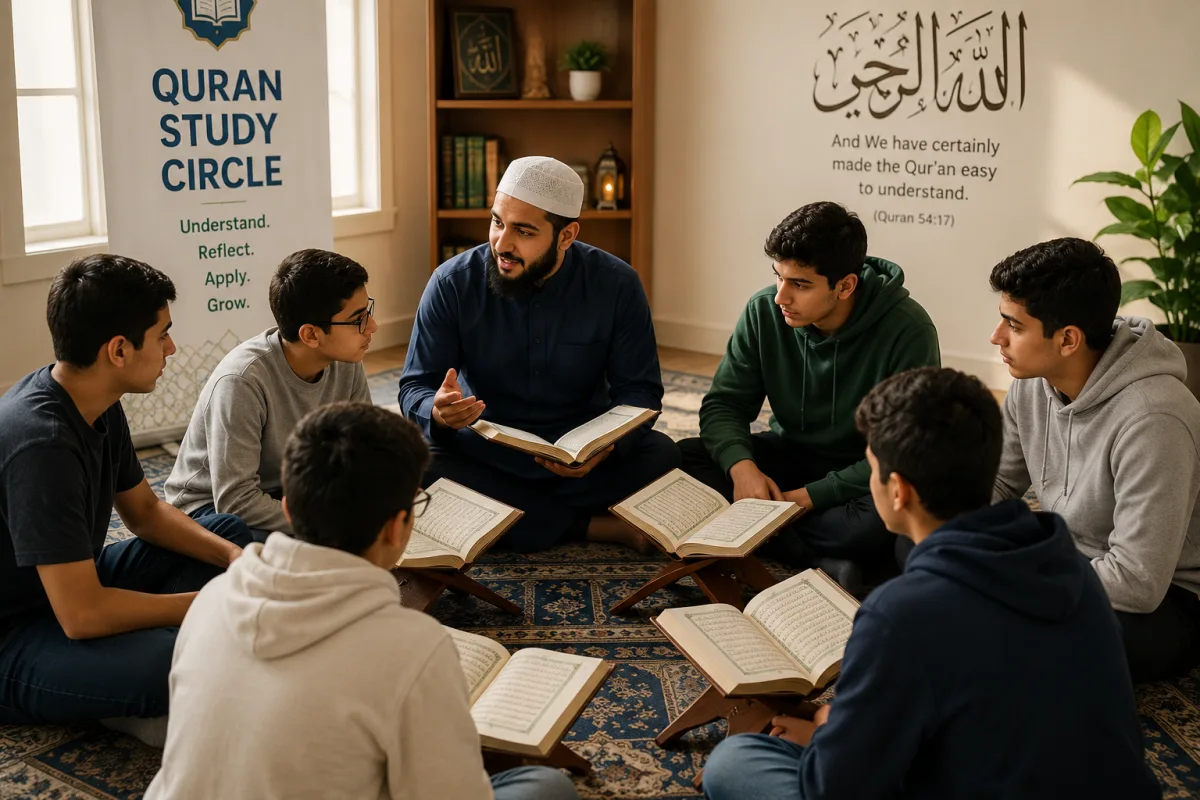
If you have ever opened the Qur'an and wished you could recite it the way you hear it recited so beautifully in prayer, you are not alone. Many beginners feel a quiet mix of longing and nervousness: longing to read the words of Allah correctly, and nervousness that the rules seem complicated or that they have started "too late." Take a breath. Learning Tajweed is a gentle, step-by-step journey, and it is one that people of every age and background complete successfully every single day.
Tajweed is the set of rules that helps us pronounce each letter of the Qur'an from its correct place and with its correct qualities, so that the recitation is accurate and beautiful. Allah instructs us in Surah al-Muzzammil, "...and recite the Qur'an with measured recitation." (73:4). That measured, careful recitation is exactly what Tajweed teaches — not showing off, not speed, but reading the words the way they were revealed and preserved.
This guide is written for complete beginners. You do not need any prior knowledge, and you do not need to memorise a dictionary of Arabic terms before you begin. We will walk through what Tajweed actually means, why it matters, the foundational rules, the mistakes to watch for, and a realistic eight-week plan to get you reciting with confidence. By the end you will have a clear map of the whole subject and know exactly where to take your first step.
Reading time: about 11 minutes.
Reviewed by the Tayseerul Quran Teaching Team Qualified Quran teachers helping children and adults learn Quran reading, Tajweed, Noorani Qaida, Hifz, and Arabic through one-on-one online classes.
What You'll Learn
- What Tajweed Actually Means
- Why Tajweed Matters
- Start With the Makharij
- The Characteristics of Letters
- The Core Rules of Noon and Meem Sakinah
- Understanding Qalqalah
- Understanding Madd
- Common Beginner Mistakes
- An 8 Week Starter Plan
- Do You Need a Teacher
- A Qualified Teacher's Perspective
- Tajweed for Children
What Tajweed Actually Means
The Arabic word Tajweed comes from a root that means to make something well, to improve, or to do something with excellence. In the context of the Qur'an, Tajweed is the science of reciting each letter correctly — giving every letter its rightful articulation point and its proper characteristics, while observing the rules that govern how letters interact when they sit next to one another.
Think of it this way. Every Arabic letter has a "home" in the mouth or throat where it is produced, and a set of natural qualities — whether air flows, whether the sound is heavy or light, whether it echoes. Tajweed is simply the organised knowledge of all of that, passed down carefully from teacher to student in an unbroken chain going back to the Prophet Muhammad (peace be upon him), who received the Qur'an from the angel Jibreel.
It helps to separate three words that beginners often confuse. Tajweed is the rules of correct pronunciation. Tarteel is the slow, measured, unhurried style of reciting that those rules produce. Tilawah is the act of reciting itself. If you would like a fuller comparison, we cover it in detail in our guide on tajweed vs tarteel vs tilawah. For now, hold onto the simple idea: Tajweed is the "how," and it exists to protect the accuracy and beauty of the recitation.
Why Tajweed Matters
There are two reasons Tajweed matters, and both are worth understanding clearly.
The first reason is meaning. Arabic is a precise language in which a small change in a sound can change a word entirely. Some letters sound similar to an untrained ear — for example the light "s" sound and the heavy emphatic letters — yet swapping one for the other can turn one word into a completely different one. Because the Qur'an is the speech of Allah, we take care that we are actually reciting the words that were revealed, not accidentally saying something else. Tajweed is the safeguard that keeps the meaning intact.
The second reason is beauty and reverence. The Qur'an deserves to be recited with care and dignity. The Prophet Muhammad (peace be upon him) is reported in Sahih al-Bukhari 5027 to have said that the best of people are those who learn the Qur'an and teach it. Learning to recite it well is part of honouring it. When you give the words their due, the recitation becomes calm, flowing and moving — the kind of recitation that softens hearts, including your own.
You do not need to master all of this at once, and you certainly do not need to feel guilty about where you are starting from. Every proficient reciter you admire was once a beginner sounding out letters one at a time. The rules exist to help you, not to intimidate you.
Start With the Makharij
The single most important foundation in Tajweed is the Makharij — the articulation points, or the specific places from which each letter is produced. If you get the letters right at the source, everything built on top of them becomes far easier.
The articulation points are grouped into a few broad regions. There is the empty space of the mouth and throat, which produces the long vowel sounds. There is the throat itself, which has three levels producing letters such as the deep guttural sounds. There is the tongue, which is the busiest region by far, responsible for many letters depending on which part of the tongue touches which part of the mouth. There are the lips, producing letters like the "b," "m," "w," and "f" sounds. And there is the nasal passage, which produces the humming sound we will meet shortly called Ghunnah.
For a beginner, the practical takeaway is this: learn to feel where each letter is made. Notice that some letters live deep in the throat, some are made with the tip of the tongue against the teeth, and some are formed at the lips. A good teacher will have you produce each letter in isolation, slowly, until your mouth learns the position by muscle memory. This is precisely the work done in noorani qaida online lessons, which build correct pronunciation letter by letter before you ever tackle full verses.
The Characteristics of Letters
Once a letter is coming from the right place, we look at its Sifaat — its permanent characteristics. Where the Makharij tell us where a letter is made, the Sifaat tell us how it sounds once it is there. Two letters can share a similar area of the mouth yet be distinguished entirely by their qualities, so the Sifaat are what keep letters from blurring into one another.
At a beginner level you do not need every technical pairing, but a few concepts will serve you well. Some letters are "whispered," meaning the breath continues to flow as you say them, while others are "voiced," where the flow of breath is held back. Some letters are heavy or emphatic, pronounced with a full, raised tongue that gives them a deep, thick sound, while others are light and thin. Some letters have a quality of running or continuing, and some stop abruptly.
You will absorb these characteristics naturally as you practise, especially with a teacher who points them out in real words. Do not try to memorise the full chart on day one. Instead, learn the qualities of each letter as you meet it, and let repetition do the work. Over a few weeks the heavy letters will start to sound heavy to you automatically, and the light ones light.
The Core Rules of Noon and Meem Sakinah
Here we arrive at the rules most people picture when they hear the word "Tajweed." They govern what happens to a silent Noon (the "n" sound with no vowel, including tanween) and a silent Meem (the "m" sound with no vowel) when they are followed by certain letters. There are four classic rules for Noon Sakinah, plus the important sound of Ghunnah, and beginners can learn them in a logical order.
Izhar means "clear pronunciation." When a silent Noon is followed by one of the throat letters, the "n" is pronounced clearly and distinctly, with no merging and no nasal hum. You simply say the "n" plainly and move on.
Idgham means "merging." When a silent Noon is followed by certain letters, the "n" sound merges into the following letter so that the two are pronounced almost as one. Some cases of Idgham carry a nasal hum and some do not.
Iqlab means "conversion." When a silent Noon is followed by the letter "b," the "n" sound is converted into a hidden "m" sound accompanied by a nasal hum. It is a small, subtle change that sounds natural once you hear it.
Ikhfa means "concealment." When a silent Noon is followed by one of a larger group of letters, the "n" is neither pronounced fully clearly nor fully merged — it is hidden in a light nasal sound that carries into the next letter.
Ghunnah is the nasal humming sound itself, produced through the nose, and it appears in several of the rules above as well as whenever a Noon or Meem carries a shaddah (a doubling mark). It is held for a short, measured beat. The Meem Sakinah has its own small set of rules that parallel these, including its own form of concealment before the letter "b" and its own merging into a following Meem. If this feels like a lot, remember you will learn them one at a time, each with plenty of examples, and they become second nature with practice. A structured tajweed practice plan checklist can help you tick them off in sequence.
Understanding Qalqalah
Qalqalah is one of the most satisfying rules for beginners because you can hear it so clearly and it makes recitation come alive. The word means "echoing" or "bouncing." It applies to five specific letters — qaaf, taa, baa, jeem, and daal — when they carry a silent marker, most noticeably at the end of a word when you pause on them.
When you pronounce one of these five letters in a silent position, you give it a light bounce or echo rather than letting it die flat. Picture tapping a drum: the sound rebounds slightly. That gentle rebound is Qalqalah. You will hear reciters produce a clear little "echo" on words ending in these letters, and once you know to listen for it, you will notice it everywhere.
The bounce should be controlled and not exaggerated — it is a small, clean echo, not a full extra syllable. Practising a handful of short words that end in these five letters is one of the quickest ways for a beginner to feel like their recitation is improving, because the effect is so audible.
Understanding Madd
Madd means "elongation" — the lengthening of a vowel sound. In Arabic, some vowels are naturally held longer than others, and Tajweed tells us exactly how long. The most basic form is the natural Madd, where a long vowel is held for a count of roughly two beats. Every long "aa," "ee," and "oo" in the Qur'an carries at least this natural length.
Beyond the natural Madd, there are longer elongations that occur for specific reasons, such as when a long vowel is followed by a hamzah or by a silent letter. In those cases the vowel is held for a longer, defined count. Beginners do not need to master every category at once; what matters first is developing a steady sense of the basic two-beat length and being consistent with it.
A helpful mental image: imagine tapping your finger on the table at a calm, even pace, one tap per beat. Natural Madd is two taps, and the longer Madds add more taps in a measured way. This steadiness is exactly what "measured recitation" means. The Qur'an itself mentions how it was made easy to remember and recite, as noted in Surah al-Qamar (54:17), and this ease is felt precisely when your rhythm is even rather than rushed. A teacher listening in real time will gently hold you to a consistent count until it becomes automatic.
Common Beginner Mistakes
Knowing the common pitfalls in advance saves you months of frustration. None of these mistakes means you are doing badly — they are simply the predictable bumps that almost every learner hits.
- Rushing. The most frequent mistake is reading too fast. Speed hides errors and prevents the mouth from settling into correct positions. Slow down; measured recitation is the goal, not speed.
- Skipping the Makharij. Learners eager to read whole verses sometimes skip the patient work of pronouncing individual letters correctly. This creates habits that are hard to unlearn later.
- Inconsistent Madd. Holding a long vowel for two beats in one word and four in the next, without reason, is very common. Aim for a steady, even count.
- Neglecting Ghunnah. Forgetting the nasal hum where it belongs, or adding it where it does not, changes the character of the recitation.
- Confusing similar letters. The emphatic (heavy) letters and their lighter cousins trip up nearly everyone at first. This is normal and improves quickly with focused listening.
- Learning only by eye. Tajweed is an oral tradition. Reading rules from a book without reciting aloud and being corrected will only take you so far.
The good news is that every one of these is fixable, and most correct themselves naturally once you are reciting aloud regularly with feedback.
An 8 Week Starter Plan
A plan turns a vague intention into steady progress. Here is a realistic eight-week outline for a beginner giving Tajweed around twenty to thirty minutes a day, most days of the week. Adjust the pace to your life; consistency matters far more than intensity.
- Week 1 — The letters. Learn to recognise and pronounce the Arabic letters in isolation, focusing on their articulation points. Do not rush ahead.
- Week 2 — Letters with vowels. Add the short vowels and practise reading simple two- and three-letter combinations aloud.
- Week 3 — Long vowels and natural Madd. Introduce the long vowels and get comfortable holding a steady two-beat length.
- Week 4 — The silent letter (sukoon) and shaddah. Practise words with silent letters and doubled letters, which prepares you for the coming rules.
- Week 5 — Ghunnah and Qalqalah. Learn the nasal hum and the bounce of the five Qalqalah letters. Enjoy these — they are audibly rewarding.
- Week 6 — Noon and Meem Sakinah, part one. Begin with Izhar and Iqlab, the most clear-cut of the rules.
- Week 7 — Noon and Meem Sakinah, part two. Add Idgham and Ikhfa, working through examples slowly.
- Week 8 — Putting it together. Recite short surahs from the end of the Qur'an, applying everything you have learned, with a teacher correcting you.
By the end of eight weeks you will not be a master — no one is in two months — but you will be reading with real understanding of the rules and the confidence to keep going. Many learners continue this journey inside structured online quran classes so that each week's practice is guided and corrected.
Do You Need a Teacher
This is one of the most common questions beginners ask, and it deserves an honest answer. Is Tajweed obligatory? The widely held position is that reciting clearly enough to avoid distorting the meaning of the words is required, while the finer refinements of Tajweed are a recommended perfection rather than a strict obligation. For a personal ruling on your own situation, it is best to ask a qualified scholar directly.
On the practical question of whether you need a teacher: while books, apps, and videos are genuinely helpful resources, Tajweed is fundamentally an oral tradition that has always been transmitted from mouth to ear. There are sounds in Qur'anic Arabic that simply cannot be learned accurately from text alone, and there are errors you will not even notice you are making until someone trained points them out. A teacher listens, catches the small slips, and corrects them before they harden into habits.
This is why one-to-one instruction is so valuable for beginners. In a personal lesson, the teacher can adjust to your exact pace, focus on the specific letters you find difficult, and give you immediate feedback in real time. That feedback loop is the single fastest way to improve.
A Qualified Teacher's Perspective
Here is something we, as qualified Quran teachers, notice again and again: the students who progress fastest are almost never the ones who started with the most talent. They are the ones who show up consistently and who let themselves be corrected without embarrassment.
From years of teaching beginners across many countries and age groups, a few lessons stand out. First, small daily practice beats occasional long sessions — fifteen honest minutes a day will carry you further than a single two-hour cram once a week. Second, reciting aloud is non-negotiable; the mouth learns by doing, not by reading silently. Third, a single trusted teacher who knows your voice will move you forward faster than a dozen scattered videos, because they remember your specific habits and hold you accountable to fixing them.
We also want to reassure adult learners in particular. Many adults arrive convinced they are "too old" or that their tongue "cannot make these sounds." In our experience this is almost never true. Adult learners often progress remarkably well precisely because they understand the rules intellectually and practise with discipline. The obstacle is rarely ability — it is usually the fear of sounding wrong in front of someone. A patient teacher dissolves that fear quickly, and the same principle applies whether your long-term goal is fluent recitation or moving on to memorize quran online. Correct recitation is the foundation that everything else, including memorisation, is built upon.
Tajweed for Children
Children have a wonderful advantage when it comes to Tajweed: their ears and mouths are still highly adaptable, and they often pick up correct sounds by imitation far more easily than adults do. The key with children is to keep lessons short, encouraging, and consistent.
For young learners, the approach is playful and repetitive. Rather than explaining the theory behind a rule, a good teacher simply models the correct sound and has the child echo it back, again and again, until it feels natural. Praise for effort, patience with mistakes, and a calm, warm atmosphere matter enormously. A child who associates the Qur'an with encouragement and kindness will carry that love for a lifetime.
One-to-one online lessons work especially well for children because the teacher can hold the child's attention, keep the pace lively, and give parents regular updates on progress. Short sessions several times a week tend to work better than one long session. And because young children mirror what they hear, learning from a teacher with correct pronunciation from the very start saves them from having to unlearn mistakes later.
Frequently Asked Questions
Is Tajweed obligatory?
The widely held view is that pronouncing the Qur'an clearly enough to avoid distorting the meaning of the words is required, while the finer refinements of Tajweed are considered a recommended perfection. Because rulings can depend on your individual circumstances, it is best to ask a qualified scholar for a personal answer.
Can an adult beginner really learn Tajweed?
Yes, absolutely. Adults learn Tajweed successfully all the time. In fact, adults often benefit from being able to understand the rules intellectually and practise with discipline. The main barrier is usually nervousness about making mistakes, and a patient teacher removes that quickly.
How long does it take to learn Tajweed?
You can grasp the foundational rules in a couple of months of steady practice, as our eight-week plan shows. Reaching fluent, polished recitation takes longer and depends on how regularly you practise, but every learner makes visible progress far sooner than they expect.
Do I need to know Arabic to learn Tajweed?
No. Tajweed is about pronouncing the letters and words of the Qur'an correctly, which is separate from understanding the meaning. Many people learn to recite beautifully before they study Arabic vocabulary and grammar. You can pursue both in parallel if you wish.
What is the difference between Tajweed and Tarteel?
Tajweed is the set of rules for correct pronunciation. Tarteel is the slow, calm, measured style of recitation that results from applying those rules. In short, Tajweed is the "how," and Tarteel is the unhurried manner of reading.
Can I learn Tajweed properly online?
Yes. One-to-one online lessons give you a live teacher who listens, corrects your pronunciation in real time, and adapts to your pace — the same feedback loop as an in-person lesson, from the comfort of home. It is one of the most effective ways for beginners to learn today.
Where should a complete beginner start?
Start with the letters themselves — their names and their articulation points — before moving to vowels and full words. A structured Noorani Qaida course is designed exactly for this and gives you a solid, patient foundation.
Continue Learning
- Noorani Qaida Online
- Online Quran Classes
- Tajweed vs Tarteel vs Tilawah
- Tajweed Practice Plan Checklist
- Memorize Quran Online
Final Thoughts
Learning Tajweed is not about achieving perfection overnight. It is about honouring the Qur'an by reciting it carefully, one letter and one rule at a time, with patience and warmth toward yourself along the way. Every reciter you admire began exactly where you are now — sounding out letters, feeling unsure, and choosing to continue.
Start small. Learn the letters, feel where they come from, hold your Madd steady, listen for your Ghunnah and Qalqalah, and let a teacher gently correct you as you go. Consistency, not intensity, is what carries you forward. The words of Allah are worth this care, and the calm, measured recitation you are working toward is well within your reach.
Wherever you are starting from, the best next step is simply to recite aloud for someone who can guide you.
Have your recitation heard and corrected — book a free trial lesson →
References
- Surah al-Muzzammil (73:4): "...and recite the Qur'an with measured recitation."
- Surah al-Qamar (54:17)
- Sahih al-Bukhari 5027