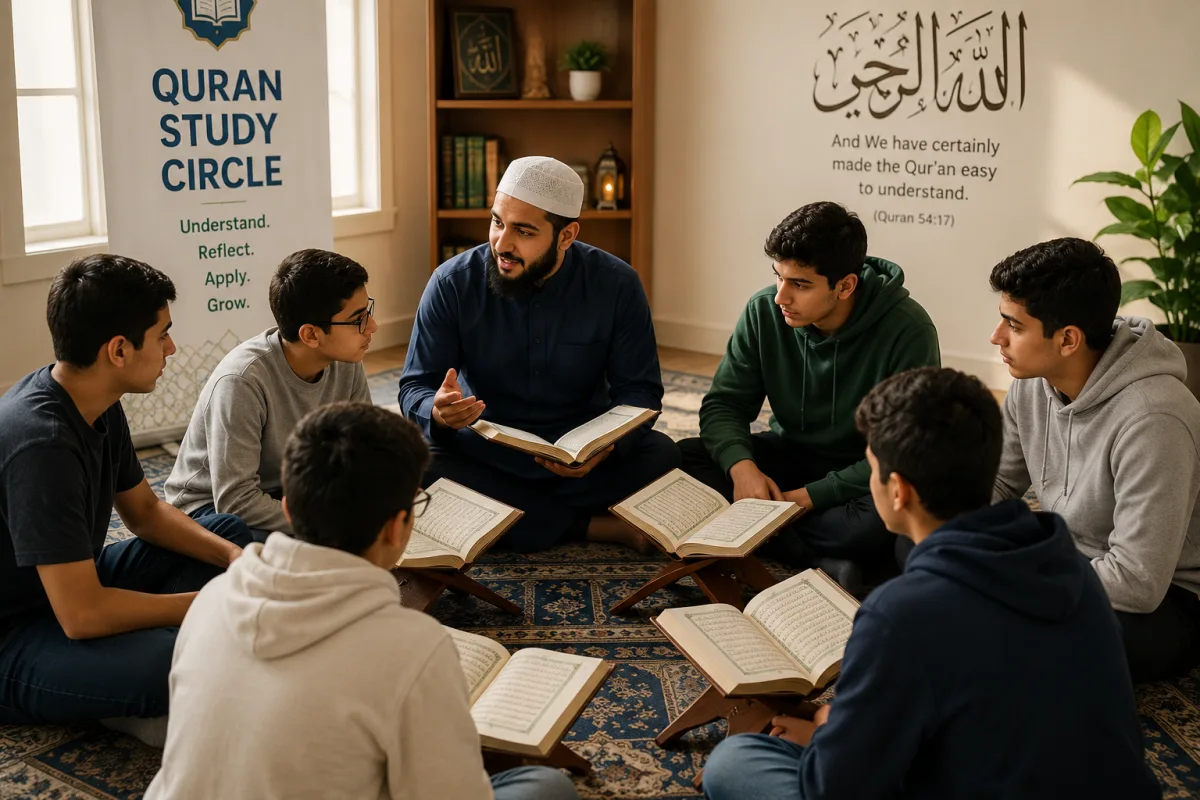
The school run, the packed lunches, the homework diary, the after-school club that finishes just in time to start dinner — modern family life moves fast, and somewhere in the middle of it sits a quiet worry many Muslim parents carry: when exactly is my child supposed to learn the Qur'an? Between a full academic timetable and a house that only settles down after bedtime, finding room for Qur'an study can feel like fitting one more thing into a bag that is already full.
An after-school Qur'an program is one of the most practical answers families have found. Rather than treating Qur'an as a weekend-only errand or a summer catch-up project, it weaves a short, focused lesson into the rhythm of an ordinary school day. And because so many of these programs now run online, the lesson comes to your living room instead of adding another drive across town. The Qur'an itself frames this learning as something achievable: "And We have certainly made the Qur'an easy to remember, so is there any who will be reminded?" (Surah al-Qamar, 54:17). Ease, in this sense, is not only about the sacred text — it is also about how we build the habit around a child's real life.
This guide is written for parents who want the whole picture before they commit. We will look at what an after-school Qur'an program actually is, why online delivery suits busy school families so well, what your child will learn, how to slot lessons around homework and bedtime, and how to choose an online Qur'an academy you can trust. The goal is simple: to help you set up something steady and gentle that your child can keep doing for years, not just for a term.
Reading time: about 11 minutes.
Reviewed by the Tayseerul Quran Teaching Team Qualified Quran teachers helping children and adults learn Quran reading, Tajweed, Noorani Qaida, Hifz, and Arabic through one-on-one online classes.
What You'll Learn
- What An After School Quran Program Actually Is
- Why Online Suits Busy School Families
- What Your Child Will Learn
- How Lessons Fit Around The School Day
- The Right Time Of Day For Lessons
- How To Choose A Good Online Quran Academy
- Keeping A Tired Child Motivated After School
- One To One Versus Group Lessons
- Scheduling And Consistency
- What Results To Expect
- A Qualified Teacher's Perspective
- Frequently Asked Questions
What An After School Quran Program Actually Is
An after-school Qur'an program is a structured course of Qur'an lessons designed to run alongside a child's mainstream schooling, usually in the late afternoon or early evening on set days of the week. Think of it as the Qur'an equivalent of a music lesson or a swimming class — regular, scheduled, and taught by someone qualified — rather than something squeezed in whenever the week allows.
The word program matters here. A one-off lesson is helpful, but a program implies a plan: a starting point, a clear path, and milestones along the way. A good one begins wherever your child is — a five-year-old meeting Arabic letters for the first time, or a ten-year-old who can decode words but stumbles over the rules of pronunciation — and moves forward in small, deliberate steps.
Historically, this role was filled by the local mosque or a weekend madrasah. Those institutions remain a blessing to their communities, but they are not always a good fit for every family's timetable or every child's pace. Online after-school programs have grown precisely because they keep the structure of a proper curriculum while removing the logistics that make attendance hard. For a fuller picture of how these classes are delivered for younger learners, our overview of online Quran classes for kids is a good companion read.
Why Online Suits Busy School Families
The strongest argument for online lessons is honest and unglamorous: they remove the drive. A physical madrasah might be a fifteen-minute journey each way, plus parking, plus waiting — nearly an hour of family time spent on logistics for a thirty-minute lesson. Online, that hour is returned to you. Your child closes a schoolbook, opens a laptop, and the teacher is already there.
Online delivery also gives families reach. A child in a small town, or in a country where Qur'an teachers are scarce, can study with an experienced, qualified teacher who lives thousands of miles away. The pool of teachers is no longer limited to who happens to live nearby, which matters enormously when you are looking for the right personality and skill to match your particular child.
There is a quieter benefit too. When lessons happen at home, you can overhear them. You notice which letters your child finds hard, you hear the teacher's encouragement, and you become part of the learning rather than a taxi driver waiting outside. Many parents tell us this visibility is what finally made Qur'an feel like a shared family project. If you are weighing this against the traditional model, our comparison of weekend madrasah versus online Quran classes walks through the trade-offs in detail.
What Your Child Will Learn
A complete after-school program is not just "reading the Qur'an." It is a sequence of connected skills, each building on the last.
For beginners, the journey usually starts with the Noorani Qaida — a foundational primer that teaches Arabic letters, their shapes, their sounds, and how they join to form words. It is the alphabet and phonics stage of Qur'anic study, and skipping it tends to create problems later. Our dedicated guide to Noorani Qaida online explains why this foundation is worth taking slowly.
From there, children move into fluent reading of the Qur'an itself, and alongside it, Tajweed — the rules that govern correct pronunciation, elongation, and the points from which each letter is articulated. Tajweed is what turns hesitant, letter-by-letter reading into flowing, accurate recitation. Some families then add memorisation (Hifz), whether that means a handful of short surahs for daily prayers or a longer commitment. Others include Arabic language study so the child begins to understand, not just recite. A well-run program will help you decide which of these goals is realistic for your child's age, and how to sequence them without overwhelming anyone.
How Lessons Fit Around The School Day
The practical genius of an after-school program is that it borrows only a small, defined slice of the day. Most young learners do well with two to four lessons a week, each lasting twenty to forty minutes depending on age and attention span. That is a far lighter load than many parents expect, and it is deliberately so — short and frequent beats long and rare when it comes to language and recitation.
The trick is to attach the lesson to something that already happens. After the school snack but before homework, or after dinner but before the bedtime wind-down, works well because it rides on an existing habit. When Qur'an has its own fixed slot rather than floating around the evening, it stops competing with everything else for attention.
It also helps to keep the transition gentle. A child who has just walked in from a long day is not ready to concentrate the second they sit down. A few minutes to change out of uniform, drink some water, and breathe makes the lesson far more productive. We explore this rhythm — and how to protect it without burning your child out — in our guide to balancing school and Qur'an routine.
The Right Time Of Day For Lessons
There is no single perfect hour, but there are patterns worth knowing. Immediately after school, some children are too wired or too drained to focus, while others are still in "learning mode" and slide easily into a lesson. Early evening, after a snack and a short rest, tends to be the reliable sweet spot for primary-age children: the school day's fatigue has settled, but bedtime tiredness has not yet arrived.
Very late lessons rarely serve young children well. A tired mind absorbs little, and a lesson that ends right before bed can leave a child too stimulated to sleep. If your only available window is late, keep the lesson short and gentle, and favour review over new material.
Because online academies often teach across time zones, you frequently have more flexibility than a local class allows — a teacher whose morning is your evening, for instance. Use that flexibility to match the lesson to your child's natural energy, not just to the first open slot. Observe your own child for a week or two; you will quickly learn when their attention is at its best.
How To Choose A Good Online Quran Academy
Not all programs are equal, and the differences are worth scrutinising before you enrol. A few questions cut through most of the marketing.
First, who is teaching? Ask about the teachers' qualifications, their experience with children specifically, and whether they can teach in a language your child understands comfortably. A brilliant reciter who cannot connect with a seven-year-old is not the right teacher for a seven-year-old.
Second, is there a real curriculum? A serious academy can show you a path — what your child learns first, what comes next, and how progress is measured. Vague promises are a warning sign. Third, how do they handle trials and feedback? A good academy offers a free trial so you can watch a lesson before committing, and gives you regular, honest updates on how your child is doing. Finally, consider safeguarding and platform: how lessons are conducted, whether parents can observe, and how the academy protects children online. Our broader guide to online Quran classes covers what a well-structured program should include from end to end.
Keeping A Tired Child Motivated After School
Motivation is where many well-intentioned routines quietly fall apart, so it deserves real attention. The first rule is to keep expectations humane. A child who has concentrated all day at school has a limited reserve of focus left; asking for an hour of intense Qur'an study on top of that is a recipe for tears. Short lessons respect that reserve.
Praise the effort, not just the result. When a child struggles through a difficult letter and finally gets it, the struggle is the achievement. Children who feel their effort is seen keep trying; children who only hear about mistakes tend to shrink back. A skilled teacher builds this encouragement into every lesson, but your reinforcement at home doubles its effect.
Small, visible progress helps too — a chart of surahs learned, a gentle celebration when a page is mastered, a quiet word to a grandparent about how well the child is doing. And on the hard days, remember that consistency beats intensity. A tired child who shows up for a short, calm lesson has done something genuinely valuable, even if little "new" was covered. The Qur'an speaks of measured, unhurried recitation — "and recite the Qur'an with measured recitation" (Surah al-Muzzammil, 73:4) — a reminder that steadiness, not speed, is the goal.
One To One Versus Group Lessons
One of the biggest advantages of online study is easy access to one-to-one teaching, and for after-school Qur'an it is often the better choice. In a private lesson, the whole session is built around your child. The teacher hears every letter, corrects mistakes in the moment, and adjusts the pace to match — slowing down where your child struggles and moving briskly where they are confident. For a tired child at the end of the day, that focused, unhurried attention is far kinder than competing for a teacher's notice.
Group lessons have their place. They can be more affordable, and some children enjoy the company and the gentle motivation of learning alongside peers. The trade-off is pace: a group must move at a shared speed, which means your child sometimes waits while others catch up, or is nudged forward before they are ready.
For beginners, for children who are shy, and for the after-school slot specifically — when energy is limited and every minute counts — most families find one-to-one lessons give the best return on that precious half hour. As your child grows more confident, a group setting can become a valuable supplement rather than the main course.
Scheduling And Consistency
A program lives or dies by its schedule. The families who succeed are rarely the ones with the most talented children; they are the ones who protected a regular slot and defended it week after week. Consistency is the engine of Qur'anic progress, far more than any burst of enthusiasm.
Choose fixed days and times, write them on the family calendar, and treat them with the same seriousness as a school commitment. When lessons are optional-feeling, they are the first thing to be dropped when life gets busy — and life is always busy. When they are simply "what we do on Mondays and Wednesdays," they survive.
Build in a little resilience too. Agree in advance with your academy how missed lessons are handled, so that an occasional illness or family event does not derail the whole rhythm. And expect the routine to need small adjustments each school term as timetables shift. The aim is not rigidity but reliability — a routine flexible enough to bend without breaking.
What Results To Expect
Honest expectations protect everyone from disappointment. Learning to read the Qur'an with reasonable fluency is typically a journey of months to a couple of years for a young beginner, depending on age, starting point, and how consistently lessons happen. Tajweed refinement continues well beyond that, and memorisation is a longer path still. Anyone promising to make your child a fluent reciter in a few weeks is selling something that does not exist.
What you can reasonably expect in the early months is steady, visible movement: firmer recognition of the letters, cleaner sounds, growing confidence, and the beginnings of joined-up reading. These small gains, stacked week upon week, are exactly how children reach fluency.
It also helps to understand how young children actually acquire this skill, because the process is not always linear — plateaus and small regressions are normal, not signs of failure. Our guide to how a young child learns to read the Qur'an sets out what typical progress really looks like, so you can measure your child against reality rather than against an imagined ideal.
A Qualified Teacher's Perspective
Having taught Qur'an to children across many time zones and family situations, our teaching team notices the same pattern again and again: the children who flourish are not necessarily the most naturally gifted, but the ones whose learning is calm, consistent, and well-matched to their energy. A qualified teacher's job is only partly about correcting pronunciation. Just as much of it is about reading the child — noticing when a mistake comes from misunderstanding versus tiredness, knowing when to push and when to soothe, and keeping the atmosphere warm enough that a child wants to come back tomorrow.
This is where genuine qualification matters. A trained teacher understands not only Tajweed and the science of recitation, but also how young learners think, tire, and grow. They can spot a bad habit forming and correct it before it sets, and they know how to make a difficult concept feel simple. The Prophet, peace be upon him, said, "The best of you are those who learn the Qur'an and teach it" (Sahih al-Bukhari 5027) — and part of teaching well is meeting each child where they are.
One honest note: on questions of religious ruling — how much a child is obliged to learn, matters of correct belief, or specifics of practice — a teacher will guide recitation but will point you to a qualified scholar for a formal ruling. That humility is itself a mark of a trustworthy teacher.
Frequently Asked Questions
How many lessons a week does my child need?
For most young learners, two to four short lessons a week works well. Frequency matters more than length at this age — several short, regular sessions build the habit and reinforce memory far better than one long weekly lesson. Your teacher can recommend a specific number after seeing how your child responds.
What age can a child start an after-school Qur'an program?
Many children begin around four or five, starting with the sounds and shapes of the letters. There is no strict cut-off, though. Some children start later and progress quickly, and older children and even adults can begin at any point. The right starting age is whenever your child can sit for a short, guided lesson.
Is online really as effective as in-person for young children?
For most children, yes — provided the lessons are one-to-one or in a small group and taught by a skilled teacher. The teacher can see and hear your child clearly, correct mistakes in real time, and hold their attention. Many parents find the focus of a good online lesson exceeds that of a crowded in-person class.
Won't Qur'an lessons overload a child who is already busy with school?
They can, if the load is set wrong — which is why short lessons and a protected, sensible slot matter so much. Done properly, an after-school program adds a calm, steady anchor to the week rather than another source of pressure. The key is realistic expectations and a routine that respects your child's energy.
What if my child is too tired after school to concentrate?
This is common and manageable. Build in a short break between school and the lesson, keep sessions brief, and consider a slightly later slot after a snack and some rest. On genuinely exhausting days, favour gentle review over new material — showing up calmly still counts as real progress.
How do I know if the academy and teacher are trustworthy?
Ask about teacher qualifications and experience with children, request a free trial lesson to observe, and check how the academy communicates progress and handles safeguarding. A trustworthy academy welcomes these questions and can show you a clear curriculum and path for your child.
Can one-to-one lessons fit a tight family budget?
Often, yes — many families find private lessons more affordable than expected, especially online, and the focused time can mean faster progress and better value per lesson. If cost is a concern, discuss lesson length and frequency with the academy; a shorter, well-run private lesson can achieve a great deal.
Continue Learning
- Online Quran Classes for Kids
- How a Young Child Learns to Read the Qur'an
- Noorani Qaida Online
- Weekend Madrasah vs Online Quran Classes
- Balancing School and Qur'an Routine
Final Thoughts
An after-school Qur'an program is, at heart, a small and steady promise your family makes to itself: that in the middle of a full and busy life, there will always be a quiet, regular space for the Book of Allah. It does not require heroics. It requires a sensible slot in the week, a qualified and caring teacher, and the patience to let small gains accumulate into something lasting.
If you set it up thoughtfully — a realistic schedule, the right time of day, lessons matched to your child's energy, and an academy you trust — Qur'an study stops feeling like one more thing to fit in and starts feeling like a settled part of who your family is. That is the quiet reward of doing it well: not a frantic sprint, but a calm, lifelong walk that your child can one day pass on to their own children.
Start your child's after-school Qur'an journey — book a free trial →
References
- Surah al-Qamar (54:17): "And We have certainly made the Qur'an easy to remember, so is there any who will be reminded?"
- Surah al-Muzzammil (73:4): "and recite the Qur'an with measured recitation."
- Sahih al-Bukhari 5027: "The best of you are those who learn the Qur'an and teach it."