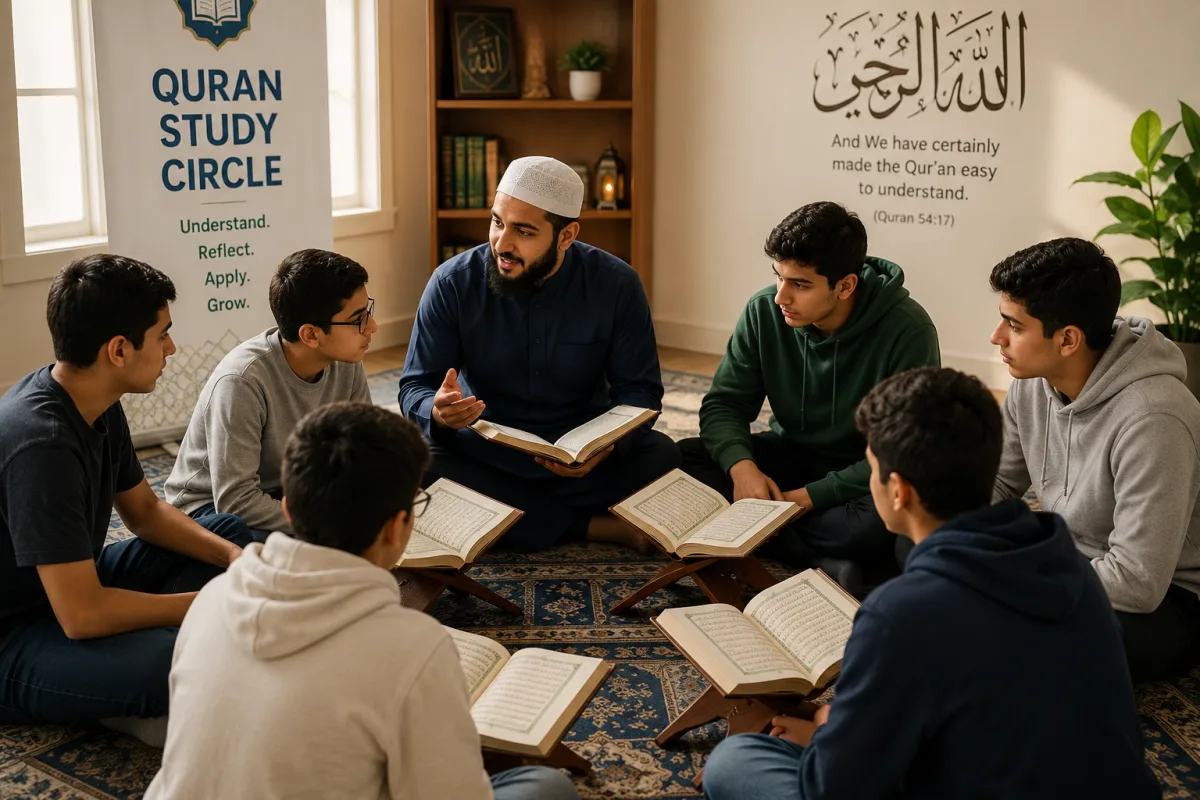
Every parent who decides to enrol their child in online Qur'an classes reaches the same crossroads sooner or later. You know, in your heart, that you want your child to build a real relationship with the Book of Allah. What you don't know yet is how to choose from the dozens of academies, teachers, and platforms all promising to help you get there. The search can feel less like a clear path and more like standing at the mouth of a maze.
This article follows one family's journey through that maze — from the first overwhelmed evening of open browser tabs to the calm rhythm of weekly lessons that finally fit. Before you read on, an honest note: the family here is illustrative. It represents the typical experience so many parents describe, woven together into one story to show you what the search really feels like. It is not a specific, real testimonial, and there are no named people or invented quotes. Think of it as a mirror held up to a common experience, not a snapshot of one household.
Why tell it as a story at all? Because choosing a Qur'an academy is rarely a tidy checklist exercise. It is emotional. It involves false starts, a lesson that goes wrong, a trial that surprises you, and the quiet relief of finally landing somewhere your child looks forward to. Allah describes His Book as something made approachable for every seeker: "And We have certainly made the Qur'an easy to remember. So is there any who will remember?" (Surah al-Qamar, 54:17). Your job as a parent is simply to find the right door in. This is the story of how a family found theirs — and what you can borrow from it for your own search.
Reading time: about 11 minutes.
Reviewed by the Tayseerul Quran Teaching Team Qualified Quran teachers helping children and adults learn Quran reading, Tajweed, Noorani Qaida, Hifz, and Arabic through one-on-one online classes.
What You'll Learn
- The Evening The Search Began
- Drowning In Options
- Deciding What Actually Mattered
- Trying The Free Trials
- The Lesson That Went Wrong
- Finding The Right Teacher
- Settling Into A Routine
- Seeing The Results
- What This Family Would Tell Other Parents
- A Teacher's Perspective
- Frequently Asked Questions
- Continue Learning
- Final Thoughts
- References
The Evening The Search Began
It usually starts small. A parent notices their eight-year-old stumbling over a short surah in Maghrib prayer, or realises the local weekend madrasah is too far, too crowded, or simply not the right fit anymore. In this family's case, it was a quiet moment after bedtime: a mother sitting with her tea, thinking that another year shouldn't pass without her children learning to read the Qur'an properly.
So she did what almost every parent does now. She opened a browser and typed something like "online Qur'an classes for kids" into the search bar. Within seconds, the screen filled with academies, adverts, glowing promises, and price comparisons. It felt productive for about ten minutes — and then it began to feel like standing in a bazaar where every stall is shouting at once.
That first evening rarely ends with a decision. It ends with a dozen open tabs, a vague sense of possibility, and a bigger question than the one she started with: out of all of these, how do I know which one is actually good for my child? If that is where you are right now, you are not behind. You are exactly at the beginning, which is precisely where every good search starts.
Drowning In Options
The second stage of the journey is the hardest, and almost nobody warns you about it. It is not a lack of options — it is a flood of them. Every academy looks polished. Every website mentions qualified teachers, flexible timings, and Ijazah-certified instructors. When everything sounds the same, comparison becomes exhausting rather than helpful.
This family spent nearly two weeks in that fog. One academy had beautiful branding but no clear information about how lessons actually worked. Another had unbeatable prices but vague answers about who would be teaching. A third seemed perfect until the trial booking form asked for payment details up front. Each new tab added information without adding clarity.
The turning point was realising that the problem wasn't the academies — it was the absence of their own criteria. They were letting each website set the terms of comparison instead of deciding, as a family, what mattered to them. A helpful frame here is to stop asking "which academy is the best?" and start asking "which academy is the best for us?" Those are completely different questions, and only the second one has an answer. Resources like our guide to the best online Qur'an academy exist precisely to help parents cut through this noise with a clear head rather than a full browser.
Deciding What Actually Mattered
Before booking a single trial, this family did something that changed everything: they sat down together and wrote out what a good fit would look like for their children, not for some imaginary ideal student. It took twenty minutes and saved them weeks.
Their list was short and honest. First, the teacher had to be patient and genuinely good with young children — knowledge alone wasn't enough. Second, lessons needed to be one-to-one, because their younger child was shy and would disappear inside a group. Third, the schedule had to survive real life: school, homework, football practice, and the occasional bad day. Fourth, the academy needed to communicate clearly with parents, not just teach behind a closed digital door.
Notice what was not on the list: the fanciest website, the lowest price, or the biggest brand. Those things are easy to measure and easy to over-weight, which is exactly why they distract so many parents. What mattered here were the harder-to-measure things — patience, attention, consistency, trust. If you would like a structured way to build your own version of this list, our choosing a Qur'an teacher checklist walks through the questions worth asking before you commit. Writing your criteria down first turns a chaotic search into a filter you can actually use.
Trying The Free Trials
Armed with their short list, the family started booking free trial lessons — and this is where the abstract search finally became concrete. A website can promise anything. A trial lesson shows you the truth in about thirty minutes.
They booked three trials over one week. The difference between reading about a teacher and watching one interact with your child in real time is enormous. In the first trial, the teacher was clearly knowledgeable but spoke over the child's head and rarely paused to check understanding. In the second, the connection was warmer, but the lesson felt disorganised, with no sense of where things were heading. The third was different in a way the parents felt before they could explain it.
A few practical lessons emerged from those trials that any parent can use. Sit in on the trial, at least for the first few minutes, and watch your child's face more than the screen. Does the teacher greet the child by name and build a little rapport before diving in? Do they adjust when the child struggles, or push ahead regardless? Do they explain to you, afterward, what they observed and what they'd work on? Free trials are not a formality to rush through. They are the single most useful tool in the entire search, and this family treated them that way. You can read more about how these sessions work in our overview of online Qur'an classes for kids.
The Lesson That Went Wrong
No honest search story is all smooth progress, and this one had a genuine misstep. After the trials, the family very nearly chose the wrong academy — and for a few weeks, they did.
They picked an option that looked excellent on paper. Good credentials, reasonable price, convenient timing. But within a month, a quiet problem surfaced. The lessons were technically correct yet emotionally flat. The teacher was competent but interchangeable — lessons were sometimes covered by a different instructor with no warning, so the child never built a real relationship with anyone. Their shy younger one began finding reasons to skip class. The spark they had hoped for simply wasn't there.
It would have been easy to blame the child, or to conclude that online learning "just doesn't work for us." Instead, the parents paid attention to what the poor fit was teaching them. Consistency of teacher matters enormously for children — the bond between student and teacher is often what carries a child through the hard, repetitive early stages of learning to read. A rotating cast of competent strangers cannot build that bond. This is one of the most common regrets parents describe, and it is worth reading through a choosing a Qur'an academy FAQ to see how often the same avoidable issues come up. The wrong fit is not a failure. It is expensive information — but only if you act on it. This family did, and they moved on.
Finding The Right Teacher
When they returned to their short list and revisited that third trial — the one that had felt different — they finally understood why it had stood out. It wasn't the technology or the price. It was the teacher.
The right teacher, they realised, did a handful of small things consistently. She learned what each child loved and used it to keep them engaged. She celebrated tiny wins — a correctly pronounced letter, a verse recalled from memory — with real warmth, so progress felt like something to be proud of rather than a chore to endure. She was firm about the fundamentals of correct recitation while being gentle about the pace, understanding that a child who enjoys the lesson will come back tomorrow, and the one who dreads it will not.
Crucially, she was the same teacher every week. Continuity let her build on the last lesson instead of restarting, and it let the children trust her. This is the quiet engine behind almost every successful Qur'an learning story: not a perfect curriculum or a flashy platform, but a consistent, caring, qualified teacher who knows your child. Allah instructs us to recite the Qur'an "with measured recitation" (Surah al-Muzzammil, 73:4) — slowly, carefully, correctly — and that kind of careful recitation is best transmitted person-to-person, from a teacher who is present and patient. If there is one thing to over-invest your attention in during your search, it is the teacher.
Settling Into A Routine
Choosing the right academy was not the end of the journey — it was the start of the part that actually produces results. What turned a good choice into real progress was routine.
The family fixed lesson times that worked with the rhythm of their week: two short sessions rather than one long one, scheduled after school snack and rest but before the evening got chaotic. Consistency of timing mattered as much as consistency of teacher. When lessons happened at the same time on the same days, they stopped being an event to negotiate and became simply "what we do on Tuesdays and Thursdays."
They also learned to protect the routine gently. Some days a child was tired or distracted, and the teacher adapted — a lighter review lesson instead of new material, so momentum was never lost entirely. The parents played their part too: a few minutes of encouragement before class, a genuine "show me what you learned" afterward, and no phones nearby during the lesson. None of this was dramatic. That is the point. Steady beats intense. A calm, repeatable weekly rhythm did more for this family than any burst of enthusiasm ever could. If you are weighing up formats and frequency, our guide to online Qur'an classes lays out how different schedules tend to work in practice.
Seeing The Results
The results didn't arrive as a single dramatic breakthrough. They arrived the way most meaningful growth does — quietly, and then all at once.
Within a couple of months, the parents noticed their older child reading a passage in prayer with a confidence that hadn't been there before. The younger one, who had once hidden from group settings, started asking to show relatives what they had learned. Letters that used to be guessed at were now recognised instantly. Small corrections the teacher had made weeks earlier had become habits. The children weren't just completing lessons; they were building a relationship with the Qur'an.
Just as important as the reading skill was the change in attitude. Class stopped being something imposed and became something owned. That shift — from obligation to affection — is the real prize, and it is almost impossible to force. It grows naturally when the fit is right: the right teacher, the right pace, a steady routine, and parents who cheer from the sidelines without hovering. The academic progress was wonderful. The love for the process was priceless. And none of it would have happened if the family had settled for the first competent-but-flat option they nearly chose.
What This Family Would Tell Other Parents
If you could sit this family down and ask them what they wish they'd known at the start, their advice would be refreshingly practical.
First, decide what matters to you before you start comparing academies, or you'll drown in features that look important but aren't. Second, treat free trials as your most valuable tool — book several, watch closely, and don't rush the decision. Third, weight the teacher above almost everything else, and insist on the same teacher every week; continuity is not a luxury, it is the mechanism. Fourth, don't panic if your first choice turns out to be wrong. A poor fit is normal, it is fixable, and it teaches you what to look for next. Fifth, once you've chosen well, protect the routine more fiercely than you protect the enthusiasm — steady attendance beats occasional intensity every time.
Above all, they would tell you to trust the process and be patient with your child. Learning to read the Qur'an well is not a race. It is a relationship built lesson by lesson, week by week. The maze of options at the start feels overwhelming, but it does have an exit, and every patient step you take brings your child closer to the Book of Allah. That is a journey worth taking slowly and getting right.
A Teacher's Perspective
From the other side of the screen, teachers see this same story play out with family after family — and there are patterns worth sharing with parents standing at the start of their own search.
The single biggest predictor of a child's progress is rarely raw talent; it is the stability of the learning relationship. When a child works with the same qualified teacher over time, the teacher can build a genuine picture of that child: which letters they find slippery, when their attention fades, what makes them light up. That accumulated understanding is what allows real teaching to happen, rather than a series of disconnected lessons. It is also why our teachers deliberately keep classes one-to-one and consistent — not as a marketing feature, but because it is how children actually learn to recite well.
The Prophet ﷺ said, "The best of you are those who learn the Qur'an and teach it" (Sahih al-Bukhari 5027). For us, teaching is not simply delivering a syllabus; it is a trust (amanah) to nurture a child's connection to the Qur'an with patience and care. That is why we encourage parents to look past the surface — the branding, the lowest price, the flashiest platform — and toward the things that genuinely shape a child's learning: the teacher's patience, the consistency of the relationship, and clear communication with you, the parent. For questions of religious ruling or matters specific to your family's situation, we always encourage consulting a qualified scholar. But for the practical question of how to choose well, the honest answer is the one this whole story points to: find a caring, qualified teacher your child can grow with, and then give the relationship time.
Frequently Asked Questions
How many academies should I try before choosing?
There is no fixed number, but most families find clarity after two to four trial lessons. The goal is not to sample every option available — it is to try enough that you can feel the difference between a mediocre fit and a good one. Once you've written down your own criteria, you'll often recognise the right teacher faster than you expect.
Is a free trial really enough to judge a teacher?
A single trial won't tell you everything, but it tells you the most important things quickly: whether the teacher connects with your child, whether they explain clearly, and whether your child seems comfortable. Watch your child's engagement during the session more than any credential on the website. First impressions in a trial are surprisingly reliable indicators of the weeks that follow.
What if my child dislikes the first academy we choose?
This is common and completely fixable. A poor fit usually reveals itself within a few weeks — reluctance to attend, flat lessons, or a rotating cast of teachers. Rather than concluding that online learning doesn't suit your child, treat it as useful information about what to look for next, and don't hesitate to switch. The right fit changes everything.
Does it matter if my child has a different teacher each lesson?
For most children, yes, it matters a great deal. Continuity lets a teacher build on previous lessons and lets your child form a trusting relationship that carries them through the harder stages of learning. If an academy cannot guarantee a consistent teacher, treat that as a meaningful drawback, especially for younger or shyer children.
How important is price when choosing an academy?
Price matters, but it should rarely be your first filter. The cheapest option can become expensive if your child stalls or disengages, and the most expensive is not automatically the best. Decide what a good fit looks like first, then find the option within your budget that meets those criteria. Value is about outcomes, not just the monthly figure.
How long before we see real progress?
Most families notice meaningful change within one to three months of consistent lessons — steadier reading, more confidence, and a warmer attitude toward class. Progress tends to arrive quietly and then accelerate. The key ingredients are a good teacher, an appropriate pace, and a routine you protect week after week.
Should I sit in on my child's lessons?
Sitting in for the first few minutes, especially early on, is genuinely helpful — you learn how the teacher works and your child feels supported. Over time, most children do best with a little independence during the lesson itself, while you stay involved through encouragement before and a genuine "show me what you learned" afterward.
Continue Learning
- Best online Qur'an academy
- Choosing a Qur'an teacher checklist
- Choosing a Qur'an academy FAQ
- Online Qur'an classes for kids
- Online Qur'an classes
Final Thoughts
Every family's search for the right Qur'an academy looks a little different, but the shape of the journey is remarkably consistent: the overwhelm at the start, the flood of similar-looking options, the clarifying power of writing down what matters, the truth revealed in a trial lesson, the occasional wrong turn, and finally the quiet relief of landing somewhere that fits. The family in this story is illustrative, but the path they walked is one you can walk too — and you can walk it with far less anxiety now that you know the terrain.
Be patient with the process and patient with your child. The goal was never simply to complete a course; it was to open a door to a lifelong relationship with the Book of Allah. That door is closer than the overwhelming first evening of searching makes it feel. Start with your own criteria, try a lesson, watch closely, and trust what you see. The right teacher is out there, and your child's journey with the Qur'an is worth every careful step it takes to begin well.
Begin your own search with a free trial →
References
- Sahih al-Bukhari 5027
- Surah al-Qamar (54:17)
- Surah al-Muzzammil (73:4)