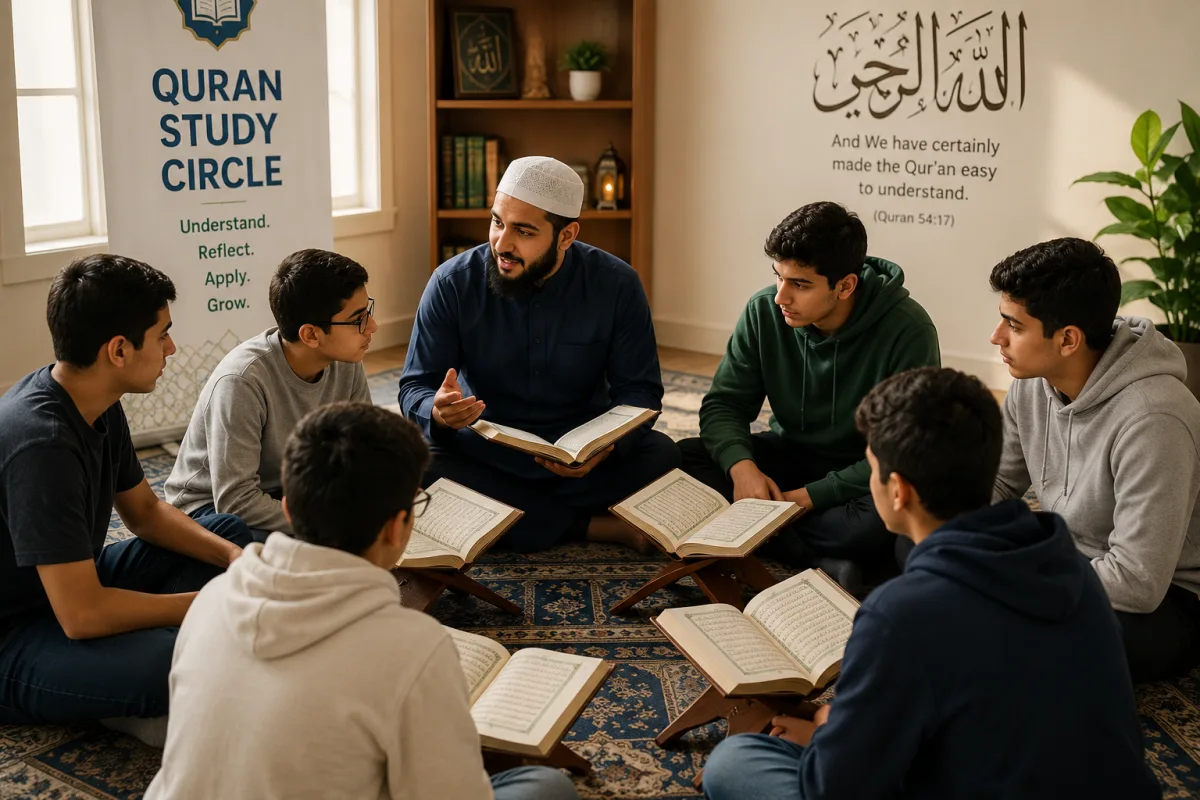
Have you ever stood in prayer, moving your lips through familiar words, and wished — really wished — that you understood what you were saying? For millions of Muslims around the world, the Qur'an is recited daily, memorised in part, and loved deeply, yet its meaning stays just out of reach behind the veil of a language they never learned. If that describes you, you are not alone, and you are not too late.
This article follows a learning Quranic Arabic journey from the very first day to the moment the words begin to open up and speak. Before you read further, one honest note: the story below is an illustrative, representative journey, not the biography of one specific person. There is no named student here and no invented quotes. Instead, this is a composite of the path that adult beginners commonly walk — the doubts, the small wins, the plateaus, and the breakthroughs — drawn together so you can see yourself somewhere in it. Your own road will have its own pace and its own texture, but the landmarks are remarkably consistent.
Why Arabic at all? The Qur'an itself gives the reason. As Allah says in Surah Yusuf: "Indeed, We have sent it down as an Arabic Qur'an that you might understand." (12:2). The language is not an accident or an obstacle; it is part of how the message was designed to be received. Learning even a little of it changes prayer from recitation into conversation.
So let us walk the road together, one honest step at a time.
Reading time: about 11 minutes.
Reviewed by the Tayseerul Quran Teaching Team Qualified Quran teachers helping children and adults learn Quran reading, Tajweed, Noorani Qaida, Hifz, and Arabic through one-on-one online classes.
What You'll Learn
- Where The Journey Begins The Starting Motivation
- The First Months Learning To Read The Letters
- Building Your First Vocabulary
- The Moment You Recognise Words In Salah
- When Basic Grammar Starts To Click
- Reading The Qur'an Alongside A Translation
- Setbacks Plateaus And Quiet Discouragement
- What Actually Makes The Difference
- A Teacher's Perspective
- Frequently Asked Questions
- Continue Learning
- Final Thoughts
Where The Journey Begins The Starting Motivation
Almost everyone who sets out to understand the Qur'an in Arabic begins at the same quiet place: a feeling. Perhaps it arrives during Ramadan, when the reciter's voice fills the mosque and you sense that something profound is passing you by. Perhaps it comes after a difficult season of life, when you turn to the Book for comfort and realise you are relying entirely on a translation. Perhaps it is simply the growing awareness that you speak to Allah five times a day in words you cannot fully explain.
That feeling is the true starting point, and it matters more than any textbook. Motivation rooted in love and longing lasts far longer than motivation rooted in guilt or pressure. The Qur'an describes itself as accessible: "And We have certainly made the Qur'an easy to remember." (54:17). That verse is often quoted about memorisation, and it carries a gentle encouragement for every learner — the door was made to be opened.
At this stage, most beginners feel two things at once: excitement and intimidation. The Arabic script looks ornate and unfamiliar. The grammar has a reputation for difficulty. And there is often an inner voice whispering that you should have started as a child. Set that voice aside. Adults bring focus, patience, and clear reasons that many children simply do not have. The journey rewards the committed far more than the naturally gifted.
The First Months Learning To Read The Letters
Understanding begins with reading, and reading begins with the letters. In the first weeks, your work is deceptively simple: learn the twenty-eight Arabic letters, how their shapes change at the beginning, middle, and end of a word, and how the short vowel marks — the fatha, kasra, and damma — tell you how to pronounce them.
This is the stage where a structured foundation like the Noorani Qaida proves its worth. The Qaida breaks the script into small, ordered steps so that nothing overwhelms you. You practise joining letters into syllables, then syllables into words, long before you worry about meaning. It feels mechanical at first — and that is exactly right. Fluent reading has to become close to automatic before comprehension can sit on top of it.
Expect the first month to feel slow. Many learners can sound out short words by week three or four, but with hesitation. By the end of the second or third month, the letters stop looking like decoration and start looking like language. A word you once had to decode letter by letter is suddenly just there, read in a single glance. That shift — from decoding to reading — is the first real milestone, and it is worth celebrating quietly when it comes.
Consistency matters here far more than intensity. Fifteen honest minutes a day will carry you further than a rushed two-hour session once a week. If you would like a realistic week-by-week map of this stage and the ones that follow, our Quranic Arabic study plan lays it out gently.
Building Your First Vocabulary
Once reading becomes comfortable, meaning can begin. The good news about Qur'anic vocabulary is that it is beautifully repetitive. A relatively small set of words appears again and again across the text. Learn the most frequent few hundred, and you will start recognising a large share of what you read — not every word, but enough to follow the thread.
Most learners begin with words they already half-know from prayer and daily life. Think of rabb (Lord), rahmah (mercy), kitab (book), yawm (day), nas (people), and nur (light). These are not obscure terms; they are the load-bearing pillars of the Qur'an's message, and you have heard them thousands of times. Attaching a confirmed meaning to a familiar sound is one of the most satisfying moments in the whole journey.
A word of caution that your teacher will echo often: do not guess meanings. Arabic is precise, and a single root can branch into shades of meaning that a beginner cannot yet see. Learn each word from a reliable source or a qualified teacher rather than assuming, and never invent a translation to fill a gap. Building vocabulary slowly and correctly is far better than building it quickly and wrongly.
If you want a fuller picture of how vocabulary fits alongside grammar and reading, our guide to learning Quranic Arabic online walks through how the pieces support one another over time.
The Moment You Recognise Words In Salah
For most learners, this is the moment the whole journey suddenly feels worth it. You are standing in prayer, reciting a surah you have said countless times, and a word you studied last week lights up. You understand it — right there, in the middle of salah, without translating in your head. It is a small thing and an enormous thing at once.
This experience tends to arrive earlier than people expect, often within the first few months, precisely because the prayers reuse the same core vocabulary. Al-Fatiha alone contains words like rabb, rahman, rahim, din, and sirat that you will meet across the entire Qur'an. When those words shift from sound to meaning, your prayer changes. You are no longer performing a memorised sequence; you are speaking, and understanding what you speak.
Prayer, after all, is meant to be recited with care and presence. Allah instructs: "And recite the Qur'an with measured recitation." (73:4). Slow, deliberate recitation is not only about beauty of sound — it gives your mind the space to register meaning, one phrase at a time. Learners often find that as their comprehension grows, they naturally slow down, and their concentration deepens.
Do not underestimate how motivating this stage is. Many people who felt like giving up during the mechanical early weeks find fresh energy the first time salah comes alive. Keep going until you reach it; it changes everything.
When Basic Grammar Starts To Click
Vocabulary tells you what the words mean. Grammar tells you how they relate — who is doing what to whom, when, and in what manner. For a long time, grammar is the part beginners dread most. And then, often quite suddenly, it starts to click.
The early wins in Arabic grammar are wonderfully practical. You learn to recognise pronouns attached to the ends of words — the difference between rabbi (my Lord), rabbuka (your Lord), and rabbuhu (his Lord). You begin to spot the difference between a command and a statement, between singular and plural, between past and present. None of this requires memorising a thousand rules at once. It comes in small, usable pieces.
What makes grammar click is seeing it work in real verses rather than in isolated tables. When a teacher shows you a familiar ayah and points out why one word ends the way it does, the rule stops being abstract. You have met that pattern before; now you have a name for it. From that point, every page you read quietly reinforces what you have learned.
Patience is essential here. Grammar is the stage where learners most often compare themselves to others and feel behind. Resist that. The patterns settle at their own pace, and once a pattern settles, it stays. Trust the accumulation.
Reading The Qur'an Alongside A Translation
By now you can read fluently, you recognise a growing bank of words, and you understand basic sentence structure. This is where a beautiful new practice becomes possible: reading the Arabic directly and checking yourself against a trusted translation, rather than reading the translation and hoping the Arabic matches.
The method is simple and powerful. Read a short passage in Arabic first. Try to catch the words and the general sense on your own. Then look at a reliable translation to confirm what you understood and to fill in what you missed. Over weeks, the gap between your first reading and the translation narrows. You start needing the translation less for the easy verses and saving it for the harder ones.
This is also the stage to be humble and careful. A translation is an interpretation, and the meanings of the Qur'an carry depth that no single rendering fully captures. When you encounter a verse that seems to touch on a ruling, a point of belief, or anything with practical consequences, do not settle it from your own beginner reading. Ask a qualified scholar. Your growing Arabic is a key that opens the door; it does not make you the authority on what lies behind it.
Read like this consistently and something lovely happens: the Qur'an stops feeling like a locked text you approach through a translator and starts feeling like a book you can sit with directly, even if you still lean on help. That shift in relationship is the real goal of the whole endeavour.
Setbacks Plateaus And Quiet Discouragement
No honest account of this journey would be complete without the hard parts. Every learner hits them. There will be weeks when nothing seems to stick, when you forget vocabulary you were sure you knew, when grammar that made sense on Monday is fog again by Friday. There will be seasons when life gets busy and your practice slips, and then the guilt of slipping makes it harder to return.
These plateaus are not signs of failure. They are a normal part of how the human mind absorbs a language. Learning is rarely a smooth upward line; it is a staircase with long flat stretches followed by sudden steps up. The flat stretches are where consolidation happens quietly, out of sight. Learners who understand this keep showing up during the plateau, and they are the ones who reach the next step.
The most dangerous moment is not the plateau itself but the discouragement that comes with it — the whisper that says you are simply not capable, that you started too late, that others learn faster. Almost every serious learner hears this voice. The ones who succeed are not the ones who never hear it; they are the ones who keep going anyway, in small, forgiving steps.
Practical help matters here too. Shorten your sessions rather than skipping them entirely. Return to easy material to rebuild confidence. And lean on a teacher who can see your progress from the outside when you cannot feel it from within. Which brings us to the single factor that most reliably separates those who finish from those who fade.
What Actually Makes The Difference
If you gathered a room of people who succeeded at understanding the Qur'an in Arabic and asked what carried them through, you would hear the same few answers again and again. None of them is a secret, and none depends on being unusually clever.
The first is consistency over intensity. Small daily practice beats occasional marathons every single time. The mind builds language through repeated, spaced contact, not through cramming.
The second is a structured path. Learners who follow an ordered sequence — reading, then vocabulary, then grammar, each building on the last — progress far more smoothly than those who jump around. Structure removes the exhausting question of "what do I do today?" and lets you spend your energy on learning itself.
The third is guided one-to-one teaching. A qualified teacher corrects your pronunciation before bad habits set in, answers your questions in the moment, adjusts the pace to you specifically, and — crucially — keeps you accountable and encouraged through the plateaus. Self-study can carry you a distance, but a good teacher shortens the road and steadies you on it. This is exactly why one-on-one online Quran classes suit adult learners so well: the whole lesson is built around you.
The fourth, quietly underneath all the others, is sincerity of intention. When your goal is to draw closer to Allah through His words, the difficult days carry meaning, and meaning sustains effort in a way that willpower alone cannot.
A Teacher's Perspective
From the teaching side, a few truths stand out that beginners rarely believe about themselves at the start.
Teachers see, over and over, that adult learners routinely underestimate what they can achieve. Students who arrive certain they are "bad at languages" reach fluency in reading within months when they simply keep at it under guidance. The barrier is almost never ability; it is consistency and confidence, and both can be built.
Teachers also see the value of correcting small things early. A pronunciation habit or a misread letter, left unaddressed, hardens over time and becomes far harder to fix later. One of the deepest reasons this tradition has always been taught mouth-to-mouth, teacher to student, is faithful transmission. It is worth remembering that the Qur'an was itself received and taught directly: the Prophet ﷺ said, "The best among you are those who learn the Qur'an and teach it." (Sahih al-Bukhari 5027). Learning in a living relationship with a teacher is not merely convenient — it is the way this knowledge has always been passed down.
Finally, teachers will always remind you of the limits of your own study. Growing Arabic is a gift that lets you taste the Qur'an directly, and that is precious. But questions of law, creed, and interpretation belong to trained scholars. A humble learner who reads the Arabic and defers on rulings is on far safer ground than a confident beginner who does not. Keep learning, keep reading — and keep asking those who know.
Frequently Asked Questions
How long does it take to start understanding the Qur'an in Arabic?
Most learners can read the script fluently within a few months of consistent practice and begin recognising common words in prayer soon after. Understanding whole passages with a translation typically develops over a year or more, depending on how regularly you study. There is no fixed finish line — comprehension keeps deepening for as long as you keep learning.
I'm an adult with no background in Arabic. Is it too late for me?
Not at all. Adults bring focus, clear motivation, and discipline that often outweigh the natural absorption of childhood. Teachers regularly see beginners in their thirties, forties, fifties, and beyond reach comfortable reading fluency. The only real requirement is consistency, and that is fully within your reach.
Do I need to memorise the whole Qur'an to understand it?
No. Understanding and memorisation are related but separate goals. You can build strong comprehension of the Arabic without being a hafiz, and many learners do exactly that. Some choose to pursue Hifz alongside understanding, but it is not a prerequisite for meaning.
Should I learn to read first or study meaning first?
Reading first, in almost every case. Fluent reading needs to become close to automatic before comprehension can rest on top of it. A structured foundation such as the Noorani Qaida establishes that reading ability, and vocabulary and grammar follow naturally afterward.
How much time should I set aside each day?
Consistency matters more than duration. Fifteen to thirty focused minutes a day, most days, will take you further than a single long session once a week. Short, regular contact is how the mind builds language, so protect a small daily slot rather than waiting for large blocks of free time.
Can I understand the Qur'an using only a translation?
A translation gives you access to the meaning, and it is a genuine blessing. But every translation is an interpretation, and it cannot carry the full precision and depth of the Arabic. Learning the language lets you engage the words directly and appreciate nuances no single rendering conveys. For rulings and matters of interpretation, always consult a qualified scholar rather than relying on your own reading.
What if I keep hitting plateaus and losing motivation?
Plateaus are normal and expected — they are where quiet consolidation happens. Shorten your sessions rather than stopping, revisit easy material to rebuild confidence, and lean on a teacher who can see the progress you cannot feel. Almost everyone who succeeds has pushed through these stretches; they are a stage of the journey, not the end of it.
Continue Learning
- Learn Quranic Arabic online: a complete beginner's guide
- A realistic Quranic Arabic study plan
- Noorani Qaida online: building your reading foundation
- Quranic Arabic FAQ: your questions answered
- Online Quran classes: how one-to-one learning works
Final Thoughts
The journey from reciting words you cannot explain to understanding them directly is real, it is walkable, and it is open to you no matter your age or your starting point. It will not be a straight line. There will be slow weeks, forgotten vocabulary, and days when the whisper of "too late" grows loud. But there will also be the morning a word lights up in your prayer, the afternoon a grammar pattern finally clicks, and the quiet evening you read a verse in Arabic and understand it before you reach for the translation.
The Qur'an was sent in Arabic so that you might understand it. That invitation is extended to you, personally, today. Take the first small step, keep showing up, and lean on a teacher who can steady you through the hard stretches. The words are waiting to open — and with patience and sincerity, they will.
Start your own Quranic Arabic journey — book a free trial →
References
- Surah Yusuf (12:2): "Indeed, We have sent it down as an Arabic Qur'an that you might understand."
- Surah al-Qamar (54:17)
- Surah al-Muzzammil (73:4)
- Sahih al-Bukhari 5027