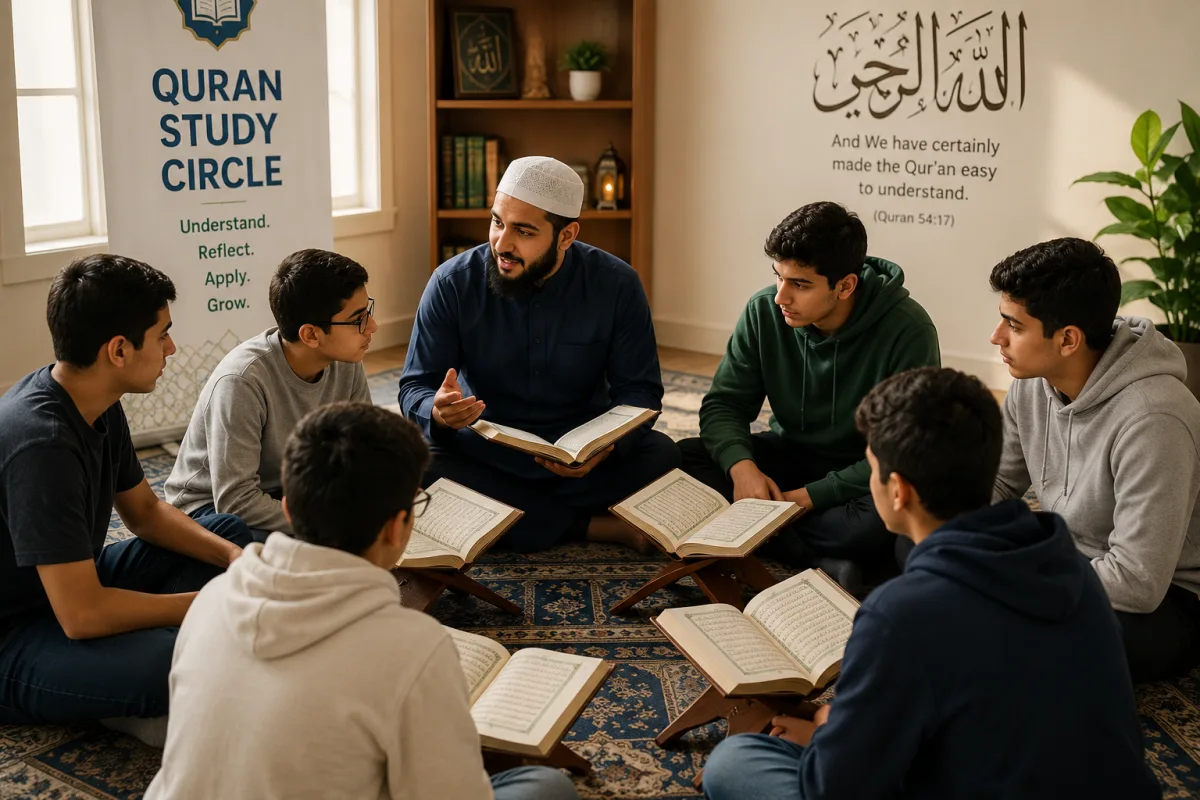
If you have ever tried to learn Arabic and felt confused by conflicting advice, you are not alone. One teacher tells you to study Modern Standard Arabic. A friend swears you need a dialect to actually talk to people. And somewhere in the middle of all this, your real goal — understanding the words of the Qur'an in your prayer and recitation — seems to get lost. So which Arabic do you actually need?
The honest answer is that "Arabic" is not a single, uniform thing. It is more like a family of closely related varieties that share the same roots but serve different purposes. The Qur'an itself is explicit about the language it was revealed in: "Indeed, We have sent it down as an Arabic Qur'an that you might understand" (Surah Yusuf, 12:2). That verse points to something important — the Arabic of the Qur'an was meant to be understood, and understanding it is a goal worth pursuing on its own terms.
This article gives you a clear, accurate comparison of three things people mean when they say "Arabic": Quranic (Classical) Arabic, Modern Standard Arabic (MSA), and the colloquial dialects spoken across the Arab world. We will look at what each one is, how they relate to one another, where they overlap and where they differ, and — most usefully — which one to learn depending on your goal. If your heart is set on understanding the Qur'an, you will finish this article knowing exactly where to focus.
Reading time: about 11 minutes.
Reviewed by the Tayseerul Quran Teaching Team Qualified Quran teachers helping children and adults learn Quran reading, Tajweed, Noorani Qaida, Hifz, and Arabic through one-on-one online classes.
What You'll Learn
- Why Arabic Is Not Just One Language
- What Is Quranic Classical Arabic
- What Is Modern Standard Arabic MSA
- What Are the Colloquial Dialects
- How the Three Relate to One Another
- Where They Overlap and Where They Differ
- Which One Should You Learn for Your Goal
- Do You Need MSA to Understand the Quran
- A Realistic Path for Quran-Focused Learners
- Why a Qualified Teacher Makes the Difference
Why Arabic Is Not Just One Language
When people say "I want to learn Arabic," they often imagine a single language the way English or French feels like a single language. Arabic is a little different. It exists as a spread of related varieties that sit along a spectrum, from the highly formal and literary at one end to the everyday and spoken at the other.
Think of it this way. There is a shared, formal register used for writing, religious texts, and formal speech that is broadly understood across the Arab world. And there are regional spoken varieties that people actually use at home, in the market, and with friends — and these differ from country to country. Both are genuinely Arabic. Neither is "wrong." They simply do different jobs.
This is not unusual among world languages, but it does matter for planning your study. The Arabic that unlocks the Qur'an is not the same starting point as the Arabic that helps you order coffee in Cairo. Knowing the map before you set out saves you months of studying the wrong thing.
What Is Quranic Classical Arabic
Quranic Arabic — also called Classical Arabic — is the Arabic of the Qur'an, the Hadith literature, and the great classical works of Islamic scholarship, poetry, and law written over the centuries. It is the language in which the Qur'an was revealed and in which it has been recited and preserved, unchanged, for more than fourteen hundred years.
Classical Arabic is precise, rich, and eloquent. Its grammar is fully articulated, including case endings and vowel patterns that give the language its rhythm and clarity. The Qur'an describes its own recitation with care: it instructs the believer to "recite the Qur'an with measured recitation" (Surah al-Muzzammil, 73:4), which is one of the foundations of the science of Tajweed. And the Qur'an twice describes itself as made accessible for remembrance in Surah al-Qamar (54:17), a reassurance that this language, however deep, was made reachable for those who sincerely seek it.
For a learner, "Quranic Arabic" usually means a focused study: the vocabulary that appears most often in the Qur'an, the grammar needed to parse verses, and the ability to connect what you recite to what it means. It is a targeted path with a clear destination — understanding the Book of Allah.
What Is Modern Standard Arabic MSA
Modern Standard Arabic, usually abbreviated MSA, is the modern formal standard used across the Arab world for writing and formal speech. It is the Arabic of newspapers, books, official documents, television news, academic writing, and formal speeches. If a Moroccan journalist and an Iraqi journalist write articles for a pan-Arab publication, they write in MSA, and readers everywhere understand them.
MSA is directly descended from Classical Arabic and remains very close to it, especially in grammar. The core grammatical system — the verb patterns, the noun cases, the sentence structure — is essentially shared. The main differences are in vocabulary and usage: MSA has developed modern words for modern things (technology, science, politics, contemporary life) and tends to be used in slightly more streamlined ways than the ornate classical style. But a person who knows MSA well can read classical texts with far less difficulty than a complete beginner, and vice versa.
In short, MSA is not a separate language from Classical Arabic. It is the same standard language in its modern, working form. This is good news for anyone who wonders whether studying one helps with the other — it very much does.
What Are the Colloquial Dialects
The colloquial dialects — often called the "spoken" or "everyday" Arabic — are the varieties people actually speak in daily life. Egyptian Arabic, Levantine Arabic (Syria, Lebanon, Palestine, Jordan), Gulf Arabic, Iraqi Arabic, and the various North African dialects (Maghrebi) are all examples. These are the mother tongues that Arabic speakers grow up with and use with family and friends.
Dialects differ from region to region in pronunciation, everyday vocabulary, and some grammatical shortcuts. A speaker of one dialect can often understand another with some effort, especially neighboring ones, but distant dialects can be genuinely hard for each other at first. Crucially, dialects are mostly spoken rather than written — when Arabs write formally, they switch to MSA.
Dialects are wonderful and alive, and if your goal is conversation, travel, or living in a particular country, a dialect is exactly what you need. But it is worth being clear: no single dialect is the language of the Qur'an. The Qur'an is in Classical Arabic, and dialects, while related, are not a substitute for it when your aim is Quranic understanding.
How the Three Relate to One Another
Picture a family tree. Classical Arabic sits near the root — the older, foundational form preserved in the Qur'an and classical literature. MSA grows directly from that root as its modern standardized continuation, keeping the same grammatical backbone while updating the vocabulary for contemporary life. The dialects branch off as the living spoken varieties, each shaped by region, history, and daily use.
Because MSA and Classical Arabic share the same grammar and a huge amount of vocabulary, they are best thought of as two registers of one written standard rather than two different languages. The dialects, by contrast, diverge more — mainly in speech and everyday words — while still drawing heavily on the same underlying Arabic roots. An Arab child typically grows up speaking a dialect at home and then learns MSA at school, which is why educated speakers move comfortably between the two.
For a learner, the practical takeaway is this: studying the formal standard (Classical or MSA) builds the foundation that connects to the Qur'an and to the written world. Studying a dialect builds conversational fluency in one region. They reinforce each other in some ways, but they answer different questions.
Where They Overlap and Where They Differ
Let us be precise, because this is where a lot of confusion happens. The overlaps are large and real. All three varieties share the same alphabet, the same core root system (the three-letter roots that generate related words), and a great deal of common vocabulary. Many everyday words — for water, book, house, mother, father — are recognizable across Classical Arabic, MSA, and most dialects. Someone who learns to read Arabic script and builds core vocabulary is building an asset that helps everywhere.
The differences fall into a few categories. Classical Arabic and MSA keep the full formal grammar, including case endings, while dialects tend to simplify or drop some of these features in speech. Dialects develop their own everyday words, pronunciations, and expressions that vary by region. And MSA adds modern vocabulary that Classical Arabic did not need.
Between Classical Arabic and MSA specifically, the differences are modest and mostly a matter of vocabulary and style rather than fundamental structure. Between the formal standard and the dialects, the differences are larger and centered on everyday speech. Understanding this map prevents a common mistake — assuming that because you learned a dialect, you have learned the language of the Qur'an. The related grammar helps, but Quranic understanding needs its own focused study. You can read more in our overview of Quranic Arabic.
Which One Should You Learn for Your Goal
Here is the part that actually helps you decide. Start with your goal, and the choice becomes clear.
If your goal is to understand the Qur'an — to know what you recite in prayer, to follow the meaning of verses, to grow closer to the Book through its own words — then Quranic (Classical) Arabic is your path. You do not need to master modern news vocabulary or a regional dialect first. You need focused Quranic vocabulary and the grammar that lets you parse verses.
If your goal is to read widely across the modern Arab world — news, literature, formal writing — or to study or work in an Arabic-speaking professional setting, then MSA is the natural choice, and it will also give you a strong bridge toward Classical texts.
If your goal is everyday conversation in a specific country — travel, family ties, living somewhere — then the local dialect is what you want, ideally alongside some MSA for reading and formal situations.
Many learners actually have a blended goal, and that is fine. But naming your primary goal first keeps you from spreading yourself thin. For Quran-focused learners, our Quranic Arabic study plan lays out a realistic route from where you are now.
Do You Need MSA to Understand the Quran
This is one of the most common questions, and the honest answer is nuanced. You do not need to complete a full MSA program before you can start understanding the Qur'an. Because Quranic Arabic and MSA share the same grammar, studying MSA does help — but it is not a required detour, and it is not the most direct route.
The most efficient path for Quranic understanding is to study Arabic through the Qur'an itself: learning the grammar as it appears in verses, and prioritizing the vocabulary that occurs most frequently in the text. This keeps every lesson connected to your actual goal, which is deeply motivating and far faster than working through general MSA material and hoping it transfers.
That said, if you already know MSA, you have a real head start — much of your grammar carries over directly, and you will find Quranic study more approachable. And if you later want to expand into MSA for other reasons, your Quranic foundation will help there too. The relationship runs both ways. But for someone whose heart is set on the Qur'an, the shortest, warmest road is a Quran-centered course of study. Our answers to common Quranic Arabic questions address this in more detail.
A Realistic Path for Quran-Focused Learners
If understanding the Qur'an is your aim, here is a sensible order that many adult learners follow. First, make sure your reading is solid. Before meaning comes accurate reading, and that begins with the Arabic letters and their sounds. A structured foundation like Noorani Qaida teaches you to read the script correctly and lays the groundwork for proper pronunciation and Tajweed.
Second, build core Quranic vocabulary. A relatively small set of words accounts for a large share of what you will encounter in the text, so early wins come quickly when you focus on high-frequency words rather than trying to learn everything at once.
Third, learn grammar through verses, not in isolation. When you see a grammatical rule working inside a verse you already recite, it sticks — and it immediately deepens your recitation. Pair this with continued attention to Tajweed, remembering the Qur'anic instruction to recite "with measured recitation" (73:4).
Fourth, be patient and consistent. Short, regular sessions beat occasional long ones. Steady weekly progress with a teacher who can correct you gently and keep you on track is worth more than sporadic bursts of effort. Many learners combine this Arabic study with their regular recitation practice in online Quran classes, so meaning and reading grow together.
Why a Qualified Teacher Makes the Difference
You can find endless free material online, but Arabic — and especially Quranic Arabic — is a language where accuracy matters enormously. A mispronounced letter can change a word. A misunderstood grammatical ending can shift a meaning. And because this is the language of revelation, we owe it care and precision. This is exactly where a qualified, experienced teacher becomes invaluable.
A good teacher does several things a video or app cannot. They listen to you and correct your pronunciation in real time, so mistakes do not become habits. They pace lessons to your goal — keeping a Quran-focused learner on the Quran-focused path rather than getting lost in unrelated vocabulary. They explain grammar in plain language and connect it directly to verses you care about. And they answer your questions with the sensitivity this subject deserves.
On matters of Islamic rulings — questions about worship, practice, or law that go beyond language — the right response is always to ask a qualified scholar, and a good teacher will happily point you toward one rather than guessing. That honesty is part of trustworthy teaching. At Tayseerul Quran, our one-to-one online classes are built around exactly this kind of careful, personalized, human instruction, so that adult learners anywhere in the world can understand the Qur'an with confidence and care.
Frequently Asked Questions
Is Quranic Arabic the same as Modern Standard Arabic?
They are very closely related but not identical. Quranic (Classical) Arabic is the older, foundational form found in the Qur'an and classical texts. MSA is its modern standardized continuation, sharing essentially the same grammar while adding contemporary vocabulary. Knowing one makes the other much easier.
If I learn a dialect, will I understand the Qur'an?
Not directly. Dialects share roots and some vocabulary with Classical Arabic, so a dialect gives you a small head start, but the Qur'an is in Classical Arabic with full formal grammar. Understanding the Qur'an needs its own focused study, even if you already speak a dialect fluently.
Do I need to master MSA before studying Quranic Arabic?
No. Because they share grammar, MSA helps, but it is not a required first step. The most direct route to Quranic understanding is to study Arabic through the Qur'an itself, learning grammar and high-frequency vocabulary as they appear in the verses.
Which Arabic should I learn if I want to talk to people?
For everyday conversation in a specific country, learn that region's dialect, ideally with some MSA for reading and formal settings. If your main goal is the Qur'an rather than conversation, focus on Quranic Arabic instead.
How long does it take to understand basic Quranic Arabic?
It varies with your starting point, consistency, and time per week. Many learners begin recognizing common words and simple grammatical patterns within a few months of steady, guided study, because a small core of frequent words covers a large portion of the text.
Can adults with no background really learn this?
Yes. Adults learn Quranic Arabic successfully all the time. Starting with correct reading, focusing on high-frequency vocabulary, learning grammar through verses, and working with a patient teacher makes it very achievable, even for complete beginners.
Where do questions about Islamic rulings fit in?
Language study helps you understand the words, but questions about worship, practice, or Islamic law should be directed to a qualified scholar. A good language teacher will focus on helping you read and understand, and refer ruling questions to the appropriate scholarly authority.
Continue Learning
- Learn Quranic Arabic Online
- Quranic Arabic Study Plan
- Quranic Arabic FAQ
- Noorani Qaida Online
- Online Quran Classes
Final Thoughts
The confusion around "which Arabic to learn" melts away once you name your goal. Quranic (Classical) Arabic is the language of the Qur'an. Modern Standard Arabic is its modern formal form, close in grammar and used for writing and news across the Arab world. The colloquial dialects are the living spoken varieties that differ by region. All three are genuinely Arabic, all three share deep roots, and each serves a different purpose.
If your goal is to understand the words of the Qur'an — to bring meaning to your recitation and your prayer — you do not need to wander through unrelated material first. The Qur'an tells us it was sent as "an Arabic Qur'an that you might understand" (12:2), and that understanding is within reach for any sincere learner willing to study steadily with good guidance. Start where it matters most, keep going gently, and let each lesson draw you closer to the Book.
Learn the Arabic of the Qur'an with a qualified teacher — book a free trial →
References
- The Qur'an, Surah Yusuf (12:2): "Indeed, We have sent it down as an Arabic Qur'an that you might understand."
- The Qur'an, Surah al-Qamar (54:17).
- The Qur'an, Surah al-Muzzammil (73:4).