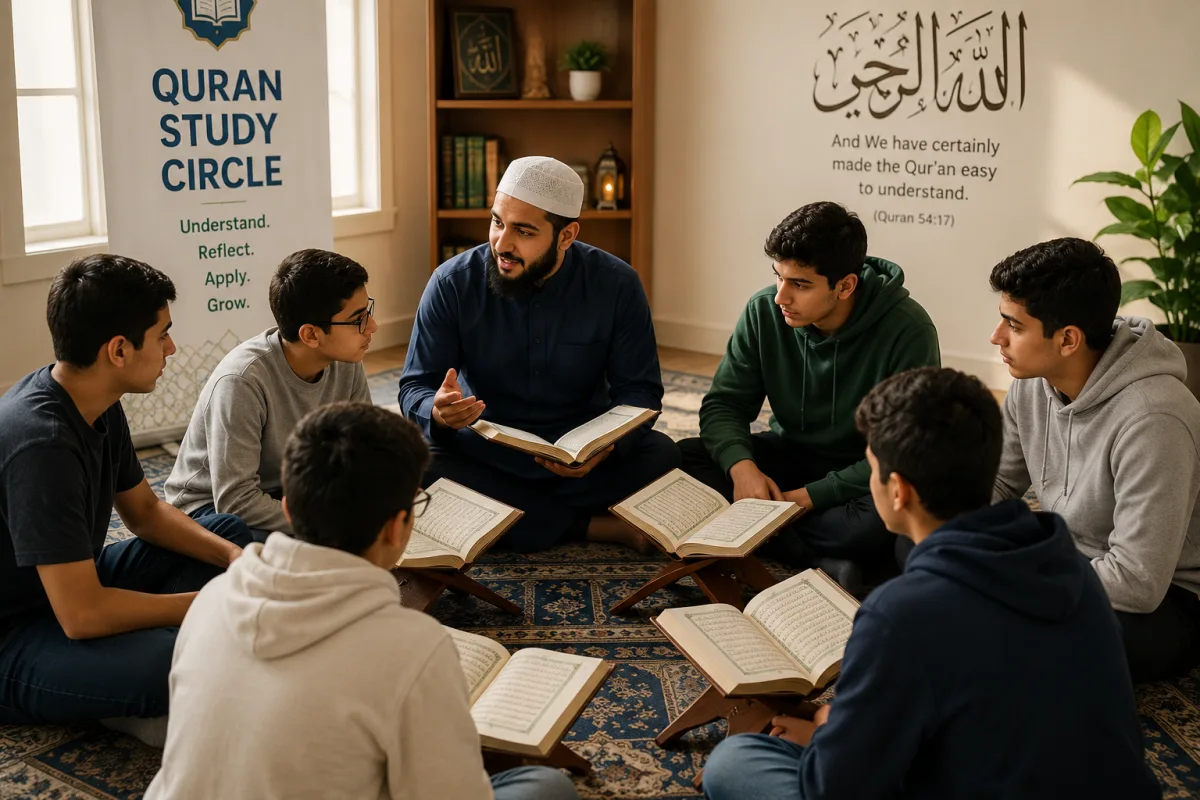
If you have ever finished reading a page of the Qur'an and quietly wished you understood the words as clearly as you pronounced them, you are far from alone. Many adults reach a point in their journey where reciting is no longer enough — they want to feel the meaning move through them as they read. That desire almost always leads to the same question: should I learn Quranic Arabic?
Quranic Arabic can feel mysterious from the outside. Some people assume it is a secret, ancient language reserved for scholars. Others worry it is impossibly hard, or that they have left it too late. The good news is that most of these worries dissolve once you understand what Quranic Arabic actually is and how ordinary learners approach it. The Qur'an itself frames its language as something meant to be understood: "Indeed, We have sent it down as an Arabic Qur'an that you might understand" (Surah Yusuf, 12:2).
This article gathers the questions we hear most often from adult learners and answers them plainly. Whether you are just curious or already committed, the goal is the same — to help you take the next step with confidence rather than confusion.
Reading time: about 11 minutes.
Reviewed by the Tayseerul Quran Teaching Team Qualified Quran teachers helping children and adults learn Quran reading, Tajweed, Noorani Qaida, Hifz, and Arabic through one-on-one online classes.
What You'll Learn
- What Quranic Arabic Actually Is
- Do I Need Quranic Arabic to Read the Quran
- How Quranic Arabic Compares to Everyday Arabic
- How Long It Takes to Understand the Quran
- Learning Quranic Arabic Online
- Grammar Root Words and What Makes Arabic Click
- Can Children Learn Quranic Arabic
- A Qualified Teachers Perspective
- Frequently Asked Questions
- Continue Learning
- Final Thoughts
- References
What Quranic Arabic Actually Is
What is Quranic Arabic?
Quranic Arabic is the classical form of the Arabic language used in the Qur'an. It is sometimes called Classical Arabic or the Arabic of revelation. When people say they want to "learn Quranic Arabic," they usually mean they want to understand the vocabulary, grammar, and sentence patterns that appear in the Qur'an so they can grasp the meaning of what they recite.
It is worth clearing up one common misconception right away: Quranic Arabic is not a separate language from Arabic. It is Arabic — a specific, highly refined register of it. The Arabic script, the sounds, and the core grammar are all shared with the wider Arabic language. What makes Quranic Arabic distinctive is its precision, its rich vocabulary, and the eloquence of its style.
Is Quranic Arabic hard to learn?
Honestly, it depends on your starting point and your goals. If your aim is to understand the general meaning of frequently recited passages, the road is much shorter than most people expect, because the Qur'an repeats a core set of words very often. If your aim is to analyse advanced grammar and rhetoric, that is a longer and deeper study. Neither goal requires you to be naturally gifted with languages — it requires steady, guided practice. We cover realistic timelines in our Quranic Arabic study plan.
Do I Need Quranic Arabic to Read the Quran
Can I read the Quran without learning Arabic grammar?
Yes. Reading the Qur'an — that is, correctly pronouncing the Arabic text — is a separate skill from understanding it. Millions of Muslims recite beautifully without formal grammar study. What you need in order to read is the ability to recognise the letters and apply the rules of correct pronunciation, which is where Noorani Qaida and Tajweed for beginners come in.
So if your immediate goal is to complete your recitation of the Qur'an, you do not need to master Quranic Arabic first. Learning to read and learning to understand can happen in parallel or one after the other — there is no single correct order for everyone.
Do I need to read Arabic before studying Quranic Arabic?
It helps a great deal. Being able to read the Arabic script fluently means that when you meet a new word, you can actually see and pronounce it rather than depending on transliteration. Most learners find their Quranic Arabic progresses much faster once basic reading is solid. If you are still building that foundation, our online Quran classes start exactly there and grow with you.
That said, you do not need to be a fast reader before you begin. Even a modest, developing reading ability is enough to start noticing familiar words in the text — and that early recognition is often what keeps learners motivated.
Will understanding change how I feel in prayer?
Many learners describe a noticeable shift once they begin to grasp the words they say every day. Phrases in the opening chapter, or short surahs recited in prayer, stop being sounds and start becoming meaning. That connection is one of the most common reasons adults tell us they wanted to study in the first place. The Qur'an describes itself as something made accessible for reflection: see Surah al-Qamar (54:17).
How Quranic Arabic Compares to Everyday Arabic
Is Quranic Arabic different from the Arabic people speak today?
Yes, in an important way. The Arabic spoken in daily life across different countries is made up of regional dialects — the Arabic of Egypt sounds different from the Arabic of Morocco or the Gulf. These spoken dialects vary in vocabulary and pronunciation and are learned largely by immersion. Quranic Arabic, by contrast, is a stable classical form that does not change from region to region.
There is also Modern Standard Arabic, the formal Arabic used in news, books, and official settings across the Arab world. It is much closer to Quranic Arabic than the spoken dialects are, since it descends from the same classical roots. We explore this comparison in detail in Quranic Arabic vs Modern Standard Arabic, which is worth reading if you are trying to decide which path fits your goals.
If I learn Quranic Arabic, will I be able to chat with Arabic speakers?
Not necessarily, and this surprises some people. Studying Quranic Arabic builds your understanding of the classical, written language of the Qur'an. It will give you a strong foundation and a large shared vocabulary, but holding a casual conversation in a local dialect is a different skill that needs conversational practice. Think of them as overlapping circles rather than the same circle — a lot in common, but not identical.
Which one should I learn first?
For someone whose main motivation is connecting with the Qur'an, starting with Quranic Arabic makes the most sense, because every hour of study goes directly toward that goal. If your motivation is travel, work, or everyday communication, a spoken dialect or Modern Standard Arabic may serve you better. Being honest with yourself about why you want to learn is the single best way to choose a path you will actually stick with.
How Long It Takes to Understand the Quran
How long does it take to understand the Quran in Arabic?
There is no universal number, and anyone who promises an exact timeline is guessing. What we can say is this: the Qur'an uses a relatively small core of words very frequently. A learner who focuses on high-frequency vocabulary and basic sentence patterns can begin to recognise the gist of many familiar passages within months of consistent study — not years.
Deeper comprehension, where you can follow less common vocabulary and appreciate the finer grammar and eloquence, takes longer and is genuinely a lifelong pursuit. The encouraging truth is that you do not have to wait until the end to enjoy the rewards. Understanding grows gradually, and each new word you recognise adds meaning to your recitation right away.
What makes some learners progress faster?
Three things, in our experience: consistency, focus, and feedback. Consistency means short, regular sessions rather than occasional long ones. Focus means prioritising the words and structures that appear most in the Qur'an instead of trying to absorb everything at once. Feedback means having someone correct your mistakes early, before they harden into habits. A structured study plan makes all three far easier to sustain.
Learning Quranic Arabic Online
Can I really learn Quranic Arabic online?
Yes — and for many adults it is the most practical option. Online learning removes the barriers of travel and rigid schedules, letting you study from home at times that fit around work and family. With one-to-one video classes, a qualified teacher can see your progress, correct your pronunciation, and adjust the pace to you personally. We walk through how this works in learn Quranic Arabic online.
The key is the quality of the learning, not the location. A well-structured online class with a dedicated teacher can be more effective than a crowded in-person class where you rarely get individual attention. What matters is that you are guided, corrected, and encouraged.
Do I really need a teacher, or can I self-study?
You can certainly learn a lot on your own with books and apps, and self-study is a valuable supplement. But a teacher offers something no app can: real-time correction and a response to your specific questions. When you misread a word or misunderstand a structure, a teacher catches it immediately and explains it in a way that suits how you think.
There is a deeper reason too. The Qur'an has been passed down through an unbroken tradition of teacher-to-student transmission. The Prophet ﷺ himself learned and taught the Qur'an directly, and about the merit of this learning it is reported: "The best among you are those who learn the Qur'an and teach it" (Sahih al-Bukhari 5027). Learning with a qualified teacher keeps you connected to that living chain rather than relying on guesswork.
What should I look for in an online Quranic Arabic teacher?
Look for someone with formal qualifications in the Qur'an and Arabic, genuine teaching experience, and patience with adult beginners. A good teacher meets you where you are, sets realistic goals, and celebrates small wins. Being comfortable and unhurried with your teacher matters more than almost anything else, because that comfort is what keeps you coming back week after week.
Grammar Root Words and What Makes Arabic Click
Is Arabic grammar as hard as people say?
Arabic grammar has a reputation that scares people off unnecessarily. Yes, it is systematic and detailed, but "systematic" is actually good news for learners: Arabic follows clear, logical patterns rather than a chaotic pile of exceptions. Once you learn a pattern, it applies again and again across countless words.
The trick is to learn grammar in small, usable doses tied to real Qur'anic examples, rather than as abstract rules memorised in isolation. When you see how a rule explains a phrase you already recite, it stops feeling like grammar and starts feeling like a key turning in a lock. A teacher paces this so you are never overwhelmed.
What are root words, and why do they matter?
This is one of the most beautiful and helpful features of Arabic. Most Arabic words are built from a root, usually of three letters, that carries a core idea. From that single root, a whole family of related words is formed by predictable patterns.
Take the very well-known example of the root k-t-b, which relates to writing. From it come words connected to writing, a book, and a writer. Once you recognise a root, you can often sense the general meaning of a new word simply because you know its family. This is why learners who understand roots feel their vocabulary suddenly start to multiply — you are no longer memorising isolated words but recognising relatives of words you already know. We should be careful, though: patterns give you a strong clue to meaning, not a guarantee, so a teacher's guidance keeps your understanding accurate.
Do I need to memorise long vocabulary lists?
Not in the way you might fear. Because the Qur'an repeats its core vocabulary so often, and because roots link words into families, effective study is smarter than brute memorisation. Focusing on high-frequency words and understanding their roots gives you disproportionate returns. The Qur'an itself invites careful, measured engagement with its words — recite it, as one verse describes, in a slow, deliberate manner (Surah al-Muzzammil, 73:4).
Can Children Learn Quranic Arabic
Is Quranic Arabic suitable for children?
Absolutely, and children often have a real advantage: their ears are quick to absorb new sounds and their minds are flexible with patterns. Many families begin their children with reading and Tajweed first, then gradually introduce meaning and vocabulary as the child matures. The pace and style simply need to match the child's age.
How is teaching children different from teaching adults?
Children usually thrive with shorter sessions, plenty of repetition, and a warm, playful approach. Adults tend to want the "why" behind a rule and can handle longer, more analytical lessons. A skilled teacher adapts naturally to each, which is one more reason one-to-one classes work so well for mixed-age families — everyone gets a lesson shaped to them rather than a single lesson stretched to fit all.
A Qualified Teachers Perspective
Everything above is easy to say in the abstract, so let us share how qualified teachers actually think about your journey. The first thing an experienced teacher does is listen — to your goals, your background, and your worries. Two learners might both say "I want to understand the Qur'an," but one is a busy parent with twenty minutes a day and the other is a student able to study for hours. The right plan looks very different for each, and pretending otherwise sets people up to feel like they failed when really the plan was wrong.
A qualified teacher also protects you from two common traps. The first is going too fast — rushing into heavy grammar before reading is solid, which leaves learners frustrated and discouraged. The second is going too slow — staying on the basics long after you are ready to grow, which drains motivation. Good teaching lives in the balance, nudging you forward at the edge of your ability without tipping you into overwhelm.
There is one boundary we hold firmly, and it reflects genuine expertise rather than a limitation. Teaching you the language of the Qur'an is not the same as issuing religious rulings. When a question moves from "what does this word mean" into "what am I obligated to do," that is the territory of qualified scholars of Islamic law, and we will always encourage you to bring such questions to them. Knowing the edge of one's own role is part of teaching responsibly.
Finally, real teachers measure success by your relationship with the Qur'an, not by how impressive the lessons look. If after a month you recite your daily portion with a little more understanding and a little more calm, that is a genuine victory — and it is exactly the kind of quiet, steady progress that lasts.
Frequently Asked Questions
Is Quranic Arabic the same as the Arabic taught in schools?
Not exactly. Schools in Arab countries teach Modern Standard Arabic, which is close to Quranic Arabic but not identical. Quranic Arabic is the classical form found in the Qur'an. The two overlap heavily, so studying one helps with the other, but they are aimed at different purposes.
Can I learn Quranic Arabic if I only speak English?
Yes. Countless learners begin with no Arabic background at all. A good teacher explains everything in a language you understand and builds your Arabic gradually from the ground up. Speaking only English is a starting point, not an obstacle.
How much should I practise each day?
Little and often beats long and rare. Even fifteen to twenty focused minutes daily, kept up consistently, will carry you further than a single long session once a week. Consistency is the real engine of progress in language learning.
Do I need to finish learning to read before studying meaning?
No, though comfortable reading helps a lot. Many learners study reading and meaning side by side, letting each reinforce the other. If your reading is still developing, you can begin recognising common words while you continue to strengthen it.
Will learning Quranic Arabic help me in daily prayers?
Very much so. The phrases you recite in prayer are drawn from the Qur'an, so as your understanding grows, your prayers can become richer and more present. Many people say this is the most rewarding part of their study.
Is it too late for me to start as an adult?
It is never too late. Adults bring focus, discipline, and clear motivation that often make them excellent learners. The best time to begin is simply whenever you are ready.
Should I ask my teacher about religious rulings I encounter?
Your language teacher can explain what words and verses mean, but questions about religious obligations and rulings should go to a qualified scholar of Islamic law. Keeping those roles distinct protects the accuracy of the guidance you receive.
Continue Learning
- Learn Quranic Arabic Online
- Quranic Arabic vs Modern Standard Arabic
- Quranic Arabic Study Plan
- Noorani Qaida Online
- Online Quran Classes
Final Thoughts
Learning Quranic Arabic is not a test you pass or fail — it is a relationship you build, one word at a time. The questions in this article come up again and again precisely because so many people share the same hopes and hesitations. If you have read this far, chances are you already feel the pull toward understanding the words you recite, and that quiet desire is the best possible reason to begin.
You do not need to be a natural linguist, you do not need to have started as a child, and you do not need to figure it all out alone. You need a clear goal, a little consistency, and a patient teacher who meets you where you are. Everything else grows from there. The Qur'an was sent to be understood, and that understanding is within your reach.
Begin Quranic Arabic with a qualified teacher — book a free trial →
References
- Surah Yusuf (12:2): "Indeed, We have sent it down as an Arabic Qur'an that you might understand."
- Surah al-Qamar (54:17)
- Surah al-Muzzammil (73:4)
- Sahih al-Bukhari 5027