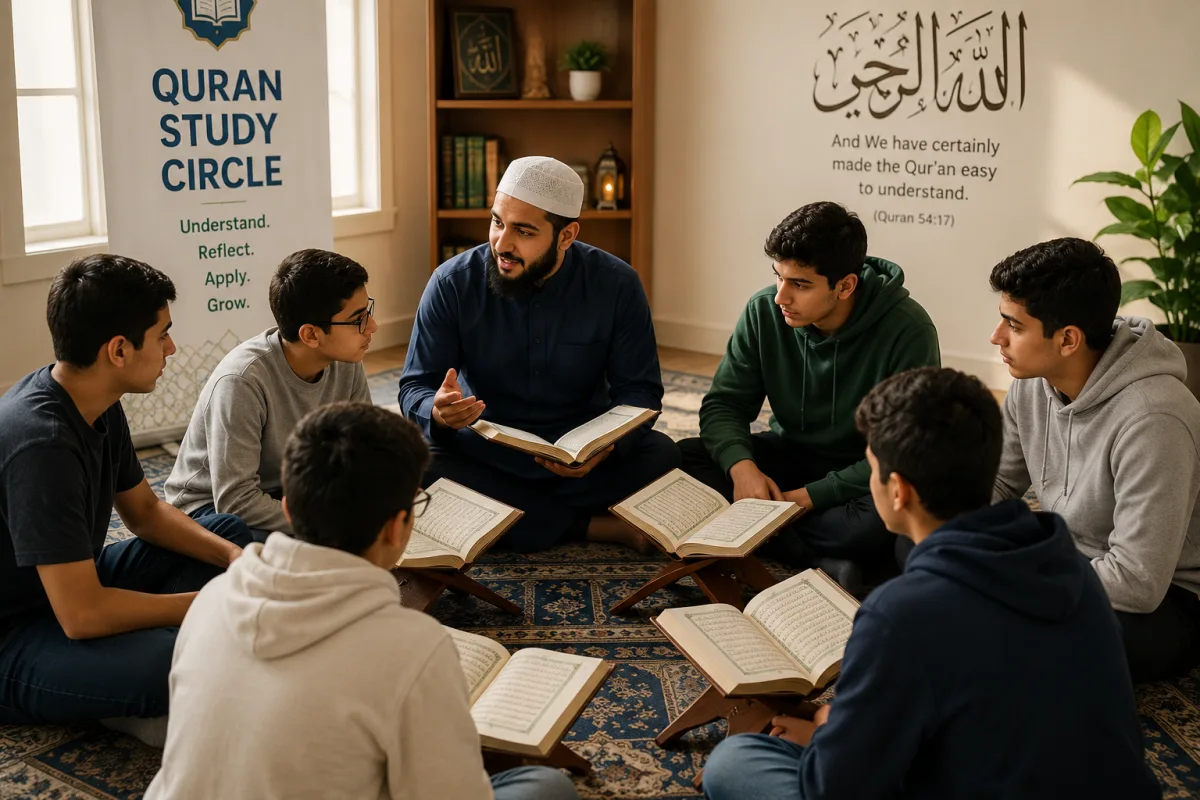
Millions of Muslims around the world recite the Qur'an every day, yet many of us reach the words without fully understanding them. We know the sounds, we love the rhythm, and we feel something stir in the heart during prayer — but the meaning stays just out of reach, hidden behind a language we were never taught. If that describes you, you are in good company, and you are exactly the kind of learner this guide is written for.
Learning Quranic Arabic online has never been more accessible. With a laptop or phone, a quiet corner, and a qualified teacher on the other end of the call, an adult beginner can move from recognising letters to understanding whole verses in a way that once required travelling abroad or sitting in a crowded classroom. The Qur'an itself points to why this journey matters. Allah says in Surah Yusuf: "Indeed, We have sent it down as an Arabic Qur'an that you might understand." (12:2) The language and the understanding were always meant to go together.
This beginner's guide walks you through what Quranic Arabic actually is, why it is worth learning, and how to start from wherever you are today — even if you cannot yet read a single Arabic letter. We will look at the building blocks of the language, how online one-to-one lessons work in practice, and a realistic path you can follow without burning out. The goal is not to overwhelm you with grammar, but to give you a clear, honest map so you can take the first step with confidence.
Reading time: about 11 minutes.
Reviewed by the Tayseerul Quran Teaching Team Qualified Quran teachers helping children and adults learn Quran reading, Tajweed, Noorani Qaida, Hifz, and Arabic through one-on-one online classes.
What You'll Learn
- What Quranic Arabic Is
- Why Learn the Language of the Qur'an
- Quranic Arabic vs Conversational Arabic
- Where to Start: Letters and Reading First
- The Power of Arabic Root Words
- Building Your Qur'anic Vocabulary
- Basic Grammar for Understanding
- How Online Lessons Work
- A Realistic Study Path
- A Teacher's Perspective
- Frequently Asked Questions
- Continue Learning
- Final Thoughts
- References
What Quranic Arabic Is
Quranic Arabic, sometimes called Classical Arabic, is the form of the Arabic language in which the Qur'an was revealed. It is the same family of Arabic that scholars have studied for over fourteen centuries, and it forms the foundation of formal Arabic to this day. When people say they want to "understand the Qur'an in its own words," this is the language they mean.
What makes Quranic Arabic special is not that it is a different language from the Arabic spoken today, but that it is a refined, precise, and deeply expressive register. Every word is chosen with care, every sentence carries layers of meaning, and even the order of words can shift the emphasis. This is why translations, however good, can only ever carry part of the message across. A translation gives you the meaning; the original gives you the meaning plus its music, its weight, and its subtle shades.
For a beginner, the encouraging news is that Quranic Arabic is a defined, finite text. Unlike learning a spoken language where you must prepare for endless everyday situations, your ultimate goal here is to understand one specific book. That focus makes the task achievable. You are not trying to hold a business meeting in Arabic — you are learning to open the Qur'an and follow along with growing understanding.
Why Learn the Language of the Qur'an
The most honest answer is that understanding changes your relationship with the Qur'an. When you know what you are reciting, prayer becomes a conversation rather than a recitation of sounds. Verses you have heard a thousand times suddenly land differently because you grasp the words behind them. Many adult learners describe this moment as the reason they wish they had started years earlier.
There is also a spiritual dimension that the Qur'an itself highlights. Allah tells us in Surah al-Qamar: "And We have certainly made the Qur'an easy to remember, so is there any who will be reminded?" (54:17) The language was designed to be accessible and memorable, not locked away. Learning it is a response to that open invitation.
Beyond the personal, understanding the language protects you from relying entirely on second-hand interpretation. You can read a verse, recognise the key words, and appreciate the context for yourself. This does not replace scholarship — for rulings and detailed interpretation you should always ask a qualified scholar — but it does make you an active reader rather than a passive one. If you want to explore this further, our overview of online Quran classes explains how structured lessons build toward this kind of independence.
Quranic Arabic vs Conversational Arabic
One of the most common points of confusion for new learners is the difference between the Arabic of the Qur'an and the Arabic people speak on the street today. They are related, but they are not identical, and knowing the distinction saves you a lot of wasted effort.
Modern Standard Arabic is used in news, books, and formal settings across the Arab world. Colloquial dialects — Egyptian, Levantine, Gulf, and others — are what people actually speak day to day, and they vary a great deal from region to region. Quranic Arabic sits at the classical root of all of these. If your goal is to understand the Qur'an, you do not need to master a modern dialect first, and you certainly do not need to learn how to order coffee in Cairo.
This matters because many beginners assume they must "learn Arabic" in the general sense before they can touch the Qur'an, and they enrol in conversation courses that never quite get them to their goal. In truth, a focused Quranic Arabic path is often shorter and more rewarding for this specific purpose. We compare the two approaches in detail in our guide to Quranic Arabic vs Modern Standard Arabic, which is worth reading before you commit to any course.
Where to Start: Letters and Reading First
If you cannot yet read Arabic script, this is where your journey begins — and it is genuinely the most important stage. Before vocabulary and grammar can mean anything, you need to be able to recognise the letters, connect them into words, and read them aloud with reasonable fluency. Trying to skip this step is like trying to run before you can stand.
The traditional and most reliable starting point is the Noorani Qaida, a carefully sequenced primer that takes you from individual letters through their sounds, connected forms, vowel marks, and finally to reading actual words and short phrases. It was designed precisely for beginners, and it works just as well for adults as it does for children. Our dedicated guide to Noorani Qaida online explains how this foundation is taught step by step in a virtual classroom.
Alongside reading, you will begin to encounter the rules of correct pronunciation, known as Tajweed. At the beginner stage this simply means learning to give each letter its proper sound and rhythm rather than mastering advanced rules. The Qur'an guides us here too: "...and recite the Qur'an with measured recitation." (73:4) A good teacher introduces these rules gently, correcting your pronunciation in real time so that bad habits never take hold. If you are curious about what this looks like early on, see our introduction to Tajweed for beginners.
The Power of Arabic Root Words
Here is where Quranic Arabic becomes genuinely exciting, and where adult learners often experience their first real breakthrough. Arabic is built on a system of roots — usually three consonants that carry a core idea. From a single root, dozens of related words branch out, all sharing that central meaning. Once you understand this system, the language stops feeling like an endless list of words to memorise and starts feeling like a logical, connected structure.
Take a word you already know: the name of your Lord, "Rabb." It comes from a root connected to the ideas of nurturing, sustaining, and bringing something to completion. When you meet other words from the same family throughout the Qur'an, you begin to sense the shared thread running between them. You are no longer learning isolated vocabulary — you are learning patterns, and patterns are far easier for the adult mind to hold onto.
This root system is the single biggest efficiency in learning Quranic Arabic. A relatively small number of roots appears again and again across the text, so effort spent understanding one root pays off many times over. A skilled teacher will point these connections out as they arise, so that your growing vocabulary reinforces itself. We will not attempt to teach detailed grammar rules here, and you should always confirm precise word meanings with a qualified teacher, but even a basic awareness of roots transforms how you read.
Building Your Qur'anic Vocabulary
Vocabulary is the bridge between reading the words and understanding them. The reassuring reality is that the Qur'an, while profound, uses a surprisingly focused set of words, and a core group of them appears extremely frequently. If you learn the most common words first, you unlock a large portion of the text far sooner than you might expect.
The smartest approach is to prioritise by frequency rather than trying to learn everything at once. Words like "Allah," "Rabb," "Rahman," and "kitab" (book) appear so often that recognising them instantly gives you an anchor in almost every page. From there, you gradually add the next most common words, always in the context of real verses rather than as a dry list. Meaning sticks far better when it is attached to a sentence you actually recite.
A practical method that works well for adults is little-and-often review. A few new words each lesson, revisited regularly, will outperform occasional cramming every time. Many learners keep a simple notebook or use flashcards for the words they meet in class. If you would like a structured way to organise this, our Quranic Arabic study plan lays out how to build vocabulary steadily alongside your reading and grammar.
Basic Grammar for Understanding
Grammar has an intimidating reputation, but for understanding the Qur'an you do not need to become a grammarian. You need enough grammar to answer a few simple questions about a sentence: who is doing something, to whom, and when. That level of understanding is very achievable, and it makes verses come alive.
At the beginner stage, this means learning to recognise a handful of essentials: how Arabic distinguishes between a person doing an action and a person receiving it, how singular and plural work, and how small words like prepositions shift meaning. You do not memorise tables in isolation; you learn each point through the verses you are already reading, so the grammar always has a purpose attached to it.
The key is pacing. Grammar introduced too early or too fast overwhelms learners and drains motivation. Introduced gradually, one idea at a time and always tied to a real example, it becomes a quiet tool that works in the background. We deliberately avoid inventing shortcuts or oversimplified "rules" that fall apart later — a qualified teacher will give you accurate explanations and correct any misunderstandings before they take root. For anything you are unsure about, asking your teacher directly is always the right move.
How Online Lessons Work
One of the biggest shifts in Islamic education over the last decade has been the rise of genuine one-to-one online learning. For Quranic Arabic in particular, this format is a remarkably good fit, because pronunciation and reading need real-time correction that pre-recorded videos simply cannot provide.
In a typical online lesson, you connect with your teacher over a video call at a time that suits your schedule. You share a screen or a digital copy of the material, read aloud while your teacher listens, and receive immediate feedback on your pronunciation, reading, and understanding. Because the class is built around you alone, the pace adjusts to your ability — there is no faster classmate to fall behind and no slower one to wait for. Mistakes are corrected gently and privately, which many adult learners find far more comfortable than a group setting.
This personal attention is what makes online Quranic Arabic so effective for busy adults. Lessons can be scheduled around work and family, repeated when you need reinforcement, and tailored entirely to your goals — whether that is understanding your daily prayers or reading a full page with comprehension. If you would also like to combine understanding with memorisation, our guide on how to memorise Quran online shows how the two can support each other.
A Realistic Study Path
Motivation is easy to find and hard to keep, so the most important thing you can do is set expectations that match real life. Learning Quranic Arabic is a gradual journey, not a weekend project, and the learners who succeed are almost always the ones who kept going steadily rather than the ones who started fastest.
A sensible path for a complete beginner looks something like this. First, spend your early weeks on reading fluency through the Noorani Qaida, until Arabic script feels natural. Next, begin recognising the most common Qur'anic words while you continue to strengthen your reading. After that, layer in basic grammar, a little at a time, so you can start following the meaning of short verses. Finally, move to reading real passages with your teacher, combining everything you have built. Each stage rests on the one before it, so there is no rush to skip ahead.
Consistency beats intensity. Two or three focused sessions a week, with short daily review in between, will carry you further over a year than occasional marathon efforts. Celebrate small wins — the first verse you understand without a translation is a milestone worth pausing on. For a week-by-week structure you can actually follow, our Quranic Arabic study plan breaks the journey into manageable stages.
A Teacher's Perspective
After years of teaching adults who arrive nervous and convinced the language is beyond them, our teaching team has seen the same pattern again and again: the barrier is rarely ability, and almost always confidence. Adults underestimate how quickly the pieces start to fit together once someone experienced is guiding them and correcting them in real time. The learners who thought they were "too old to start" are often the most rewarding to teach, precisely because they bring patience and genuine intention.
From a teacher's chair, the difference a qualified instructor makes is most visible in the small corrections. A slightly mispronounced letter, an overlooked vowel, a word connected to the wrong root — these are easy to fix on the spot and difficult to unlearn later if they slip through. This is the heart of why one-to-one teaching matters so much for the Qur'an: the feedback loop is immediate and personal. It is also why we are careful never to hand learners invented rules or guessed meanings; accuracy is a trust, and where a question touches on interpretation or a ruling, we direct learners to a qualified scholar rather than improvise.
The Prophet ﷺ said, as recorded in Sahih al-Bukhari: "The best of you are those who learn the Qur'an and teach it." (Sahih al-Bukhari 5027) That responsibility shapes how a serious teacher approaches every lesson. Our advice to every new adult learner is simple: start before you feel ready, choose a qualified teacher who corrects you kindly, and trust the process. The understanding you are hoping for is closer than it feels today.
Frequently Asked Questions
Do I need to know how to read Arabic before I start?
No. Complete beginners start with the letters themselves, usually through the Noorani Qaida, and build up to reading whole words. Your teacher meets you exactly where you are, even if you have never seen the Arabic alphabet before.
How long does it take to understand Quranic Arabic?
It depends on your starting point and how consistently you study, so there is no single honest number. Many adults begin recognising common words within a few months and follow the meaning of short verses within the first year of steady, regular lessons.
Is Quranic Arabic the same as the Arabic people speak today?
Not exactly. Quranic Arabic is the classical form in which the Qur'an was revealed, while spoken dialects vary by region. The good news is that you do not need to learn a modern dialect to understand the Qur'an.
Am I too old to start learning?
Not at all. Adults often learn efficiently because they can grasp patterns, such as the root system, and they bring focus and motivation. Age is far less important than consistency and having a patient, qualified teacher.
Can I really learn effectively online?
Yes. For Quranic Arabic, one-to-one online lessons are especially effective because they allow real-time correction of your reading and pronunciation, personalised pacing, and scheduling that fits around your work and family.
How much time should I commit each week?
A realistic and sustainable rhythm is two or three focused lessons a week, with a little daily review in between. Steady, regular study consistently outperforms occasional intensive sessions over the long run.
Will learning the language replace the need for scholars?
No, and it is not meant to. Understanding the language makes you an active reader, but detailed interpretation and religious rulings should always be referred to a qualified scholar. The two work together rather than one replacing the other.
Continue Learning
- Quranic Arabic: Frequently Asked Questions
- Quranic Arabic vs Modern Standard Arabic
- A Practical Quranic Arabic Study Plan
- Noorani Qaida Online: A Beginner's Foundation
- Tajweed for Beginners
Final Thoughts
Learning Quranic Arabic online is one of the most rewarding journeys an adult believer can begin. It asks for patience rather than genius, consistency rather than intensity, and a willingness to start before you feel completely ready. The words you long to understand were revealed in a language described as clear and made easy to remember — and with a qualified teacher guiding you, they are well within your reach.
Wherever you are today, whether you are still learning the letters or already reading fluently but without understanding, there is a next step waiting for you. Take it gently, take it seriously, and take it with someone who can correct you kindly along the way.
Start learning Quranic Arabic with a qualified teacher — book a free trial →
References
- Surah Yusuf (12:2): "Indeed, We have sent it down as an Arabic Qur'an that you might understand."
- Surah al-Qamar (54:17): "And We have certainly made the Qur'an easy to remember, so is there any who will be reminded?"
- Surah al-Muzzammil (73:4): "...and recite the Qur'an with measured recitation."
- Sahih al-Bukhari 5027: "The best of you are those who learn the Qur'an and teach it."