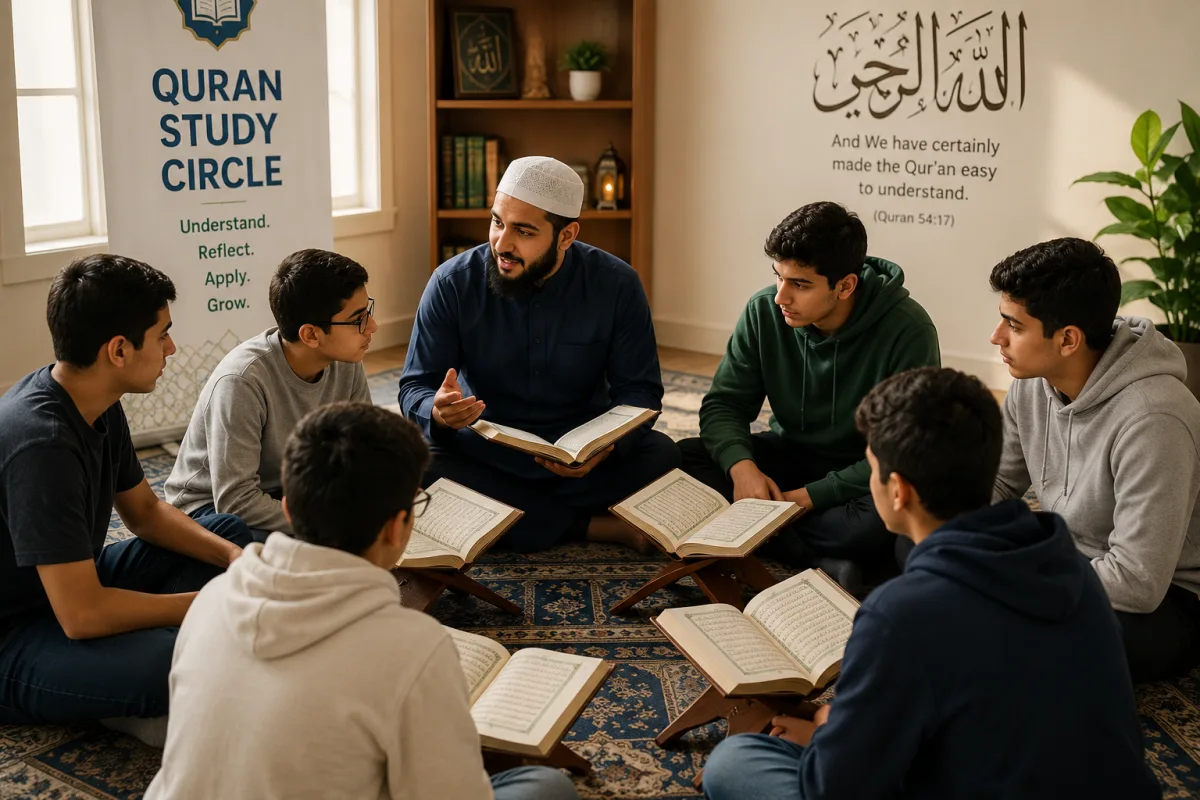
For many sisters, the wish to learn the Qur'an sits quietly in the heart for years. Perhaps you learned a little as a child and forgot it. Perhaps you never had the chance to begin at all. Perhaps life filled up with family, work, and responsibilities, and the thought "one day I will finally learn to read properly" kept getting pushed to the side. If that sounds like you, please know that you are not late, and you are not alone. Thousands of women around the world are beginning exactly where you are, at every age and every stage.
Allah has made this journey gentle. He says in Surah al-Qamar, "And We have certainly made the Qur'an easy to remember, so is there any who will be reminded?" (54:17). That reassurance is repeated in the Qur'an because the door truly is open to everyone who sincerely wants to walk through it. Learning to read the Book of Allah is not reserved for scholars or for those who started young. It is for the sister with a full house and a busy schedule, for the revert taking her very first steps, and for the grandmother who has waited a lifetime to read a single verse on her own.
This article is a complete FAQ written especially for women and sisters who are considering private Quran classes. We will answer the questions that most often hold sisters back: whether you can really learn online, whether a female teacher is available, whether the setting is private and comfortable, and how on earth you fit lessons around family life. The goal is simple and honest guidance, so that you can decide with a calm heart whether to begin.
Reading time: about 10 minutes.
Reviewed by the Tayseerul Quran Teaching Team Qualified Quran teachers helping children and adults learn Quran reading, Tajweed, Noorani Qaida, Hifz, and Arabic through one-on-one online classes.
What You'll Learn
- Can Women Learn the Quran Online
- Female Teachers, Privacy, and Comfort
- Starting as a Complete Beginner
- Fitting Lessons Around Family Life
- How the Learning Actually Works
- A Qualified Teacher's Perspective
- Frequently Asked Questions
- Continue Learning
- Final Thoughts
Can Women Learn the Quran Online
Is it really possible to learn the Qur'an properly over the internet?
Yes, and very well. Reciting the Qur'an is something a teacher hears and corrects, sound by sound. A good video call gives your teacher everything she needs: she can hear your pronunciation clearly, watch how you shape each letter, and guide you in real time. In many ways, a one-to-one online lesson is closer and more personal than sitting in a large classroom where the teacher divides her attention among many students.
Online learning also removes the barriers that once kept sisters away from the Qur'an entirely. There is no travel, no need to arrange childcare to leave the house, and no worry about finding a suitable class nearby. Your lesson comes to you, in your own home, at a time you choose. For women living in places with few Islamic teachers, or with schedules that make attending a physical class impossible, online classes have opened a door that used to be closed.
Will my recitation be as accurate as learning in person?
It can be just as accurate, because the method is the same. The Qur'an has always been passed from teacher to student by listening and repeating, generation after generation. That living chain does not depend on being in the same room. What matters is that a qualified teacher hears you, corrects your mistakes, and does not let errors settle in. A dedicated one-to-one online class gives you exactly that attention. If you would like a fuller comparison, our guide on online vs in-person Quran classes for sisters walks through the differences honestly.
Female Teachers, Privacy, and Comfort
Can I have a female teacher?
Yes. At Tayseerul Quran, sisters can learn with a qualified female Quran teacher, and this is one of the most common requests we receive. Many women feel far more at ease learning from another sister, and that comfort matters. When you feel relaxed, you speak up, you ask to repeat a line, and you are not shy about making mistakes, which is exactly how learning happens. You can read more about what to look for in our article on choosing a female Quran tutor online.
Are the classes private?
Your one-to-one lesson is a private session between you and your teacher. It is not a public group where strangers watch and listen. This privacy is part of what makes the experience comfortable for sisters. Your pace, your struggles, and your progress stay between you and the person teaching you, in an atmosphere of trust and respect.
Do I have to appear on camera?
No, you do not have to be on camera if you prefer not to be. Reciting the Qur'an is learned through sound, so your teacher primarily needs to hear you clearly. Some sisters are happy to keep their camera on, some keep it off, and some choose a female teacher precisely so they feel free either way. There is a small benefit to your teacher seeing your mouth when learning the exact shape of certain letters, but it is never a requirement. You should always feel comfortable, and you can arrange whatever setup puts your heart at ease.
What if I feel embarrassed about how little I know?
Please set that worry down gently. Every teacher was once a beginner, and every student stumbles at the start. A good teacher has heard every kind of mistake and meets each one with patience, never judgment. Reciting slowly, mispronouncing a letter, forgetting what you learned last week, all of this is normal and expected. The Qur'an is learned one small step at a time, and there is honour in the effort itself, regardless of how far along you are.
Starting as a Complete Beginner
I cannot read Arabic at all. Can I still start?
Absolutely. Complete beginners are welcome, and there is a clear, tested path for you. Most sisters begin with the Arabic letters and their sounds through a foundational method called the Noorani Qaida. It teaches you to recognise each letter, join letters together, and read short words and then verses, step by step. You do not need any prior knowledge, and you do not need to know a word of Arabic vocabulary to begin reading the script. Our introduction to Noorani Qaida online explains how this foundation works.
Am I too old to begin?
No. Adults learn to read the Qur'an every single day, and being older brings real advantages: patience, focus, and a sincere motivation that many children do not yet have. Your first command from your Lord was to read, "Read in the name of your Lord who created" (96:1), and that invitation has no age limit. Sisters in their forties, sixties, and beyond begin and succeed. The only thing that matters is that you start and stay consistent.
What will I actually learn first?
In the early lessons you will learn to name and pronounce the Arabic letters correctly, then to connect them and read simple combinations. From there you move into reading short verses, and gradually your teacher introduces the rules that make recitation beautiful and correct. These rules are called Tajweed, and they govern how letters are pronounced and how the recitation flows. If you would like a preview, our guide to Tajweed for beginners gives a gentle overview of what lies ahead.
Fitting Lessons Around Family Life
I am a busy mother. How can I possibly find the time?
This is perhaps the most honest and most common question sisters ask, and it deserves an honest answer. You do not need large blocks of empty time, because you rarely have any. What works is a short, regular lesson, often two or three times a week, scheduled around the rhythm of your day. Early morning before the children wake, the quiet hour after school, or the calm of the evening once the house settles are all times that sisters use well. Because the class comes to your home, you lose no time travelling. Our article on building a busy mother's Quran routine is full of practical ideas for protecting a little time each day.
How long are the lessons, and how often?
Lessons are usually around thirty minutes, and many sisters take two or three each week. Short and frequent beats long and rare. A focused half hour, followed by a few minutes of practice on your own most days, will carry you further than a single long session that leaves you tired and discouraged. Your teacher will help you find a rhythm that fits your life rather than fighting against it.
Can I reschedule when family life gets in the way?
Family life is unpredictable, and good teaching allows for that. Children fall ill, guests arrive, and some weeks are simply harder than others. The flexibility of one-to-one online classes means your timing can be arranged around your circumstances, and a missed week does not undo your progress. What matters is returning, gently and consistently, rather than expecting yourself to be perfect.
How long will it take me to learn to read?
This varies from sister to sister, and it would be dishonest to promise a fixed number of weeks. Your starting point, how often you practise, and how much time you can give all shape the pace. As a general and widely-agreed idea, a committed beginner working steadily on the Noorani Qaida foundation often reaches confident basic reading within several months, though some move faster and others take longer. The goal is not speed. The goal is reading the Qur'an correctly for the rest of your life, and that is worth a patient beginning.
How the Learning Actually Works
Is one-to-one better than a group class?
For most sisters, yes. In a one-to-one class, every minute is yours. The teacher listens only to you, corrects only your mistakes, and moves at exactly your pace, neither rushing ahead nor holding you back. In a group, attention is shared and shy students often stay quiet. Private classes remove that pressure entirely and tend to produce faster, more solid progress. You can explore the wider picture of online Quran classes and how they are structured.
How much practice do I need between lessons?
A little, most days, is the winning formula. Even ten to fifteen minutes of reviewing what your teacher covered will hold the lesson in place and make the next one easier. Allah instructs us to "recite the Qur'an with measured recitation" (73:4), and that measured, unhurried spirit applies to practice too. Slow and steady daily review beats a frantic hour the night before your lesson. Your teacher will tell you exactly what to review, so you are never left guessing.
Can my daughter learn too?
Yes, and many sisters learn alongside their children, which is a beautiful arrangement. Some mothers take their own lessons and book separate one-to-one classes for their daughters with a female teacher, so each learns at her own level. Children often thrive with the same patient, private attention, and there is something deeply encouraging about a mother and daughter walking this path together, each helping the other stay consistent.
What equipment do I need?
Very little. A smartphone, tablet, or computer with a camera and microphone, a stable internet connection, and a quiet corner are enough to begin. A copy of the Qur'an or the Noorani Qaida, whether printed or on a screen, completes what you need. There is no special software to master. Your teacher will guide you through the simple setup in your very first session.
A Qualified Teacher's Perspective
From years of teaching sisters online, our team has seen a clear pattern: the sisters who succeed are almost never the ones with the most free time or the strongest background. They are the ones who begin, and then keep showing up. A qualified teacher's role is not only to correct pronunciation but to protect that consistency, to encourage on the hard weeks, and to make each sister feel that her effort is seen and valued.
Correct recitation matters because the Qur'an is trust placed in our care, and small errors left uncorrected tend to harden over time. This is exactly why a trained teacher listens so carefully in those early lessons. A good teacher notices the letter you are shaping slightly wrong, the rule you are applying inconsistently, or the habit forming before it takes root, and she gently guides you back. That attentive correction, given with warmth, is the heart of authentic Qur'an learning, and it is the reason the Book has been transmitted faithfully from teacher to student across the centuries.
There is also great reward in this path for both learner and teacher. The Prophet, peace and blessings be upon him, said, "The best of you are those who learn the Qur'an and teach it" (Sahih al-Bukhari 5027). A sincere teacher carries that hadith in her heart, understanding that she is a small link in a long and blessed chain. When you learn with a qualified teacher, you are not simply buying a service. You are joining that chain, and your teacher considers your progress a genuine honour.
On matters of religious rulings, whether about tajweed obligations, recitation in prayer, or any question of fiqh, a teacher's role is to teach recitation and point you toward reliable knowledge. For specific rulings, it is always best to ask a qualified scholar, and a good teacher will happily encourage you to do so rather than answer beyond her scope.
Frequently Asked Questions
Can women learn the Qur'an completely online?
Yes. One-to-one online classes let a qualified teacher hear and correct your recitation in real time, from the comfort of your own home, with no travel required.
Is a female Quran teacher available for sisters?
Yes. Sisters can request a qualified female Quran teacher, which many women find more comfortable and encouraging for open, relaxed learning.
Do I have to turn my camera on during lessons?
No. Reciting is learned through sound, so your teacher mainly needs to hear you. You can keep your camera off if that puts you more at ease.
Can a complete beginner who cannot read Arabic start?
Yes. Beginners usually start with the Noorani Qaida, which teaches the Arabic letters and their sounds from the very beginning, with no prior knowledge needed.
How long does it take an adult woman to learn to read the Qur'an?
It depends on your starting point and practice, but a committed beginner working steadily often reaches confident basic reading within several months.
How do I fit Quran classes around caring for my family?
Short, regular lessons of around thirty minutes, two or three times a week, scheduled around your daily rhythm, work well. Flexible timing lets you rearrange when needed.
Is a private one-to-one class better than a group?
For most sisters, yes. You receive the teacher's full attention, learn at your own pace, and feel free to make mistakes without any pressure from other students.
Continue Learning
- Female Quran Tutor Online: How to Choose the Right Teacher
- Online Quran Classes: A Complete Guide
- Noorani Qaida Online: Your First Steps in Reading
- Tajweed for Beginners: A Gentle Introduction
- Building a Busy Mother's Quran Routine
Final Thoughts
If your heart has been quietly asking to learn the Qur'an, take that as a sign worth honouring. You do not need to be young, you do not need to know any Arabic, and you do not need hours of free time. You need only a sincere intention and the willingness to begin with one small, steady step. Allah has promised that the Qur'an is made easy for those who turn to it, and a patient, qualified teacher is there to walk beside you the whole way.
The comfort of a private class, the reassurance of a female teacher, and the flexibility to fit lessons around your family remove the very obstacles that may have held you back until now. There is no better time than the present, and there is no harm in simply trying a first lesson to see how it feels.
Request a free trial with a qualified female Quran teacher →
References
- Surah al-Qamar (54:17): "And We have certainly made the Qur'an easy to remember, so is there any who will be reminded?"
- Surah al-Muzzammil (73:4): "...and recite the Qur'an with measured recitation."
- Surah al-Alaq (96:1): "Read in the name of your Lord who created."
- Sahih al-Bukhari 5027: "The best of you are those who learn the Qur'an and teach it."