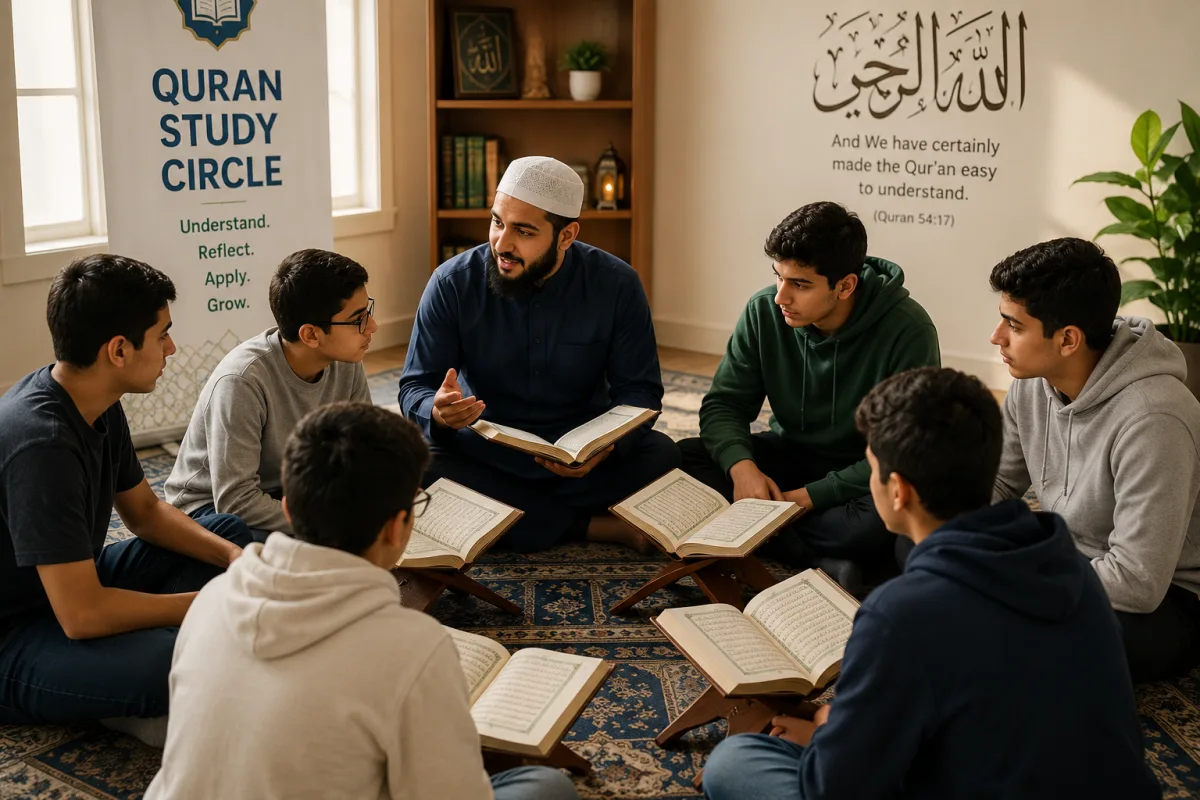
Choosing how to learn the Qur'an is a deeply personal decision, and for many sisters it comes down to one practical question: should you study online from home, or attend classes in person at a local mosque or study circle? Both paths can lead to the same beautiful goal — reading the Book of Allah with confidence, understanding, and correct Tajweed. Yet they feel very different day to day, and what suits one sister may not suit another.
Allah reassures every learner in Surah al-Qamar (54:17): "And We have certainly made the Qur'an easy to remember." That ease does not mean the journey requires no effort; it means the door is open to anyone who sincerely knocks, whatever their circumstances. A busy mother with young children, a working professional, a revert learning the Arabic letters for the first time, and a grandmother returning to the Qur'an after decades all deserve a route that fits their life.
This article offers an honest, balanced comparison of online and in-person Qur'an classes for sisters. We will not pretend one is perfect and the other is worthless. In-person study carries real blessings, especially the warmth of sisterhood and community. Online study, meanwhile, has quietly solved problems that kept many women away from learning for years. By the end, you should have a clearer sense of which is better for you.
Reading time: about 11 minutes.
Reviewed by the Tayseerul Quran Teaching Team Qualified Quran teachers helping children and adults learn Quran reading, Tajweed, Noorani Qaida, Hifz, and Arabic through one-on-one online classes.
What You'll Learn
- Privacy and comfort at home
- Access to qualified female teachers
- Flexibility for mothers and working women
- One-to-one attention and personalised pace
- Community and sisterhood where in-person shines
- Cost and long-term value
- Safety and safeguarding
- Consistency and staying on track
- What a qualified teacher's perspective adds
- A balanced verdict which is better for you
- Frequently Asked Questions
- Continue Learning
- Final Thoughts
- References
Privacy and comfort at home
For many sisters, privacy is not a luxury — it is the difference between learning and not learning at all. Reading the Qur'an aloud in front of others can feel exposing, especially in the early stages when you are still sounding out letters, correcting mistakes, and building confidence. Some women feel self-conscious about their accent or their pace. Others prefer, for reasons of modesty and personal comfort, not to sit in a room where they may be seen or heard by people outside their household.
Online classes remove that barrier almost entirely. You learn in your own room, in your own clothes, with your camera arranged however you wish. Many providers allow audio-only lessons with a female teacher, so you can recite freely without feeling watched. There is no getting ready to go out, no worry about who might be in the corridor, no rush to look presentable for a room full of strangers.
In-person study offers less of this shelter. A mosque class or community circle is, by nature, a shared space. For confident, outgoing learners that openness is energising. For a sister who is shy, recovering her confidence, or simply values her privacy, the home setting of an online Quran class often makes the whole experience feel safe enough to actually begin — and to keep going.
Access to qualified female teachers
This is one of the most decisive differences, and it deserves an honest look. In many towns and cities, there is simply no qualified female Qur'an teacher within reach. A sister may have a mosque nearby, but its classes are taught by men, run only for children, or scheduled at times she cannot attend. Learning to recite properly requires listening, imitating, and being corrected out loud, and many women strongly prefer to do that with another woman.
Online learning changes the map completely. Distance no longer decides your teacher. A sister in a small town can study with an experienced, ijazah-holding female teacher hundreds or thousands of miles away, matched to her level and goals. The Prophet ﷺ said, as recorded in Sahih al-Bukhari 5027, "The best of you are those who learn the Qur'an and teach it." Online platforms have widened access to exactly those teachers, so that geography no longer keeps sisters from the best available instruction.
In-person classes can only offer whoever happens to be local. When a skilled female teacher is nearby, that is a real gift. But for the majority of sisters worldwide, a female Quran tutor online is not a compromise — it is the only realistic way to study one-to-one with a woman who is genuinely qualified.
Flexibility for mothers and working women
Life rarely leaves neat, empty slots for study. Mothers work around feeding times, school runs, naps, and bedtimes. Working women study before dawn, on a lunch break, or late in the evening. Carers and students juggle responsibilities that shift week to week. A fixed weekly class at a fixed location, requiring travel each way, can be almost impossible to sustain — and one missed month often turns into quiet dropping out.
Online classes bend around your schedule instead of asking your schedule to bend around them. Lessons can be booked in short, frequent sessions, moved when something comes up, and slotted into the pockets of time you actually have. There is no commute eating into your day, no childcare to arrange just to attend, no weather to brave. A mother can study while the baby sleeps in the next room; a nurse can learn between shifts.
In-person classes ask more of your logistics: travel, timing, and often a rigid term structure. Some sisters thrive on that fixed rhythm — leaving the house is the discipline that keeps them accountable. But for those with unpredictable days, the flexibility of online study is frequently what makes learning possible at all. If your life is full, our guide to a Quran routine for busy mothers shows how small, consistent sessions add up.
One-to-one attention and personalised pace
Qur'an recitation is a precise skill. The difference between a correct and incorrect sound is often subtle — the placement of the tongue, the length of a vowel, the point of articulation of a letter. Allah instructs in Surah al-Muzzammil (73:4): "and recite the Qur'an with measured recitation." Learning to recite with that care requires close, attentive correction, ideally from a teacher who is focused on you alone.
One-to-one online lessons are built around exactly this. Your teacher hears every letter, catches every recurring slip, and adjusts the lesson to your pace. If you need three sessions on the heavy letters, you get them. If you are ready to move ahead, nothing holds you back. There is no waiting for a group to catch up and no feeling of being left behind.
In-person study can offer this too — but usually only in private tuition, which is expensive and, again, depends on a qualified teacher being local. Group classes, the more common in-person format, split the teacher's attention across many students. You may recite aloud only briefly and receive limited correction. For a skill this detail-oriented, undivided one-to-one attention is a genuine advantage of the online model.
Community and sisterhood where in-person shines
Here we must be fair, because in-person learning offers something precious that online study struggles to fully replicate. Sitting together in a room, reciting alongside other sisters, sharing tea afterwards, seeing familiar faces week after week — this builds a bond that a screen cannot easily match. For many women, the community is the reason they keep coming back.
That sisterhood has real spiritual and emotional value. It offers encouragement on hard days, gentle accountability, friendships that extend beyond the class, and the quiet strength of worshipping and learning in the physical company of others. A local circle can become a second family, a source of duʿā and support through life's ups and downs. None of that should be dismissed.
Online learning is not devoid of community — many platforms host group revision sessions, sister-only forums, and shared progress milestones — but the connection is naturally thinner than sitting knee to knee. If deep, in-person fellowship is what nourishes your faith, a local class, or a blend of both, may serve you better than online study alone. Honesty here matters more than winning an argument.
Cost and long-term value
Money is a practical reality, and the two paths differ. In-person private tuition, where available, tends to be the most expensive option, partly because it depends on a scarce local teacher and often includes travel costs for one of you. Group mosque classes, by contrast, are frequently low-cost or free — a real strength of community-based learning that no comparison should ignore.
Online classes usually sit between these extremes and offer strong value for what you receive. One-to-one lessons with a qualified female teacher, at a fraction of the price of local private tuition, are within reach for many households. There is no commute cost, no childcare arranged solely to attend, and flexible plans let you match your spending to the number of lessons you actually take. Many providers offer a free trial so you can test the fit before committing anything.
When weighing cost, look past the sticker price to the value delivered: teacher quality, individual attention, consistency, and whether the format is one you can genuinely maintain. The cheapest class helps nobody if life makes it impossible to attend, and a well-matched paid lesson you keep for years is often the better investment. Our FAQ on Quran classes for women covers common questions about pricing and plans in more detail.
Safety and safeguarding
Safeguarding matters for every learner, and it looks different in each setting. Online, the key questions are practical and answerable: Is the teacher verified and qualified? Are lessons conducted on a secure, reputable platform? Can you choose a female teacher and audio-only sessions? Reputable providers vet their teachers, keep records, and give you control over your own environment — you decide who sees and hears you, and you can end a session at any moment.
In-person study has its own considerations: the safety of travel, especially for evening classes; the setting and who else is present; and the reassurance of learning in a known community space. For some sisters, a familiar local venue feels safest. For others — particularly those who would otherwise travel alone after dark, or who live where suitable classes are absent — the controlled, at-home nature of online learning is the safer and calmer choice.
Whichever path you choose, ask direct questions before you begin. A trustworthy provider or institution will welcome them. Your comfort and safety are not an imposition; they are your right as a learner, and any good teacher understands that.
Consistency and staying on track
Progress in the Qur'an comes from steady repetition far more than from occasional bursts of intensity. The format that helps you show up regularly is, in practice, the better format for you — however impressive the alternative looks on paper. This is where honestly assessing your own life pays off.
Online study tends to win on consistency for people with full or unpredictable schedules, because it removes the friction of travel and rigid timing. When a lesson is a few clicks away, at a time you chose, you are far more likely to keep the habit alive week after week. Short, frequent sessions are easy to protect.
In-person study can win on consistency too, but through a different mechanism: the commitment of leaving the house, the accountability of a waiting teacher, and the pull of a community expecting you. If that external structure is what keeps you disciplined, honour it. Know yourself honestly — which kind of accountability actually keeps you going — and choose accordingly.
What a qualified teacher's perspective adds
From a teacher's chair, the pattern is clear: the sisters who progress fastest are rarely the ones with the most talent, but the ones whose learning format fits their life so well that they simply keep turning up. As qualified Qur'an teachers, we have seen women who struggled for years with sporadic local classes flourish once they could study one-to-one from home — and we have also seen sisters draw deep strength from a beloved in-person circle. Both are real.
Good teaching is not defined by the medium but by qualification, care, and correct method. A properly trained teacher listens for the fine details of articulation, corrects with patience, builds a plan around your specific weaknesses, and grounds it all in authentic method rather than guesswork. That standard can be met online or in person; what matters is that your teacher genuinely holds it. When choosing, ask about qualifications, ijazah, teaching experience, and how they handle correction — the answers tell you far more than the format does.
We also encourage sisters to keep learning grounded in trustworthy sources and, for any matter of religious ruling, to ask a qualified scholar rather than relying on general advice online. For the technical craft of recitation, though, a skilled teacher and a format you can sustain are the two things that matter most. If you are starting from the very beginning, a structured Noorani Qaida course online with a qualified teacher builds the foundation the right way.
A balanced verdict which is better for you
So which is better — online or in-person? Honestly, it depends on you, but the pattern is consistent enough to guide the choice. For most adult sisters worldwide, online classes win on the things that decide whether learning actually happens: privacy and comfort, access to qualified female teachers, flexibility around motherhood and work, one-to-one attention, and, often, cost and value. If any of these has kept you from starting, online study likely removes the obstacle.
In-person study wins where community and sisterhood are the heart of the matter, where a genuinely qualified female teacher is local and available, and where the discipline of leaving home is exactly what keeps you consistent. For sisters blessed with a warm, capable local circle, that fellowship is a real and lasting gift.
Many women find the wisest answer is not either-or but both: a steady rhythm of one-to-one online lessons for correction and progress, paired with an in-person circle when one is available for connection and community. Whatever you choose, choose the path you can sustain — because the Qur'an rewards the sister who keeps returning to it, gently and consistently, over years.
Frequently Asked Questions
Is online Quran learning as effective as in-person?
For the core skill of correct recitation, yes — often more so, because one-to-one online lessons give your teacher's full attention to your recitation and let the pace suit you. In-person group classes split attention across many students. Effectiveness depends far more on teacher quality and your consistency than on the medium itself.
Can I choose a female teacher for online classes?
Yes. Most reputable providers, including Tayseerul Quran, let you request a qualified female teacher, and many offer audio-only lessons for added privacy. This is one of the main reasons sisters choose online study, since a suitable female teacher is often unavailable locally.
What if I value the community of in-person classes?
That is a valid and beautiful reason to attend in person, and community should not be dismissed. Consider blending both: online one-to-one lessons for focused progress and correction, plus a local circle for sisterhood when one is available. You do not have to choose only one path.
Do I need any special equipment for online classes?
Very little. A smartphone, tablet, or laptop with a stable internet connection and a video-call app is usually enough. A pair of headphones helps you hear fine points of Tajweed clearly. Most providers guide you through the simple setup before your first lesson.
Is online Quran study suitable for complete beginners?
Absolutely. Beginners often benefit most, because a one-to-one online lesson can start from the very first Arabic letters without any pressure from a group. A structured Noorani Qaida programme with a patient teacher is an ideal starting point for adults new to Arabic.
How do I know an online teacher is genuinely qualified?
Ask directly about their qualifications, ijazah, and teaching experience, and take a trial lesson to judge their method and manner. A trustworthy provider welcomes these questions. For any question of religious ruling, always consult a qualified scholar rather than relying on general online sources.
Which option is cheaper?
Free or low-cost mosque group classes are often the cheapest in person. Local private tuition is usually the most expensive. Online one-to-one lessons typically sit in between and offer strong value, with no travel or childcare costs and flexible plans, plus a free trial to test the fit.
Continue Learning
- Female Quran tutor online
- Online Quran classes
- Quran classes for women FAQ
- A Quran routine for busy mothers
- Noorani Qaida online
Final Thoughts
There is no single right answer to the online-versus-in-person question — only the answer that fits your life, your comfort, and your goals. Be honest with yourself about what has helped you learn before and what has held you back. For most sisters, the privacy, flexibility, and access to a qualified female teacher that online study offers make it the path they can actually sustain; for others, the sisterhood of a local circle is irreplaceable. Both can bring you closer to the Book of Allah, and the very best choice is the one you will keep returning to.
If you would like to try learning in your own space, at your own pace, with a teacher matched to you, taking a small first step costs nothing.
Learn comfortably from home with a qualified female teacher — book a free trial →
References
- Surah al-Qamar (54:17)
- Surah al-Muzzammil (73:4)
- Sahih al-Bukhari 5027