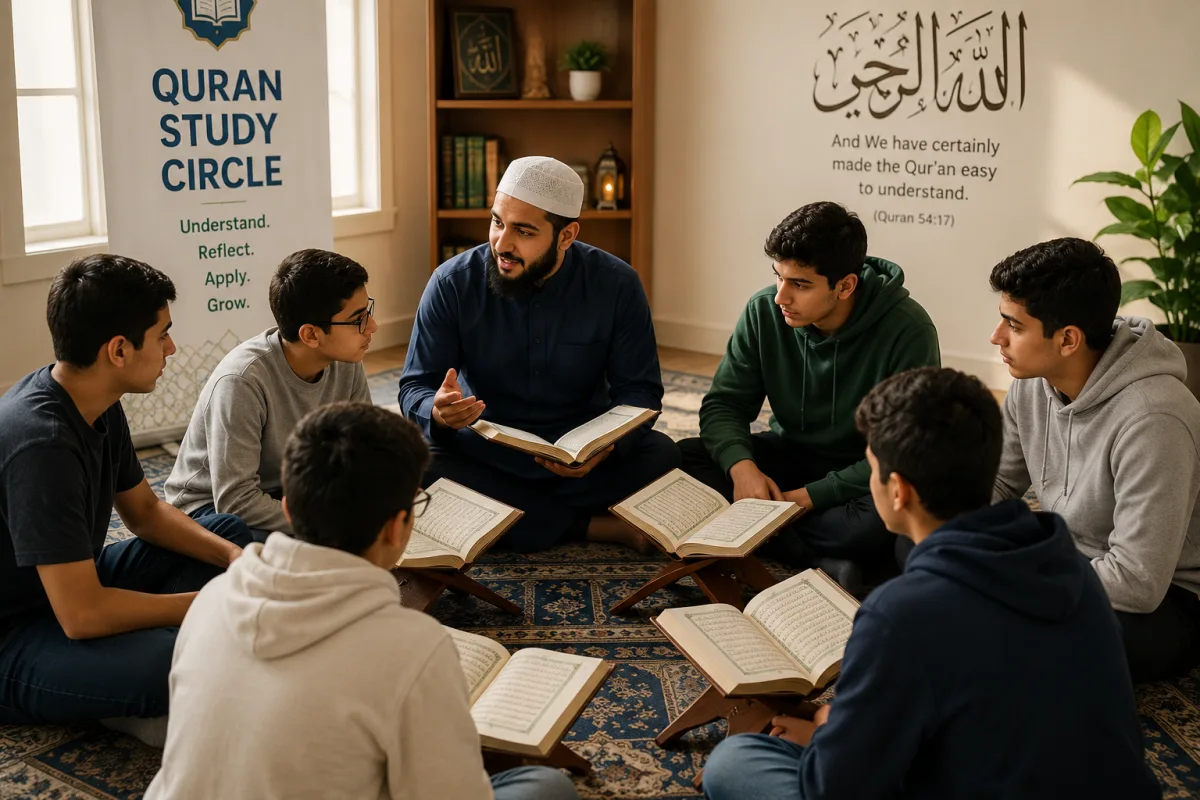
If you have ever searched for a way to improve your Quran recitation, you have probably run into the same fork in the road that almost every learner faces: should you take private, one-to-one lessons, or should you join a group class? Both formats can genuinely help you grow. Both are used every day by sincere students of all ages. And yet they feel very different in practice, and they tend to produce different results depending on what you are actually trying to achieve.
The reason this question matters so much is that reciting the Quran well is not only about reading the words on the page. It is about pronouncing each letter from its correct place, applying the rules of Tajweed, and reciting with care and beauty. Allah instructs the believers in Surah al-Muzzammil (73:4): "and recite the Quran with measured recitation." That "measured" quality is a skill built through steady, attentive practice — and the format of your lessons shapes how quickly and how precisely you build it.
This article gives you an honest comparison of private versus group Quran lessons. We will not pretend that one is perfect and the other is worthless, because that simply is not true. Instead, we will look at where each format shines, where each one struggles, and how to match the right format to your goals, your budget, your child, and your stage of learning.
Reading time: about 10 minutes.
Reviewed by the Tayseerul Quran Teaching Team Qualified Quran teachers helping children and adults learn Quran reading, Tajweed, Noorani Qaida, Hifz, and Arabic through one-on-one online classes.
What You'll Learn
- The Core Difference Between Private And Group Lessons
- Individual Attention And Real Time Correction
- Pace And Personalization
- Cost And Value For Money
- Motivation Accountability And Consistency
- Community Social Learning And Barakah
- Which Format Suits Recitation And Tajweed
- Which Format Suits Beginners And Children
- A Qualified Teacher Perspective On Quality And Trust
- A Balanced Verdict Choosing What Fits You
The Core Difference Between Private And Group Lessons
At the simplest level, the difference comes down to attention. In a private lesson, one teacher works with one student for the whole session. Every minute of that time is yours. The teacher listens only to your voice, watches only your mouth, and corrects only your mistakes. In a group lesson, that same teacher divides attention among several students, and each student receives a share of the time rather than all of it.
Neither arrangement is inherently better for every purpose. A group can create energy, friendly comparison, and a sense of belonging that some learners thrive on. A private setting creates focus, safety, and a pace built entirely around one person. The trick is understanding what you are trading in each direction so you can choose deliberately rather than by accident.
Online learning has blurred some of these lines. A well-run online Quran class can offer a private one-to-one setting from your own home, or a small structured group, depending on what the school provides. So the question is less about "online versus in person" and more about how many students share the teacher's attention in each session.
Individual Attention And Real Time Correction
This is where private lessons show their clearest advantage. Recitation is a spoken skill, and spoken skills are corrected in the moment. When you mispronounce a heavy letter, shorten a vowel that should be stretched, or miss a rule of ghunnah, a private teacher hears it immediately and stops you right there. You repeat the word correctly, you feel the difference in your mouth, and the correct habit begins to form before the mistake settles in.
In a group, correction still happens, but it is spread thin. If eight students are reciting in turn, the teacher may catch a recurring error in one student and address it to the whole class, which is efficient but general. Your specific slip on a specific letter might pass unheard simply because there was not time to listen to you alone. Over weeks, small uncorrected errors can quietly become fixed habits that are harder to unlearn later.
The Prophet ﷺ received the Quran directly, and Sahih al-Bukhari 5027 records his teaching: "The best among you (Muslims) are those who learn the Quran and teach it." That transmission — one who knows listening closely to one who is learning — is the heart of what one-to-one correction preserves. If precise correction is your priority, the private format is built for it. Our guide on how to improve your Quran recitation goes deeper into how targeted feedback accelerates progress.
Pace And Personalization
Every learner moves at a different speed, and every learner has different weak spots. In a private lesson, the pace is yours completely. If you grasp the rules of noon saakin quickly, you move on. If a particular sound gives you trouble for three weeks, the teacher stays with it patiently until it is solid. Nothing is rushed and nothing drags, because the whole plan bends around you.
Group lessons follow a shared curriculum and a shared pace. This has real value: structure keeps a class moving forward and stops any one student from stalling the whole group indefinitely. But it also means the fast learner sometimes waits while others catch up, and the slower learner sometimes feels pushed past a point they had not truly mastered. A good group teacher manages this skillfully, but the tension is built into the format.
Personalization also affects what you study. A private student can request focused work on Tajweed rules, on a specific surah for prayer, or on preparation for Hifz. A group works through a set path. If your goals are unusual or your schedule is tight, the flexibility of private lessons is hard to match.
Cost And Value For Money
Here group lessons have a genuine, honest advantage. Because the teacher's time is shared among several students, the cost per student is usually lower. For families on a tight budget, or for anyone who wants regular Quran learning without a large monthly commitment, a group class can make consistent study affordable and sustainable. That affordability is not a small thing — the best lesson format is the one you can actually keep attending.
Private lessons cost more because you are paying for undivided time and expertise. For many learners that cost is well justified by faster, more precise progress, especially when correcting recitation. But it is fair to say that private is the larger investment, and not every family can or needs to make it for every child at every stage.
There is also a middle path worth knowing about. Some schools offer small-group lessons — three or four students rather than ten — which sit between the two extremes on both cost and attention. And some learners combine formats: private lessons for the demanding work of Tajweed correction, plus a group setting for revision and community. Value for money is not only about the lowest price; it is about what you get for what you pay relative to your goal.
Motivation Accountability And Consistency
Motivation cuts in interesting ways here, and neither format wins outright. Private lessons create strong accountability of a personal kind: your teacher knows exactly what you practiced and what you did not, and there is nowhere to hide. Many students find that this gentle, direct responsibility keeps them consistent, and the close relationship with one teacher becomes a real source of encouragement over time.
Group lessons offer a different fuel: the motivation of company. Seeing peers work hard, hearing others recite, and feeling part of a shared journey can push a student to keep up and stay engaged. For learners who feel lonely or unmotivated studying alone, the social energy of a group can be exactly what carries them through the hard middle stretch where enthusiasm usually dips.
The risk in a group is that it is easier to blend into the background, coast quietly, and let a stronger student carry the session. The risk in private lessons is that without peers, a less disciplined student may lean entirely on the teacher's structure. Knowing your own temperament honestly is the key to predicting which kind of motivation will actually work for you.
Community Social Learning And Barakah
Islam is deeply communal, and there is something beautiful about learning the Quran alongside others. A group class can build friendships, create a sense of shared purpose, and remind students that they are part of a wider community of learners walking the same path. Children in particular often love the social side, and adults sometimes find that studying with others deepens their commitment and their joy in the process.
There is also the matter of gathering to learn the Book of Allah, which carries its own spiritual weight in the tradition. Sitting together in remembrance and study is praised, and many learners feel that a group carries a certain warmth and blessing that solitary study lacks. This is a real benefit of group formats and one that should not be dismissed by anyone weighing purely practical factors.
Private lessons are not devoid of relationship — the bond between a dedicated teacher and student is precious, and for many that one strong connection is enough. But if community and social belonging are important to you or your child, a group setting delivers something that a one-to-one lesson, by its nature, does not.
Which Format Suits Recitation And Tajweed
When the goal is refining recitation and mastering Tajweed, private one-to-one lessons usually have the edge, and it is worth being clear about why. Tajweed is a craft of tiny, precise adjustments — the exact length of a stretch, the exact point of articulation, the subtle nasal sound of ghunnah. These details are hard to hear in a crowd and hard to fix without repeated, individual attention on your particular voice.
The Quran itself points to careful attention to how it is recited. Allah asks in Surah al-Qamar (54:17): "And We have certainly made the Quran easy to remember. So is there any who will remember?" The ease is real, but it is unlocked through consistent, corrected practice — and correction of fine detail is exactly what a private lesson provides most fully. If your main aim is to recite more beautifully and accurately, prioritize the format that lets a teacher hear you and only you.
That said, group Tajweed classes have a place too, especially for learning the rules themselves. Understanding the theory of Tajweed — what the rules are and when they apply — can be taught well in a group. It is the applied, spoken correction of your own recitation that benefits most from one-to-one time. Our beginner's guide to Tajweed explains the rules that both formats build on.
Which Format Suits Beginners And Children
Absolute beginners have a specific need: they must learn the letters, the sounds, and the foundations of reading through Noorani Qaida before anything else. A beginner making early mistakes benefits enormously from immediate, patient correction, which points toward private lessons for the earliest stage. Building correct habits from day one saves years of undoing errors later.
For children, the picture is more nuanced. Some children flourish in a group, energized by peers and by a sense of friendly progress together. Others — especially younger children or those who are shy — get distracted, fall behind quietly, or lose confidence when compared to faster classmates. Many parents find that a young child learning to read Quran does best with the focused, gentle, one-to-one attention that keeps them engaged and moving. Our guide to online Quran classes for kids explores how to keep children motivated in either setting.
The honest answer is that it depends on the individual child and stage. A confident, social child who has already learned to read may thrive and save money in a group. A brand-new reader, or a child who needs coaxing to focus, will usually get more from private lessons at the start, perhaps moving to a group later for revision and community once the foundations are firm.
A Qualified Teacher Perspective On Quality And Trust
Whichever format you choose, the single most important factor is the teacher. A format is only a container; the teacher is what fills it. A skilled, qualified teacher with a proper grounding in Tajweed and a gift for explaining can make a group class outstanding, while an unqualified tutor can waste your time even one-to-one. So before comparing formats, ask about the teacher's qualifications, their training, and how they were taught themselves.
From a teaching standpoint, the reason we lean toward one-to-one for correction is not marketing — it is what happens in the room. When a teacher can hear a single student clearly, they can diagnose the exact cause of an error, whether it is tongue placement, breath control, or a misunderstood rule, and prescribe the precise fix. That diagnostic precision is difficult across many voices at once. It is the same principle by which the Quran was transmitted person to person, carefully and faithfully, across the generations.
For any question about religious rulings — such as the etiquette of reciting, obligations around learning, or matters specific to your situation — please ask a qualified scholar rather than relying on a general article. Our role as teachers is to help you read and recite correctly; matters of fiqh and ruling belong with those trained to give them. If you would like more on common learner questions, our Quran recitation FAQ addresses many of them directly.
A Balanced Verdict Choosing What Fits You
So which improves recitation faster? For the specific job of correcting and refining how you recite, private one-to-one lessons are usually the faster and more thorough route, because they give you undivided attention, immediate correction, and a pace built entirely around your voice. If beautiful, accurate recitation is your main goal, that is the honest recommendation.
But "faster for recitation correction" is not the same as "better for everyone in every situation." Group lessons win on cost, offer real community and social motivation, and suit confident learners who already read well and want structured, affordable practice among peers. For many families, the wisest path is not choosing one forever but sequencing them: private lessons to build strong foundations and fix recitation, and group settings for community, revision, and sustained motivation once the basics are solid.
Choose based on your actual goal, your budget, your temperament, and — if it is a child — their personality and stage. There is no shame in either choice, and both are honorable ways to draw closer to the Book of Allah. What matters most is that you start, that you stay consistent, and that whoever teaches you is genuinely qualified to do so.
Frequently Asked Questions
Are private Quran lessons really worth the extra cost?
For focused recitation correction and Tajweed refinement, most learners find the extra cost worthwhile because progress is faster and more precise. If your budget is tight or your goals are more general, a good group class can still serve you well, so weigh the cost against your specific aim.
Can group lessons still improve my recitation?
Yes. Group lessons genuinely help, especially for learning Tajweed rules, staying motivated, and practicing regularly at an affordable price. The main limitation is that individual, in-the-moment correction of your own voice is thinner than in a private setting, so fine recitation errors may take longer to catch.
Which is better for a complete beginner?
Beginners usually benefit most from private lessons at the very start, so that correct pronunciation and reading habits form from day one. Some confident beginners do fine in a small group, but early one-to-one attention tends to prevent errors that are hard to unlearn later.
Is a group class better for my child socially?
It can be. Many children enjoy the friendship and shared energy of a group, which helps motivation. Others, especially shy or very young children, focus better one-to-one. Consider your child's personality and current reading level rather than choosing by cost alone.
Can I combine private and group lessons?
Absolutely, and many learners do. A common approach is private lessons for demanding recitation and Tajweed work, plus a group setting for revision, community, and motivation. This blends the strengths of both formats while managing overall cost.
How important is the teacher compared to the format?
Very important. A qualified, skilled teacher can make either format excellent, while an unqualified one can waste your time in any setting. Always ask about a teacher's training and qualifications before focusing on private versus group.
Does online learning change this comparison?
Online delivery makes both formats widely accessible from home. A one-to-one online lesson preserves the full attention of private study, while online groups keep costs down and build community. The core trade-offs between private and group remain the same online as in person.
Continue Learning
- How to Improve Your Quran Recitation
- Online Quran Classes: What to Expect
- Online Quran Classes for Kids
- Tajweed for Beginners
- Quran Recitation FAQ
Final Thoughts
The private-versus-group question does not have a single winner, and anyone who tells you otherwise is oversimplifying. Private one-to-one lessons are usually the faster, more thorough route to correcting and beautifying your recitation, thanks to undivided attention and immediate feedback. Group lessons bring real gifts of their own — lower cost, community, and the motivating energy of learning alongside others.
Match the format to your goal and your circumstances, keep your teacher's qualifications at the center of your decision, and above all, begin and stay consistent. Whether you learn one-to-one or in a group, every corrected letter is a step closer to reciting the Quran as it deserves to be recited.
Experience one-to-one correction — book a free trial lesson →
References
- Surah al-Muzzammil (73:4): "and recite the Quran with measured recitation."
- Surah al-Qamar (54:17): "And We have certainly made the Quran easy to remember. So is there any who will remember?"
- Sahih al-Bukhari 5027: "The best among you (Muslims) are those who learn the Quran and teach it."