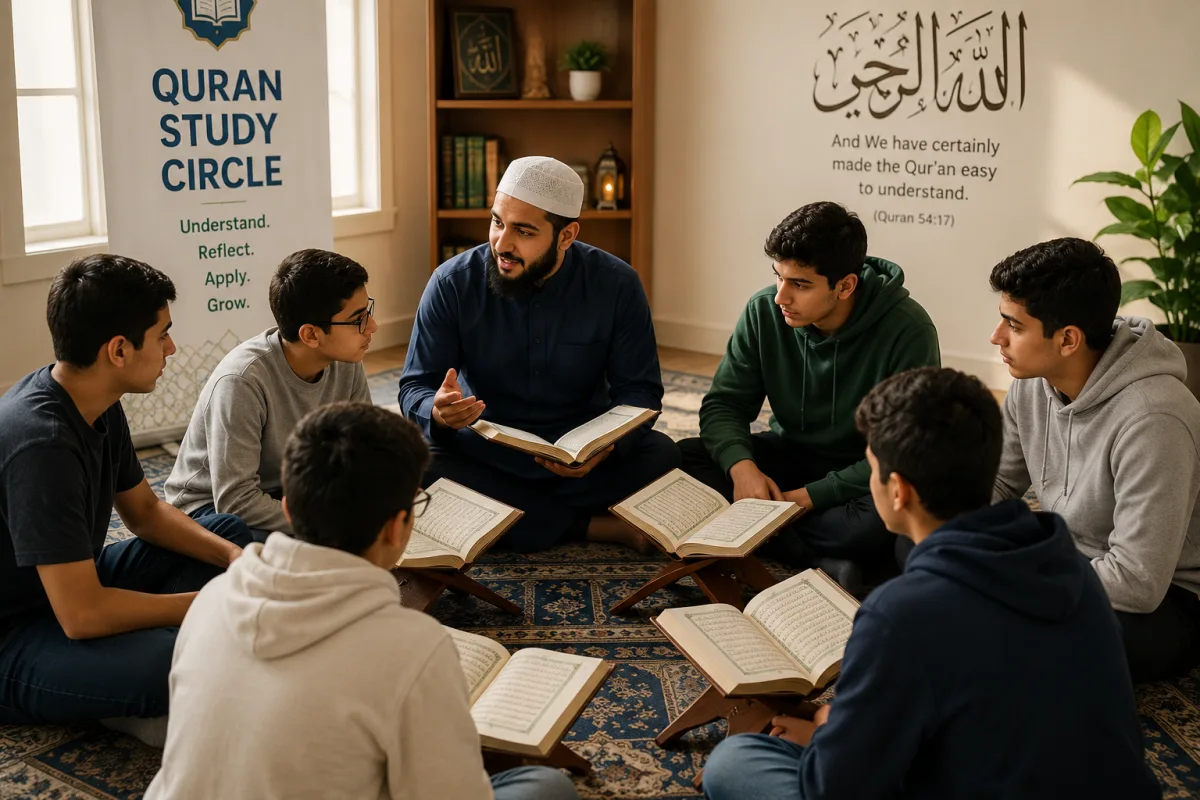
If you have ever finished a page of the Qur'an and quietly wondered, "Am I actually doing this right?", you are in good company. Almost every learner — from the child sounding out their first letters to the adult returning after decades away — carries a handful of the same questions. Why do I keep stumbling on the same word? Do I really need a teacher listening in? How long until I recite the way I hear reciters recite online? These are not silly questions. They are the honest, practical concerns of people who care about reading the Book of Allah beautifully and correctly.
The good news is that reciting the Qur'an well is a learnable skill, and it always has been. Allah described the manner of recitation directly in the Qur'an: "and recite the Qur'an with measured recitation" (Surah al-Muzzammil 73:4). That single instruction — slow, deliberate, measured — quietly answers a surprising number of the worries below. Recitation was never meant to be rushed or perfect on the first try. It was meant to be steady.
This article gathers the questions we hear most often from students around the world and answers them plainly, without jargon and without pressure. Whether you are trying to smooth out your fluency, silence that nagging feeling that you make the same mistakes forever, or simply work out how much daily practice is "enough," you will find a grounded, encouraging answer here. Let's begin.
Reading time: about 11 minutes.
Reviewed by the Tayseerul Quran Teaching Team Qualified Quran teachers helping children and adults learn Quran reading, Tajweed, Noorani Qaida, Hifz, and Arabic through one-on-one online classes.
What You'll Learn
- Improving Your Recitation Day To Day
- The Same Mistakes Problem
- Do You Need A Teacher
- Timelines And Realistic Expectations
- Fluency Speed And Rhythm
- Feedback Practice And Consistency
- Children And Recitation
- Confidence And Nervousness
- A Qualified Teacher's Perspective
- Frequently Asked Questions
- Continue Learning
- Final Thoughts
- References
Improving Your Recitation Day To Day
Most improvement in recitation does not come from one dramatic breakthrough. It comes from small, repeated corrections that add up over weeks. Understanding what actually moves the needle helps you spend your time on the things that matter.
How can I improve my Quran recitation?
The most reliable path is simple to state and harder to practise: recite slowly, listen to a skilled reciter for the same passage, and repeat short sections until they feel natural before moving on. Improvement is built on repetition of correct sound, not on covering more pages. Trying to read faster or read more usually cements existing mistakes rather than fixing them.
A practical loop looks like this. Choose a few lines. Listen to how a qualified reciter pronounces them. Read them aloud slowly yourself. Compare honestly. Repeat the same lines until the letters and rules come out without effort. Only then move on. This is unglamorous work, but it is exactly how fluent reciters were built. If you want a structured version of this routine, our guide to improving your Quran recitation breaks it down step by step.
Should I focus on Tajweed or fluency first?
For most learners, the two grow together rather than one before the other. You do not need to master every Tajweed rule before you are allowed to become fluent, and you should not try to read quickly before your pronunciation of the letters is sound. A balanced approach is to build correct letter pronunciation (the makharij, or points of articulation) first, then layer the rules of Tajweed on top while your reading gradually becomes smoother. If you are starting from the beginning, Tajweed for beginners explains which rules to learn first and why.
The Same Mistakes Problem
Few things frustrate learners more than making the same error over and over. It can feel like proof that you are not improving. Usually it is the opposite: it is a sign that a small habit was learned incorrectly and simply needs to be un-learned with attention.
Why do I keep making the same recitation mistakes?
Repeated mistakes almost always come from a mistake that became a habit before it was corrected. Your mouth learned a sound or a rhythm one way, and now it repeats that pattern automatically, even when you "know" the correct version in your head. The problem is rarely a lack of effort or ability. It is that the wrong version was practised many times before anyone caught it.
Breaking the pattern requires two things: someone (or something) pointing out the exact mistake clearly, and then slow, deliberate repetition of the correct version until the new habit overwrites the old one. You cannot fix what you cannot hear, which is why an outside ear matters so much for stubborn errors. Reading faster in the hope that the mistake "smooths out" does the reverse — it locks the error in deeper.
Can I fix a mistake I have made for years?
Yes. Long-standing mistakes take a little more patience because the habit is deeply grooved, but they are not permanent. The brain and mouth remain capable of forming new patterns at any age. The method is the same as for any mistake: isolate the specific word or rule, hear it done correctly, and repeat the correct form slowly and often. What changes with an old habit is only the number of repetitions needed, not whether it can be fixed.
Do You Need A Teacher
This is one of the most common questions, especially now that so much material is available for free online. The honest answer has some nuance to it.
Do I need a teacher to correct my recitation?
For accurate recitation, some form of correction from a knowledgeable person is extremely valuable, and for most learners it is what separates slow, uncertain progress from steady, confident improvement. The reason is straightforward: you cannot reliably hear your own mistakes. Certain letters sound almost identical to an untrained ear, and Tajweed rules involve subtle differences in sound and length that are difficult to self-assess. A teacher hears what you cannot and corrects it before it becomes a habit.
The Qur'an itself was transmitted through listening and correction — the Prophet ﷺ received it and taught it by recitation, person to person. That tradition of learning "from the mouth of a teacher" exists precisely because recitation is an oral skill that is hard to perfect alone. This is also why one-to-one attention is so effective: the correction is immediate and specific to you.
Can I learn to recite well on my own?
You can make real progress on your own, especially with good audio recordings to imitate and honest self-recording to check yourself. Many learners improve their fluency and confidence this way. What is very hard to achieve alone is confirming that your finer pronunciation and Tajweed are truly correct, because the errors you most need to catch are the ones you cannot hear. A common and sensible approach is to practise heavily on your own and check in with a qualified teacher regularly so your independent practice stays on the right track. Our comparison of private versus group Quran lessons can help you decide what kind of guidance fits your situation.
Timelines And Realistic Expectations
Almost everyone wants to know how long this will take. It is a fair question, but the honest answer depends on where you start and how consistently you practise.
How long does it take to recite the Quran well?
There is no fixed timeline, and anyone who promises an exact number is guessing. That said, some realistic patterns hold. A beginner who practises consistently can usually read the Arabic script and apply basic Tajweed within a matter of months, not years. Reciting with genuine fluency and beauty — the kind you admire in skilled reciters — is a longer journey that continues even for advanced students. The key variable is not talent; it is consistent, correct practice. Fifteen focused minutes every day will carry you far further than a long session once a week.
Is it too late to improve as an adult?
It is never too late. Adults sometimes assume that children learn recitation more easily and that the window has closed for them, but adult learners bring real advantages: they can understand explanations of the rules, follow a structured plan, and stay disciplined about daily practice. Plenty of adults begin from the very basics — even from Noorani Qaida — and go on to recite beautifully. The obstacle is almost never age. It is usually the false belief that improvement is no longer possible, which quietly stops people from starting. If you are returning to recitation later in life, online Quran classes are designed to meet you exactly where you are.
Fluency Speed And Rhythm
Once the basics are in place, learners often ask how to sound smoother and whether they should be reading faster. Here the guidance from the Qur'an itself is remarkably clear.
How can I recite more fluently?
Fluency is the result of familiarity, and familiarity comes from repetition. The passages you recite often will feel effortless; the ones you rarely touch will always feel clumsy. To become more fluent, recite the same portions regularly rather than constantly reading new material. Reading aloud daily, even briefly, trains your mouth and eyes to work together smoothly. Listening to a skilled reciter and then imitating the flow of their recitation is one of the fastest ways to internalise natural rhythm and pacing.
Should I recite fast or slowly?
Slowly — especially while learning. This is not merely practical advice; it reflects the Qur'anic instruction to "recite the Qur'an with measured recitation" (Surah al-Muzzammil 73:4). Measured, unhurried recitation gives you time to pronounce each letter correctly, apply the Tajweed rules, and actually reflect on the words. Speed, when it comes, should be a natural by-product of familiarity, never a goal you chase. A student who recites slowly and correctly is progressing well, even if it feels less impressive than reading quickly. Rushing almost always sacrifices accuracy, and accuracy is the whole point. If you want a paced routine that builds fluency safely, our Quran recitation practice plan lays one out clearly.
Feedback Practice And Consistency
Two practical questions come up constantly: how do I know if I am improving, and how much should I practise? Both have clear, doable answers.
How can I get feedback on my recitation online?
Online learning has made feedback more accessible than ever. The most effective method is live one-to-one lessons, where a qualified teacher listens as you recite and corrects you in real time — this is the closest thing to the traditional way the Qur'an has always been taught. Between lessons, recording yourself and comparing your recitation to a skilled reciter is a powerful self-feedback tool; hearing yourself back reveals mistakes you miss while reading. A good rhythm is to practise and self-record often, and bring your recitation to a teacher regularly so that real errors get caught early. Modern one-to-one online classes make this loop simple to maintain from anywhere in the world.
How much should I practise recitation each day?
Consistency beats duration. A short daily session — even ten to fifteen minutes — repeated every day will outperform a single long session once a week, because recitation is a physical skill built through frequent repetition. The ideal is little and often. If you can manage more, wonderful, but do not let the idea of a "perfect" long session stop you from doing the small, regular practice that actually produces results. Attach it to an existing daily habit, such as after a particular prayer, so it becomes automatic rather than something you have to remember.
Children And Recitation
Parents often ask whether the same principles apply to their children, and whether kids really improve at recitation the way adults hope they will.
Can children improve their recitation quickly?
Children often absorb the sounds of recitation very naturally, and with regular, patient practice they can improve noticeably. What matters most for children is the same as for adults — consistency and correct guidance — but delivered in a way that stays gentle and encouraging. Short, frequent, positive sessions work far better than long ones that feel like a chore. Praising effort, keeping sessions light, and letting the child recite along with a skilled reciter all help a great deal.
How do I keep a child motivated to practise?
Keep it short, warm, and free of shame. Children lose motivation quickly when practice becomes stressful or when mistakes are met with frustration. Celebrate small wins, keep sessions brief, and make recitation a calm part of the daily routine rather than a test. A patient teacher who knows how to encourage young learners — rather than merely correct them — makes an enormous difference in whether a child grows to love recitation or dread it. One-to-one lessons help here too, because the pace can be tailored entirely to the child.
Confidence And Nervousness
Finally, one of the most human questions of all — and one people are often too shy to ask aloud.
How do I stop feeling nervous when I recite?
Nervousness when reciting is extremely common, and it fades with familiarity and gentle repetition, not with pressure. Much of the anxiety comes from fear of making a mistake in front of others. Two things help most. First, remember that recitation is an act of worship and effort, not a performance to be judged; sincere effort is what is asked of you, and mistakes while learning are entirely normal and even rewarded. Second, practise reciting aloud regularly in a low-pressure setting so that speaking the words becomes ordinary rather than frightening. A supportive one-to-one teacher, where there is no group to feel self-conscious in front of, is often exactly what a nervous learner needs to find their voice.
There is a beautiful, comforting narration here. The Prophet ﷺ said that the one who recites the Qur'an and is skilled in it will be with the noble scribes, "and the one who recites the Qur'an and stumbles in it, and finds it difficult, will have a double reward" (Sahih al-Bukhari 5027). In other words, the very difficulty you feel while struggling through recitation is not a mark against you — it carries reward. Let that ease your heart the next time you feel nervous.
A Qualified Teacher's Perspective
After years of teaching recitation to children and adults across many countries, a few truths stand out to our teaching team — things that rarely appear in a list of rules but shape whether a student succeeds.
The first is that almost everyone underestimates how much a small, consistent habit accomplishes and overestimates the value of long, occasional bursts. Students who recite a little every day, and who are corrected regularly, quietly overtake more "talented" students who practise sporadically. Progress in recitation is cumulative, and it rewards patience above intensity.
The second is that the single biggest accelerator we see is timely correction. A mistake caught in the first week takes minutes to fix; the same mistake caught after a year of repetition takes weeks. This is not a sales point — it is simply what we observe. It is also why the tradition of learning recitation directly from a teacher has endured for centuries: the Qur'an is an oral skill, transmitted and refined through listening and correction, from the time of the Prophet ﷺ until today.
The third is gentleness. The students who last — who are still reciting years later — are almost always the ones whose early experience was patient and encouraging rather than harsh. Correction and kindness are not opposites. The best teaching holds both at once. On any question of religious ruling, rather than fine points of pronunciation, we always encourage students to ask a qualified scholar, as our role is teaching recitation, not issuing rulings.
Frequently Asked Questions
How can I improve my Quran recitation the fastest?
Recite short passages slowly, imitate a skilled reciter, and repeat the same lines until they are effortless before moving on — while getting your mistakes corrected regularly. Frequent correct repetition, not covering more pages, is what produces the fastest genuine improvement.
Do I really need a teacher, or can I self-study?
You can make real progress alone, but confirming that your pronunciation and Tajweed are truly correct is very hard by yourself, because the errors you most need to fix are ones you cannot hear. Most learners progress best by combining independent practice with regular correction from a qualified teacher.
How long will it take me to recite well?
There is no fixed timeline, but consistent daily practice lets many beginners read the script with basic Tajweed within months. Reciting with true fluency and beauty is a longer, ongoing journey, and consistency matters far more than talent.
Should I recite the Quran quickly or slowly?
Slowly, especially while learning. The Qur'an instructs measured recitation (Surah al-Muzzammil 73:4), and reciting slowly gives you time to pronounce each letter and apply Tajweed correctly. Speed should come naturally with familiarity, never as a goal.
Is it too late for me to improve as an adult?
No. Adults have real advantages — they can understand the rules, follow a plan, and practise with discipline. Many adults begin from the basics and go on to recite beautifully. The main obstacle is the false belief that it is too late, not age itself.
How much should I practise each day?
A short daily session of ten to fifteen minutes, done consistently, is more effective than one long session per week. Recitation is a physical skill built through frequent repetition, so little and often wins.
Why do I keep making the same mistakes?
Repeated mistakes come from a habit learned incorrectly before it was corrected. To break the pattern, have the specific error identified clearly, then repeat the correct version slowly and often until the new habit replaces the old one.
Continue Learning
- How to improve your Quran recitation
- Tajweed for beginners
- Noorani Qaida online
- A Quran recitation practice plan
- Private vs group Quran lessons
Final Thoughts
If you take only one idea from all of these questions, let it be this: reciting the Qur'an well is not reserved for the naturally gifted or for those who started as children. It is a skill built by ordinary people through slow, steady, corrected practice — a little every day, done patiently and without shame. The measured recitation the Qur'an itself asks for is not a high bar to fear; it is an invitation to take your time and read with care.
Every stumble you push through is progress, and as the Prophet ﷺ reminded us, even the difficulty carries reward. So be gentle with yourself. Recite slowly, get corrected regularly, and keep showing up. The beauty you are hoping for is on the other side of consistency, and it is closer than you think.
Book a free trial Quran recitation lesson today →
References
- Surah al-Muzzammil (73:4)
- Surah al-Qamar (54:17)
- Sahih al-Bukhari 5027