There is a particular kind of longing that many mothers carry quietly. It is the wish to sit with the Qur'an — really sit with it — and read it the way it deserves to be read. Not rushed, not guessed at, not half-remembered from a childhood class that ended too soon. For years it stays folded up inside the busyness of raising a family, waiting for a season that never quite seems to arrive. If that longing lives in you, this article was written with you in mind.
What follows is an illustrative, representative journey — a picture of a typical path that many sisters walk when they decide to learn the Qur'an as adults. It is not the testimony of one specific person, and none of the moments described belong to a real named individual. There are no invented quotes and no claims about anyone in particular. Think of it instead as a mirror held up to a very common experience, so that you can recognise yourself somewhere in it and see that the road is walkable.
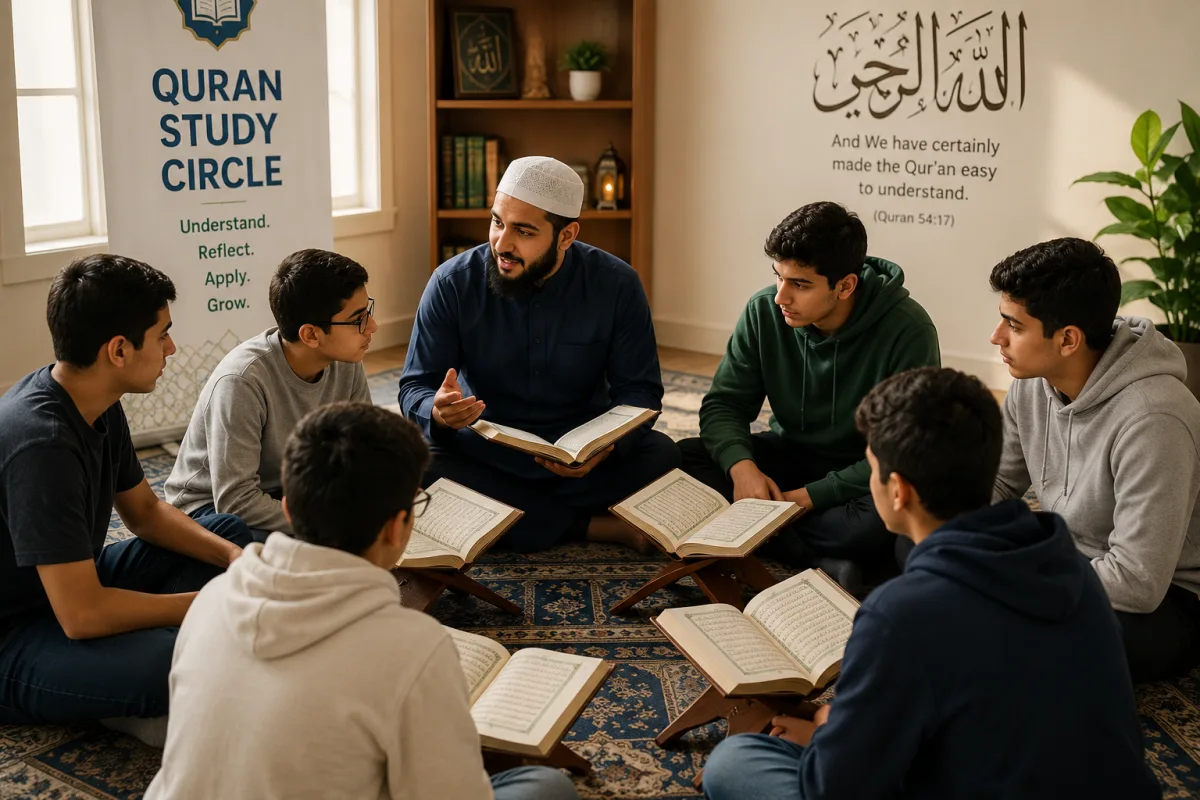
Allah reminds us of how approachable this Book is meant to be: "And We have certainly made the Qur'an easy to remember. So is there any who will remember?" (Surah al-Qamar, 54:17). That gentleness is the spirit of everything below. Learning to read the Qur'an as a mother is not a race against younger students or a test of how much free time you have. It is a slow, dignified return to something that was always meant for you.
Reading time: about 11 minutes.
Reviewed by the Tayseerul Quran Teaching Team Qualified Quran teachers helping children and adults learn Quran reading, Tajweed, Noorani Qaida, Hifz, and Arabic through one-on-one online classes.
What You'll Learn
- The Intention You Kept Postponing
- Starting From the Letters Again as an Adult
- Carving Out Time Around the Children
- The First Surah Read Correctly
- Learning Alongside Your Children
- When Busy Family Weeks Pull You Off Course
- The Quiet Growth of Confidence
- What Actually Makes the Difference
- A Teacher's Perspective
- Frequently Asked Questions
- Continue Learning
- Final Thoughts
The Intention You Kept Postponing
Almost every adult learner begins in the same place: with an intention that has been quietly postponed for a long time. Perhaps you learned a little as a child and then life moved on. Perhaps you never had the chance at all, and you have carried a low, persistent ache about it ever since. Then a baby arrives, and another, and the years fill up with feeding, school runs, cooking, and the thousand small acts of love that motherhood is made of. The intention does not disappear. It simply waits.
What often finally breaks the delay is a small, ordinary moment. You hear your child stumble over a verse and realise you cannot correct them with certainty. You stand in prayer and wish you understood more of the words leaving your own lips. You watch someone recite beautifully and feel a pull rather than envy. None of these are dramatic. But they are the nudges that turn "one day" into "this week."
It helps to name a truth here plainly: the postponement was never a sign that you did not care. It was a sign of how much you were giving to everyone else. Choosing now to learn is not selfish — it is you finally letting yourself receive something too. The Prophet ﷺ said, "The best of you are those who learn the Qur'an and teach it" (Sahih al-Bukhari 5027), and every teacher was once a beginner who simply decided to start.
Starting From the Letters Again as an Adult
One of the biggest fears adult learners carry is that starting from the beginning — from the individual Arabic letters and their sounds — is somehow beneath them, or embarrassing. It is neither. In truth, going back to the foundations is exactly what allows adults to progress quickly and correctly rather than building shaky habits on a weak base.
Starting again as an adult actually has hidden advantages. You understand why a sound matters. You can hear the difference between two similar letters when a teacher points it out, and you can hold a rule in your mind across a whole week. A four-year-old learns by pure repetition; you learn by repetition and understanding, which is a powerful combination. Many mothers are surprised at how much faster things click than they feared.
The structured path most learners follow is the Noorani Qaida, a foundational primer that walks you from single letters, to joined letters, to short words, and finally to reading connected verses with the correct rules of pronunciation. It is not childish — it is the same architecture that produces confident, accurate reciters at every age. Working through it with a patient teacher who never makes you feel rushed is one of the kindest things you can do for your future self.
Remember, too, that the very first revelation of the Qur'an was itself an instruction to a beginner: "Recite in the name of your Lord who created" (Surah al-Alaq, 96:1). The word was recite — read, begin, speak the words aloud. You are not doing something strange. You are answering the oldest invitation there is.
Carving Out Time Around the Children
The single most common question mothers ask is not about the Arabic. It is: when am I supposed to fit this in? The honest answer is that you do not find the time — you build it, in small and defended pockets, and you protect it the way you protect your children's mealtimes.
For many mothers the natural windows are the quiet edges of the day. The half hour after the little ones sleep. The lull during an afternoon nap. The early morning before the house wakes, which carries a barakah all its own. Allah Himself pointed to the special quality of the night for this: "Indeed, the night is more effective for concurrence and more suitable for words" (Surah al-Muzzammil, 73:4). You do not need hours. A consistent twenty to thirty minutes, a few times a week, will carry you further than an occasional marathon session you can never repeat.
The practical secret is to shrink the goal until it is impossible to fail. One page. One rule. Five new words. When the target is small, you meet it even on hard days, and meeting it keeps the habit alive. If you would like a fuller, realistic framework for this, we wrote a whole guide on building a busy mother's Qur'an routine that fits around real family life rather than an imaginary one.
Fixed one-to-one class times help enormously here, because a scheduled appointment with a teacher creates an anchor in the week that the rest of your responsibilities have to flow around — instead of your learning being the thing that always gets dropped.
The First Surah Read Correctly
There is a moment in almost every learner's journey that changes everything, and it is smaller than you would expect. It is the first time you read a complete surah — often a short one you have recited a thousand times from memory — and read it correctly, with the letters coming from their proper places and the rules applied without you having to force them.
Something shifts in that moment. The surah you have said in every prayer since childhood suddenly feels like it is truly yours. You are no longer approximating it; you are reading it. Many mothers describe a quiet emotion here — not fireworks, but a deep, grounding sense of this is what I was missing. It is the point at which the effort stops feeling like a chore and starts feeling like a homecoming.
This milestone matters because it proves something to you that no amount of encouragement could: that you are capable. The voice that said "it's too late for me" or "I'm too old to learn this" goes quiet. And once it is quiet, the rest of the journey opens up, because now you are learning from a place of belief rather than doubt.
Learning Alongside Your Children
One of the most beautiful and unexpected gifts of learning as a mother is that you rarely learn alone. Your children see you practising. They see you doing homework, sounding out letters, being corrected, and trying again. And in seeing that, they learn something no lecture could ever teach them: that seeking knowledge of the Qur'an is a lifelong honour, not a childhood chore to be finished and forgotten.
Homes often develop a lovely rhythm around this. You and a child revise together at the kitchen table. An older child, a little further ahead, gently corrects your pronunciation and glows with pride at being useful. A younger one climbs into your lap while you recite. The Qur'an stops being the thing the kids "have to do" and becomes something the whole family gathers around. You become the example rather than only the enforcer, and children absorb example far more deeply than instruction.
There is a quiet wisdom in this too. When your children watch you push through difficulty as an adult — showing up tired, forgetting a rule and relearning it, staying patient with yourself — you are modelling exactly the perseverance you hope they will carry into their own studies. Your learning becomes their curriculum in disguise.
When Busy Family Weeks Pull You Off Course
Now for the part that no honest article should skip: it will not be a smooth, upward line. There will be weeks when illness sweeps through the house, when relatives visit, when a child's exams or a newborn's sleepless nights swallow every spare minute. You will miss classes. You will forget things you thought you had secured. You may go a week — or three — without opening the Qur'an at all, and then feel a wave of guilt that whispers you have failed.
You have not failed. A pause is not a collapse. The mothers who ultimately succeed are not the ones who never fall behind — no such mother exists — they are the ones who return without punishing themselves. The guilt, if you let it grow, is far more dangerous to your progress than the missed week itself, because guilt tempts you to quit entirely rather than simply resume.
The practical remedy is to build in a plan for the hard weeks before they arrive. Agree with your teacher on a "minimum" version of your routine — perhaps just reviewing five lines instead of learning something new — that keeps the thread unbroken even when life is chaotic. And when you do fall off completely, treat coming back as its own act of worship. Reopening the Book after a gap is not starting over from zero; the foundation you built is still there, waiting patiently for you.
The Quiet Growth of Confidence
If you could compare the mother at month one with the same mother at month eight, the change is striking — and most of it is not on the page. Early on, everything is deliberate and a little anxious. You second-guess each letter. You dread reading aloud. You brace for correction. Then, so gradually that you barely notice it happening, the reading begins to flow. You stop translating every rule consciously and start simply reading.
Confidence in the Qur'an tends to spill outward into the rest of a mother's spiritual life. Prayer becomes richer because the words mean more. You feel able to lead your children's revision instead of outsourcing it entirely. You volunteer to read aloud in a gathering of sisters instead of shrinking into the back. The small, private discipline of a few sessions a week quietly rebuilds a woman's relationship with her own worship.
This is the compounding nature of the journey. Each small session deposits something, and the deposits accumulate into a transformation that would have seemed impossible on day one. The mother who once thought she was "too far gone" becomes, without any single dramatic moment, someone her family turns to.
What Actually Makes the Difference
Having watched many adult learners succeed and many stall, the factors that separate the two are surprisingly consistent — and none of them is raw talent.
The first is consistency over intensity. Short, regular sessions beat rare long ones every single time, because the brain and the tongue both learn through spaced, frequent repetition rather than occasional flooding.
The second is the right teacher. A teacher who is patient with adult beginners, who never makes you feel foolish, and who understands the realities of motherhood, changes everything. Many sisters specifically prefer a female Qur'an tutor online, because the comfort of a female teacher in a private, one-to-one setting removes a layer of self-consciousness and lets them relax, ask "silly" questions, and read aloud without hesitation.
The third is one-to-one attention. In a group, mistakes slip through and shy learners hide. In a private class, every error is caught early — before it becomes a habit — and the pace bends to fit you rather than the other way around. If you are weighing up formats and practicalities, our overview of online Qur'an classes walks through how this works day to day.
The fourth is self-compassion, which we have already touched on but which deserves its own line, because it is the quiet foundation under all the rest.
A Teacher's Perspective
From the side of the teacher, there is something uniquely moving about teaching a mother. Children learn quickly, but adults learn deliberately — they arrive having chosen this, often after years of waiting, and that intention makes them some of the most committed and rewarding students to guide.
Good teachers of adults know that the real work in the early weeks is rarely technical. It is dismantling the belief that it is "too late." A skilled teacher spends as much energy building a mother's confidence as correcting her pronunciation, because a learner who believes she can do it will practise, and a learner who practises will inevitably improve. Encouragement is not fluff here; it is pedagogy.
Teachers also understand that a mother's schedule is not disorganised — it is full. So the approach that works is flexibility without lowering standards: adjusting when life demands it, celebrating small wins loudly, and holding a warm, steady line on the fundamentals of correct recitation. The goal is never to make a learner feel behind. It is to make her feel that every session, however short, moved her forward. If you have specific worries before you begin, our Qur'an classes for women FAQ answers many of the questions mothers most often ask.
As for any question of religious ruling — what is obligatory, how to weigh competing duties, or matters of fiqh — those should always be taken to a qualified scholar. A teacher's role is to help you read beautifully and correctly; a scholar's role is to guide you on the rulings.
Frequently Asked Questions
Is it really possible to learn to read the Qur'an as an adult mother?
Yes, absolutely. Adults learn very effectively because they combine repetition with understanding and bring a strong, chosen intention. Starting from the foundations with a patient teacher, most mothers are reading short surahs correctly within a matter of months.
I only have twenty or thirty minutes a few times a week. Is that enough?
It is genuinely enough to make steady progress. Consistency matters far more than long sessions. Short, regular practice keeps the habit alive and lets learning accumulate, whereas rare marathon sessions are hard to sustain and easy to abandon.
I'm embarrassed to start from the letters again. Is that normal?
It is completely normal, and it is nothing to be embarrassed about. Returning to the letters is not childish — it is the correct, efficient foundation that produces accurate reading at any age. A good teacher makes this stage feel dignified, not remedial.
Can I have a female teacher?
Yes. Many mothers specifically choose a female tutor for one-to-one classes, and it often makes learning far more comfortable — you can read aloud, make mistakes, and ask anything without self-consciousness in a private, respectful setting.
What if I fall behind because of family responsibilities?
That is expected, not a failure. Every learner has weeks derailed by illness, visitors, or exhaustion. The key is simply to return without guilt. A missed week does not erase your foundation; the progress you made is still there waiting for you.
Will learning alongside my children help or distract me?
It usually helps both of you. Children who see their mother learning absorb that seeking Qur'anic knowledge is a lifelong honour, and the shared effort creates a warm family rhythm around the Qur'an. You become a living example rather than only an instructor.
Do I need to know Arabic already before I start?
No. You begin exactly where you are. The early stages teach you the letters, their sounds, and how they join, so no prior Arabic is assumed. Understanding the language can come later; correct reading comes first.
Continue Learning
- Finding a female Qur'an tutor online
- Building a busy mother's Qur'an routine
- Qur'an classes for women: your questions answered
- Learning with the Noorani Qaida online
- How online Qur'an classes work
Final Thoughts
If there is one thing to carry away from this journey, it is that the door was never closed. The years of postponement were not wasted and they were not disqualifying. They were simply the long inhale before the step you are ready to take now. Allah made this Book easy to remember and easy to return to, and He placed no age limit on the invitation.
You do not need a quiet house, endless free hours, or a perfect track record. You need a small, protected pocket of time, a patient teacher who believes in adult beginners, and the willingness to forgive yourself on the weeks that fall apart. Everything else — the confidence, the flowing recitation, the children who learn by watching you — grows from those humble beginnings.
The mother who reads beautifully today was, not long ago, exactly where you are: hopeful, a little nervous, and unsure whether it was too late. It was not. It is not. Your own journey can begin this week.
Start your own journey with a female teacher — book a free trial →
References
- Surah al-Qamar (54:17)
- Surah al-Muzzammil (73:4)
- Surah al-Alaq (96:1)
- Sahih al-Bukhari 5027