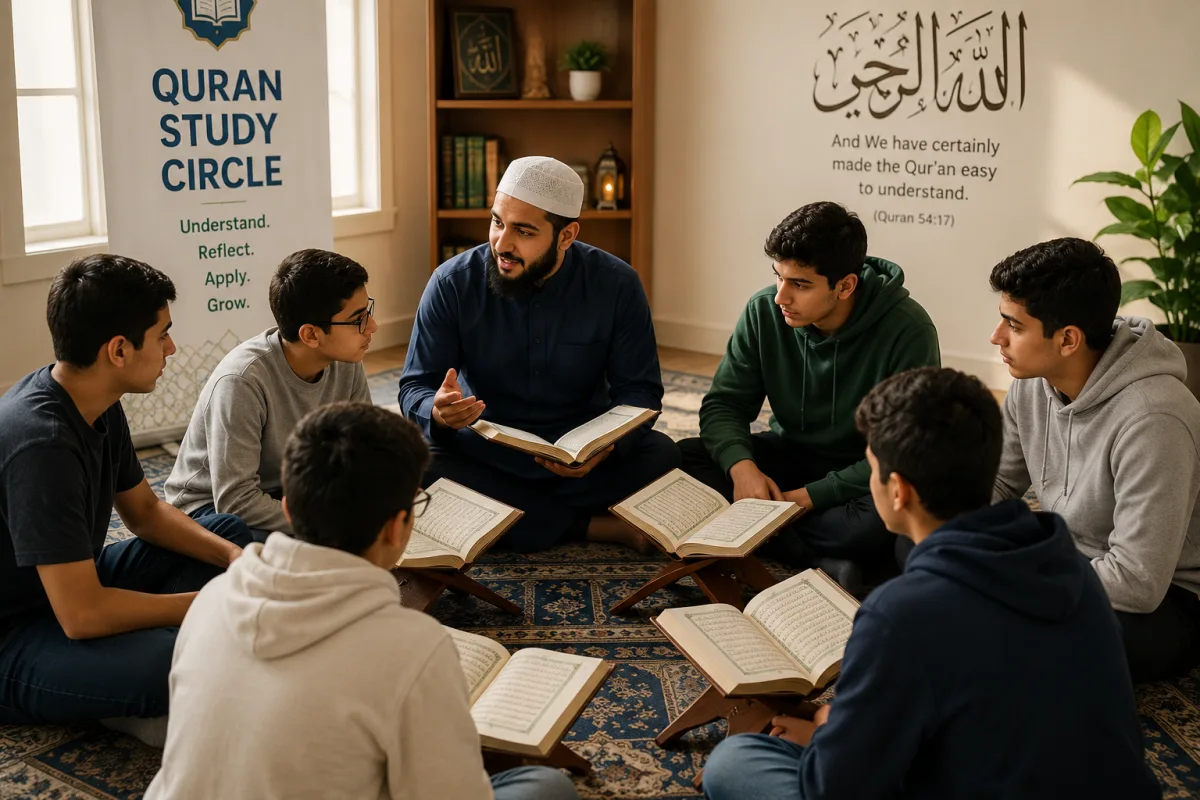
Learning to recite the Qur'an beautifully begins with one small, honest question: "Where do I start?" For many beginners, that question quickly grows into a dozen more. What exactly is Tajweed? Is it obligatory? Am I too old? Do I need to speak Arabic first? Can my child manage it? And can any of this really be learned online?
If those questions sound familiar, you are in the right place. This guide gathers the most common questions we hear from new students and their families and answers them clearly, without jargon and without pressure.
The encouraging news is that Allah has made this path accessible. As the Qur'an itself reminds us: "And We have certainly made the Qur'an easy to remember, so is there any who will be reminded?" (Surah al-Qamar 54:17). Tajweed is not a locked door reserved for scholars. It is a learnable, teachable skill, and thousands of ordinary beginners master it every year.
Read on for straight answers to the questions people are often too shy to ask out loud.
Reading time: about 11 minutes.
Reviewed by the Tayseerul Quran Teaching Team Qualified Quran teachers helping children and adults learn Quran reading, Tajweed, Noorani Qaida, Hifz, and Arabic through one-on-one online classes.
What You'll Learn
- Tajweed Basics
- Is Tajweed Obligatory
- Learning Tajweed as an Adult
- Do You Need Arabic First
- How Long Tajweed Takes
- Learning Tajweed Online
- Do You Need a Teacher
- Tajweed for Children
- Tajweed Terms Explained
- A Qualified Teacher's Perspective
- Frequently Asked Questions
- Continue Learning
- Final Thoughts
- References
Tajweed Basics
What is Tajweed?
The word Tajweed comes from an Arabic root meaning "to make well" or "to improve." In practice, it is the set of rules that governs how each letter of the Qur'an should be pronounced, including where the sound originates in the mouth and throat and how long certain sounds are held. It ensures the Qur'an is recited the way it was revealed to the Prophet ﷺ.
Why does Tajweed matter?
Tajweed protects the meaning of the Qur'an. Many Arabic letters sound similar to an untrained ear, and mispronouncing one can change a word entirely. Reciting with Tajweed keeps the words accurate, preserves their beauty, and helps you recite with the calm, measured pace the Qur'an describes for itself.
Is Tajweed the same as reading Arabic?
Not quite. Reading Arabic is about decoding letters and words, while Tajweed is about pronouncing them correctly according to specific rules. A person can technically "read" Arabic text yet still recite the Qur'an incorrectly. Tajweed is the layer that turns basic reading into proper recitation.
Is Tajweed Obligatory
Is Tajweed obligatory?
This is one of the most asked questions, and it deserves a careful answer. Scholars widely agree that pronouncing the letters clearly enough that you do not distort the meaning of the words is required of every reciter. The finer refinements of Tajweed, such as the precise measures of elongation and the subtler rules, are generally considered a recommended perfection rather than a strict obligation. For a personal ruling on your own situation, it is always best to ask a qualified scholar.
Does that mean beginners are sinning if they make mistakes?
No. Every learner starts somewhere, and honest effort is rewarded. What matters is that you are working to improve and correct clear errors that would change meaning. Beginners are not expected to recite like experts overnight, and striving to learn is itself an act of worship.
What does the Qur'an say about how we should recite?
The Qur'an gives a beautiful instruction on the manner of recitation: "...and recite the Qur'an with measured recitation" (Surah al-Muzzammil 73:4). This measured, unhurried style is exactly what Tajweed helps you achieve. It is less about speed and more about care.
Learning Tajweed as an Adult
Can adults learn Tajweed?
Absolutely. Adults learn Tajweed successfully every day, and in some ways they have real advantages: focus, discipline, and a genuine motivation to improve. If you have ever felt that Qur'an learning is only for children, please set that worry aside. It is never too late to begin.
I feel embarrassed to start as an adult. Is that normal?
It is completely normal, and you are far from alone. Many adults carry quiet embarrassment about not having learned earlier, which is exactly why one-to-one classes work so well. In a private lesson, there is no group to feel self-conscious in front of, only you and a patient teacher working at your pace. For a gentle starting point, see our guide to Tajweed for beginners.
Will my progress be slower than a child's?
Not necessarily. Adults sometimes learn the rules faster because they can grasp explanations quickly, while children often absorb pronunciation more naturally. Both can reach an excellent standard. Consistency matters far more than age.
Do You Need Arabic First
Do I need to learn Arabic before Tajweed?
You do not need to speak or understand Arabic as a language to learn Tajweed. What you do need is the ability to recognise the Arabic letters and read them, which is a skill you build early on. Tajweed is about pronunciation and recitation rules, not about translating or having conversations in Arabic.
Where should a complete beginner start?
Most complete beginners start with the Noorani Qaida, a foundational primer that teaches the letters, their sounds, and how they join together. It gently introduces core pronunciation before you tackle full Tajweed rules. Our overview of Noorani Qaida online explains how this works step by step.
Can I learn Tajweed and Arabic understanding at the same time?
Yes, though they are separate goals. Many students focus first on reciting correctly with Tajweed, then later study Arabic meaning and grammar to deepen their understanding. There is no single right order; a good teacher will help you plan a path that suits your goals.
How Long Tajweed Takes
How long does it take to learn Tajweed?
There is no single answer, because it depends on your starting point, how often you practise, and your goals. A beginner who studies consistently might read confidently with basic rules within several months, while polishing finer details is an ongoing journey. Think of Tajweed as a skill you refine over time rather than a box you tick once.
How much daily practice do I need?
Short, regular practice beats long, occasional sessions. Even ten to fifteen focused minutes a day, applying what your teacher showed you, builds real momentum. Consistency is the single biggest factor in steady progress. Our Tajweed practice plan and checklist offers a simple structure to follow.
Will I ever be "finished" learning Tajweed?
Tajweed rewards a lifetime of attention, and even skilled reciters keep refining. That said, you will reach clear, satisfying milestones along the way: reading your first page smoothly, mastering a rule that once confused you, reciting a short surah beautifully. Celebrate those; they are real achievements.
Learning Tajweed Online
Can I learn Tajweed online?
Yes, and online learning has become one of the most effective ways to study. With live video, a teacher can hear your recitation in real time, correct your pronunciation instantly, and demonstrate the correct sound for you to imitate. For many students, this is just as effective as sitting in the same room. Learn more about how online Quran classes work in practice.
Is online Tajweed as good as in-person?
For most learners, yes. The heart of Tajweed learning is listening and imitating, and clear audio and video capture that beautifully. Online study also removes travel, widens your choice of qualified teachers, and lets you learn from the comfort of home. What matters most is the quality of the teacher, not the classroom.
What do I need to get started online?
Very little: a stable internet connection, a device with a microphone and camera, a quiet space, and a copy of the Qur'an or Qaida your teacher recommends. Most students are surprised by how simple the setup is. A free trial lesson is the easiest way to test it for yourself.
Do You Need a Teacher
Do I really need a teacher, or can I self-study?
You can learn a great deal from books and videos, but Tajweed is an oral tradition passed from teacher to student for a reason. Many pronunciation errors are impossible to hear in yourself; you simply do not notice you are making them. A teacher catches these, corrects them early, and stops small mistakes from becoming habits.
Why is one-to-one better than a group?
In a one-to-one lesson, every minute is focused on you. The teacher can pace the class to your needs, spend extra time on the sounds you find tricky, and give feedback on your recitation specifically. Beginners especially benefit from this individual attention and the comfort of a private, judgment-free setting.
How do I know if a teacher is qualified?
Look for teachers with formal training in Tajweed and Qur'an, experience teaching beginners, and the patience to explain things gently. A good teacher meets you where you are and adjusts to your learning style. A free trial is a natural chance to see whether a teacher is the right fit before committing.
Tajweed for Children
Can children learn Tajweed?
Yes, and children often take to it wonderfully. Young learners tend to absorb pronunciation naturally by listening and imitating, much as they pick up any language. With a kind, encouraging teacher and short, engaging lessons, children can build strong Tajweed foundations that last a lifetime.
What age can a child start?
Many children begin once they can sit for a short lesson and follow along, often around five or six, though this varies from child to child. Early lessons focus on letter sounds and simple imitation rather than heavy rules. The goal at this stage is enjoyment and gentle familiarity with recitation.
How do you keep children engaged online?
Skilled teachers keep young students engaged with warmth, encouragement, repetition made fun, and lessons kept short enough to match a child's attention span. One-to-one online classes let the teacher tailor pace and tone to each child. When learning feels positive, children look forward to their lessons.
Tajweed Terms Explained
What are Makharij?
Makharij (singular: makhraj) are the articulation points, the specific places in the mouth, throat, and lips where each Arabic letter's sound is produced. Learning them helps you pronounce similar-sounding letters distinctly and correctly. They are one of the foundations that make accurate recitation possible.
What is Ghunnah?
Ghunnah is a nasal sound, a gentle resonance produced through the nose, applied to certain letters in specific situations. You will meet it early in your studies, especially with the letters noon and meem. It is easier to imitate from a teacher than to describe in words.
What is Qalqalah, and how is it different from Qira'at?
Qalqalah is a slight echoing or bouncing sound on certain letters when they carry a sukoon, giving recitation its characteristic rhythm. Qira'at, by contrast, refers to the different authenticated methods of reciting the Qur'an that were transmitted from the Prophet ﷺ, which is a more advanced topic than everyday Tajweed. If the distinction between recitation styles interests you, our article on Tajweed vs Tarteel vs Tilawah is a helpful next read.
A Qualified Teacher's Perspective
Why does learning from a qualified teacher matter so much?
From years of teaching beginners, our team sees the same pattern again and again: the students who progress fastest are not the most naturally gifted, but the ones who receive consistent, personal correction. A qualified teacher hears the errors you cannot hear yourself and shapes your recitation gently from the very first lesson, before bad habits take root.
What does the tradition say about teaching the Qur'an?
Teaching the Qur'an is one of the most honoured acts in Islam. The Prophet ﷺ said, "The best of you are those who learn the Qur'an and teach it" (Sahih al-Bukhari 5027). This is why our teachers approach each lesson as a trust and a privilege, not merely a job. You are not just receiving a service; you are joining a chain of learning that stretches back centuries.
How does Tayseerul Quran ensure quality?
Our lessons are one-to-one, taught by qualified Quran teachers experienced in guiding both children and adults. That personal format means your teacher truly knows your recitation, tracks your progress, and adapts to your needs. It is the difference between generic content and a lesson built around you.
Frequently Asked Questions
Is Tajweed obligatory for every Muslim?
Reciting clearly enough that you do not distort the meaning of the words is widely held to be required, while the finer refinements are generally viewed as a recommended perfection. Beginners are expected to strive and improve, not to be flawless immediately. For a ruling specific to your circumstances, consult a qualified scholar.
Can I learn Tajweed if I am a complete beginner?
Yes. Complete beginners are exactly who structured Tajweed learning is designed for, usually starting with the Noorani Qaida to build the basics. A good teacher will meet you at your level and build up gradually. Everyone starts somewhere.
Do I need to know Arabic to learn Tajweed?
No. You need to recognise and read the Arabic letters, but you do not need to speak or understand Arabic as a language. Tajweed focuses on pronunciation and recitation rules rather than translation.
How long before I can recite properly?
With consistent practice, many beginners read confidently with basic rules within a few months, though refining finer details continues over time. Your pace depends on how regularly you practise. Short daily sessions produce the best results.
Is online Tajweed effective for children?
Yes. Children often thrive in one-to-one online lessons, where a patient teacher can keep sessions short, warm, and engaging. The live format lets the teacher correct pronunciation instantly and adapt to each child.
How much should I practise each day?
Even ten to fifteen minutes of focused daily practice makes a meaningful difference. Regularity matters more than long, infrequent sessions. Applying your teacher's corrections between lessons is where real progress happens.
Can I try a lesson before committing?
Yes. A free trial lesson is the best way to experience one-to-one online Tajweed, meet a teacher, and see how comfortable the setup feels before you decide.
Continue Learning
If you found this guide helpful, you may also enjoy:
- Tajweed for Beginners
- Noorani Qaida Online
- Tajweed vs Tarteel vs Tilawah
- Tajweed Practice Plan and Checklist
- Online Quran Classes
Final Thoughts
Every one of the questions in this guide comes from a real beginner who was once unsure where to start, and every one of them has a hopeful answer. Tajweed is learnable at any age, it can be studied beautifully online, and you do not need to speak Arabic or be perfect to begin. What you need is a willing heart, a little consistent practice, and a patient, qualified teacher to guide you.
The Qur'an has been made easy for those who turn to it. Take that first small step, and let the rest unfold one lesson at a time.
Book a free trial Tajweed lesson today →
References
- Surah al-Qamar (54:17): "And We have certainly made the Qur'an easy to remember, so is there any who will be reminded?"
- Surah al-Muzzammil (73:4): "...and recite the Qur'an with measured recitation."
- Sahih al-Bukhari 5027: The Prophet ﷺ said, "The best of you are those who learn the Qur'an and teach it."