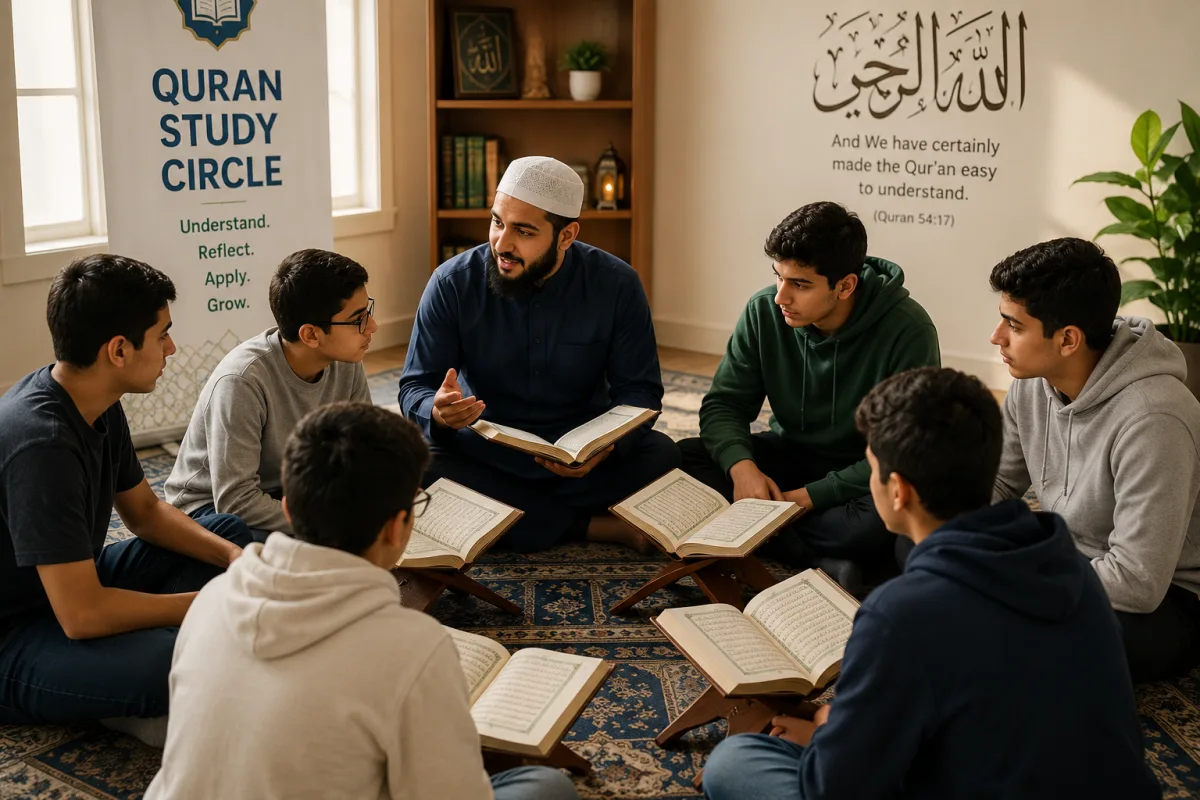
Every parent who wants their child to grow up reading the Qur'an eventually reaches the same crossroads. Should you enrol them in the mosque or Islamic centre down the road, sitting beside a teacher in a familiar room? Or should you choose one of the online Quran programs that now teach children in almost every time zone, from a laptop or tablet at the kitchen table? Both paths lead to the same beautiful goal. The question is which one fits your child, your family, and your week.
It helps to remember why this matters so much in the first place. Allah made this Book approachable on purpose. As the Qur'an says of itself, "And We have certainly made the Qur'an easy to remember. So is there any who will remember?" (Surah al-Qamar, 54:17). The method you choose is simply the doorway. A patient teacher, a steady routine, and a child who feels safe enough to try, stumble, and try again — that is what actually moves a learner forward, whether the classroom is a carpet in the masjid or a video call.
This article is an honest comparison, not a sales pitch. We will look at attention, convenience, safety, social life, engagement, cost, and more — and we will be fair to both sides, because in-person classes genuinely win in some areas. By the end you will have a clear, reasonable way to decide.
Reading time: about 10 minutes.
Reviewed by the Tayseerul Quran Teaching Team Qualified Quran teachers helping children and adults learn Quran reading, Tajweed, Noorani Qaida, Hifz, and Arabic through one-on-one online classes.
What You'll Learn
- How Online and In-Person Quran Classes Differ
- Attention and One-to-One Focus
- Convenience and Consistency
- Safety and Comfort
- Social Interaction and Community
- Engagement and Motivation
- Cost and Value
- What Qualified Teachers Notice
- The Balanced Verdict
- Frequently Asked Questions
- Continue Learning
- Final Thoughts
- References
How Online and In-Person Quran Classes Differ
In-person Quran classes are the way most of us learned. A child goes to the mosque, a madrasah, or an Islamic centre, often in a small group, and reads to a teacher who listens and corrects. There is a physical room, a shared rhythm, and the natural presence of other Muslim children.
Online Quran classes are usually one-to-one over a video call. The teacher shares their screen or a Qur'an page, the child reads aloud, and the teacher listens closely and corrects sound by sound. Lessons are booked at set times, and the child learns from home.
The core skill being taught is identical: reading Arabic letters correctly, applying the rules of Tajweed, and eventually reading fluently from the mushaf. What changes is the delivery — the room, the group size, the schedule, and the level of individual attention. Those differences are exactly where the two options start to pull apart, so let us take them one at a time.
Attention and One-to-One Focus
This is where online classes tend to shine, and it is worth being specific about why.
Reciting the Qur'an correctly is a precision skill. The difference between two similar Arabic letters, the length of a stretched vowel, the point where a letter is articulated in the mouth — these are small details that only improve when someone is genuinely listening to your child, not to five children at once. Allah tells the Prophet ﷺ, "and recite the Qur'an with measured recitation" (Surah al-Muzzammil, 73:4). Measured, careful reading is best built through close, individual feedback.
A typical online lesson is one teacher and one student for the whole session. The child cannot hide at the back, and there is no waiting turn while others read. Mistakes get caught the moment they happen, and the pace bends to the child instead of the group average.
Group madrasah classes can still teach beautifully, especially with a skilled teacher. But when eight or ten children share one adult, quieter learners often slip through, and a child who needs a little longer on a tricky letter may simply not get that time. If your child benefits from focused attention, the one-to-one format is a real advantage. You can read more about how this works in practice in our guide to online Quran classes for kids.
Convenience and Consistency
Consistency is the quiet factor that decides most Qur'an journeys, and this is the second area where online has an edge for many families.
In-person classes depend on the commute. Weather, traffic, a tired evening after school, a younger sibling who needs collecting — any of these can turn into a missed lesson, and missed lessons add up. If the nearest good teacher is thirty minutes away, that is an hour of travel wrapped around every session.
Online lessons remove the journey entirely. The class happens at home, which makes it far easier to keep a steady weekly rhythm, and steady rhythm is what actually builds fluency. It also opens up scheduling: a family in a small town, or in a country with few Qur'an teachers, can learn from a qualified teacher elsewhere, and times can often be arranged around school, naps, and time-zone differences.
None of this replaces daily practice at home, which matters more than any single lesson. Our daily Quran routine for kids shows how a few focused minutes each day, layered on top of regular classes, is what makes progress stick.
Safety and Comfort
For younger children especially, comfort shapes how well they learn.
Online classes take place in the child's own home, usually with a parent nearby in the next room. Many children relax more in familiar surroundings, and shy children in particular often find it easier to read aloud when they are not performing in front of a room of peers. Parents also value being close by — able to hear the lesson, see the teacher, and stay involved.
In-person classes offer a different kind of comfort: the reassurance of a known local teacher, a community everyone recognises, and face-to-face presence. Both settings can be safe and warm. The practical point is oversight. With online learning, choose an established provider, keep lessons in a shared family space rather than behind a closed door, and stay aware of who your child is learning with — the same sensible care you would take with any class.
Social Interaction and Community
Here in-person classes genuinely win, and it would be dishonest to pretend otherwise.
Learning the Qur'an alongside other Muslim children does something a screen cannot easily reproduce. There is the friendship, the shared identity, the gentle motivation of seeing a friend move ahead, and the simple joy of belonging to a group that is all facing the same direction. Walking into the masjid, hearing other children reciting, praying together — this builds a sense of community and Muslim identity that is deeply valuable, and for many families it is the whole point.
Online learning is strong on individual skill but naturally lighter on peer community. A one-to-one lesson gives your child a close relationship with a teacher, but not a room full of classmates.
This is the honest trade-off. If community and social belonging are your top priority, in-person has a real advantage. Many families solve it by combining both: online classes for focused daily reading progress, plus the local mosque, weekend school, or halaqah for community and connection. You do not always have to choose one and abandon the other.
Engagement and Motivation
Engagement depends less on the format and more on the teacher and the fit — but the two settings pull different levers.
Online lessons can use screen-sharing, digital Qur'an pages, highlighting, and interactive tools that many children find genuinely engaging, and the constant one-to-one interaction leaves little room to drift. A warm online teacher who greets your child by name and celebrates small wins can hold attention remarkably well.
In-person classes bring the energy of a shared space and the natural motivation of learning beside friends. Some children are lifted by that group atmosphere; others find it distracting and do better in a calmer one-to-one setting.
Younger children in particular respond to short, playful, encouraging sessions in either format. If you want to understand what actually keeps a small child moving forward, our guide on how a young child learns to read the Qur'an walks through the stages and the pacing that keeps early learners keen rather than overwhelmed.
Cost and Value
Costs vary widely by country, teacher, and format, so treat this as a way to compare rather than a fixed rule.
In-person classes at a local mosque or madrasah are sometimes free or low-cost, supported by the community, which is a real blessing — though larger groups usually mean less individual time per child. Private in-person tutors who come to your home tend to be the most expensive option, since you are also paying for their travel.
Online one-to-one classes usually sit in between: more than a large group class, often less than a private home tutor, with the full benefit of individual attention. There is no travel cost, no fuel, and no time lost commuting, which has its own value for a busy family.
When you weigh cost, weigh it against attention received and consistency achieved, not the headline price alone. A cheaper class that your child attends erratically, or where they read for only a few minutes per session, may deliver less than a modestly priced one-to-one lesson they attend every week. You can compare formats and see how structured online programs are organised in our overview of online Quran classes.
What Qualified Teachers Notice
After years of teaching the Qur'an, a few things become clear to teachers regardless of the medium, and they are worth passing on to parents.
First, correction quality matters more than classroom style. A teacher who has properly studied Tajweed and articulation can hear the exact letter that needs work and knows how to fix it gently, whether they are sitting beside a child or listening over a clear video call. What you are really choosing is a teacher, not just a format. This is the trust the Prophet ﷺ pointed to when he said, "The best of you are those who learn the Qur'an and teach it" (Sahih al-Bukhari 5027).
Second, foundations decide everything that follows. A child who is rushed past the basics of letters and sounds struggles for years afterwards. A patient, well-structured start — the kind that a solid Noorani Qaida online course provides — makes fluent, correct reading far more likely later, in any setting.
Third, on questions of religious ruling — for example, whether a particular arrangement is acceptable in your situation — ask a qualified scholar rather than relying on a general article. Our role as teachers is to help your child read well; a scholar's role is to answer questions of fiqh. When you choose, look for verifiable qualifications, clear methods, and teachers who involve parents rather than keeping them at arm's length.
The Balanced Verdict
So which is better? Here is our honest, reasonable read.
For most families today, online one-to-one classes are the stronger choice for building actual reading skill. They deliver more individual attention, they make weekly consistency far easier, and they let you reach a qualified teacher regardless of where you live. For the core task of learning to read the Qur'an correctly and steadily, those advantages are hard to beat.
In-person classes win clearly on community, friendship, and the lived experience of the masjid. If your child already has access to an excellent local teacher and thrives in a group, that is a wonderful thing and you should not feel any pressure to change it.
The best answer for many families is not either-or. Use online classes for focused, consistent reading progress, and use your local mosque, weekend school, or family halaqah for community and belonging. Whatever you choose, the decisive ingredients are the same: a qualified, caring teacher, a routine you can keep, and a little daily practice at home.
Frequently Asked Questions
Are online Quran classes as effective as in-person for kids?
For building reading and Tajweed skill, yes — often more so, because online lessons are usually one-to-one and easier to attend consistently. In-person classes remain excellent for community and social belonging.
Is my child too young for online classes?
Many children as young as four or five do well online with short, playful sessions and a parent nearby. The key is a patient teacher and brief lessons, not the format itself. Our guide on how a young child learns to read the Qur'an explains the early stages.
Do online classes work if I am not fluent in Arabic myself?
Yes. A qualified teacher does the teaching and correction. Your job is simply to help your child show up, keep a routine, and offer encouragement — you do not need to know Tajweed yourself.
Which option is better for shy children?
Shy children often prefer online one-to-one classes, because reading from home to a single friendly teacher feels less intimidating than reading aloud in front of a group. Every child is different, so trust what you see in your own.
Can we do both online and in-person?
Absolutely, and many families do. A common approach is online classes for focused daily reading progress plus the local mosque or weekend school for community. The two complement each other well.
How do I know an online teacher is qualified?
Look for verifiable Qur'an and Tajweed qualifications, a clear teaching method, transparency with parents, and an established provider. A free trial lesson is a good way to judge patience and clarity before you commit.
Is it permissible to learn Qur'an online?
Learning the Qur'an from a qualified teacher over video is widely practised and helps many Muslims. For any specific ruling about your situation, please ask a qualified scholar.
Continue Learning
- Online Quran classes for kids
- How a young child learns to read the Qur'an
- A daily Quran routine for kids
- Online Quran classes
- Noorani Qaida online
Final Thoughts
There is no single right answer that fits every family — only the answer that fits your child, your week, and your community. In-person classes offer irreplaceable friendship and belonging. Online classes offer close attention and the consistency that quietly builds fluency. Many families are happiest combining the two.
What never changes is the heart of it: a qualified, patient teacher, a routine you can keep, and a child who feels encouraged to keep going. Get those right and your child will grow with the Book, whichever room they learn in. The easiest way to compare is to try it for yourself and watch how your child responds.
See the difference — book a free trial lesson for your child →
References
- Surah al-Qamar (54:17)
- Surah al-Muzzammil (73:4)
- Sahih al-Bukhari 5027: "The best of you are those who learn the Qur'an and teach it."