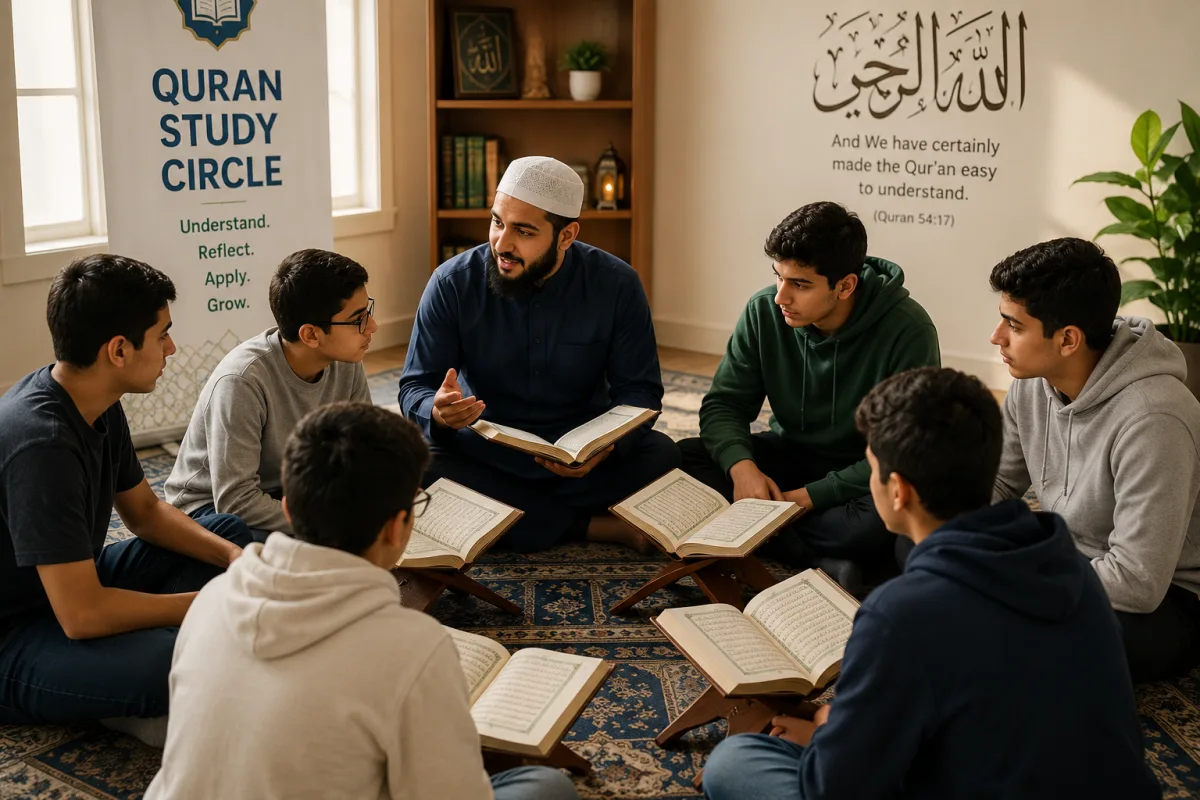
For millions of Muslims around the world, the very first pages of the Qur'an they ever hold in memory come not from the beginning of the Mushaf, but from its final section: Juz Amma. It is the part recited softly by a child in their first prayer, hummed by a grandmother as she works, and returned to again and again throughout a lifetime. If you have ever wondered where to begin your journey with the Qur'an — whether for yourself or for your children — this is almost certainly it.
Juz Amma is the thirtieth and last juz of the Qur'an, and it holds a special place in the hearts of learners everywhere. It is short in verses but immense in meaning, familiar in sound yet endlessly rewarding to study. Beginning here is not a shortcut or a simplification; it is a time-honored path walked by generations of students and teachers.
Allah reminds us of His mercy in making this book approachable. As we read in Surah al-Qamar (54:17): "And We have certainly made the Qur'an easy to remember, so is there any who will be reminded?" That ease is felt most keenly in Juz Amma, where the surahs are compact, rhythmic, and beautifully suited to the human memory.
This guide will walk you through what Juz Amma is, why so many learners start here, how to read and memorize it well, and how one-to-one online lessons can make the journey steady and joyful for children and adults alike.
Reading time: about 11 minutes.
Reviewed by the Tayseerul Quran Teaching Team Qualified Quran teachers helping children and adults learn Quran reading, Tajweed, Noorani Qaida, Hifz, and Arabic through one-on-one online classes.
What You'll Learn
- What Juz Amma Is
- Why Most People Start With Juz Amma
- Why The Short Surahs Matter So Much
- Learning To Read Juz Amma Correctly
- Memorizing Juz Amma Step By Step
- Tajweed In The Short Surahs
- Teaching Juz Amma To Children
- How Online Lessons Help You Learn Juz Amma
- A Realistic Plan For Learning Juz Amma
- A Qualified Teacher's Perspective
What Juz Amma Is
The Qur'an is traditionally divided into thirty parts, called ajza (singular: juz), to make reading and memorization more manageable. Each juz is roughly equal in length, and this division has helped students structure their study for centuries. Juz Amma is the thirtieth and final of these parts.
The name "Amma" comes from the opening words of Surah an-Naba', the surah that begins this section. Because Arabic chapters and sections are often named after their first distinctive word, "Juz Amma" simply means "the juz that begins with 'Amma.'" It sits at the very end of the Mushaf, occupying roughly the last portion of the book.
What makes Juz Amma so recognizable is that it gathers together many of the shorter surahs of the Qur'an. These are the chapters most often recited in daily prayer, taught to young children, and memorized first by new learners. Their brevity does not diminish their weight — these surahs speak powerfully about faith, accountability, the natural world, and the life to come.
If you are just beginning to picture the Qur'an as a whole, it helps to understand how Juz Amma differs from the opening chapters. You can explore that contrast in more depth in our guide on Juz Amma vs the start of the Qur'an.
Why Most People Start With Juz Amma
There is a beautiful wisdom in the way learners across the world begin at the back of the book rather than the front. The opening juz of the Qur'an contains longer surahs with extended passages, whereas Juz Amma offers short, self-contained chapters that a beginner can complete in a single sitting.
Starting here builds confidence quickly. A young child or a busy adult can learn a full surah — beginning, middle, and end — in a matter of days rather than weeks. That sense of completion is deeply motivating. Instead of feeling overwhelmed by the scale of the whole Qur'an, the learner tastes early, genuine success.
There is also a profoundly practical reason. The short surahs of Juz Amma are precisely the ones used again and again in the five daily prayers. Learning them is not an academic exercise; it directly enriches an act of worship performed every single day. Every surah memorized here becomes part of your standing before Allah.
For learners who want to understand this starting point more deeply, our Juz Amma FAQ answers many of the common questions parents and adult students ask before they begin.
Why The Short Surahs Matter So Much
It would be a mistake to think of the short surahs as merely "easy" or "for beginners." Their length has nothing to do with their status. Many of the most frequently recited passages in a Muslim's life come from this final juz.
Consider the role these surahs play in salah. When a worshipper stands to pray, after reciting the opening chapter they add another portion of the Qur'an — and for most Muslims, most of the time, that portion comes from Juz Amma. This means these chapters are woven into the fabric of daily devotion in a way few other parts of the Qur'an are.
Because of this, learning Juz Amma well is one of the most immediately useful things a Muslim can do. It transforms prayer from something recited hesitantly into something offered with understanding and calm. The words stop being unfamiliar sounds and become a conversation you truly know.
This is also why accuracy matters here more than anywhere. A surah you will recite thousands of times in your life deserves to be learned correctly from the very start, with proper pronunciation and rhythm. Building that foundation is the goal of structured programs like online Quran classes with a dedicated teacher.
Learning To Read Juz Amma Correctly
Before memorization comes reading — and reading the Qur'an is a skill of its own. Arabic letters have precise points of articulation, and even small differences in how a letter is pronounced can change a word entirely. This is why learners are encouraged to build a solid reading foundation before rushing to memorize.
The traditional path to fluent Qur'anic reading begins with recognizing the letters and their sounds, then joining them into words, and finally reading smoothly with the rules of recitation applied. Many students build this foundation through Noorani Qaida, a time-tested primer designed to teach the Arabic letters and their combinations in a gentle, structured order. You can read more about this in our guide to Noorani Qaida online.
When a learner reads Juz Amma with a teacher, the teacher listens closely and corrects gently — catching a mispronounced letter, a shortened vowel, or a rushed pause. This kind of live feedback is difficult to replicate from an app or a recording alone, because reading the Qur'an is fundamentally an oral tradition passed from teacher to student.
Allah instructs us on the manner of recitation in Surah al-Muzzammil (73:4): "...and recite the Qur'an with measured recitation." Reading slowly, clearly, and with care is not optional polish — it is part of how the Qur'an is meant to be read.
Memorizing Juz Amma Step By Step
Once a learner can read a surah comfortably, memorization becomes far more natural. Trying to memorize words you cannot yet read fluently is like trying to run before you can walk; it leads to frustration and shaky retention. So the first principle of memorizing Juz Amma is simple: read it well first.
A reliable method is to work in small, repeated portions. Rather than attempting an entire surah at once, a learner recites a single verse many times while looking at the text, then repeats it from memory, then connects it to the verse before. Small daily portions, consistently reviewed, outperform large bursts of effort that are quickly forgotten.
Review is where memorization truly lives. New verses fade without regular revisiting, so successful students weave old surahs back into their daily practice — often simply by reciting them in their prayers. In this way, memorization and worship reinforce one another beautifully.
For a complete, practical walkthrough of this process, including how to structure daily sessions and revision cycles, see our dedicated guide on how to memorize Juz Amma. And for those who feel drawn to continue beyond this juz, our resource on memorizing Quran online shows how the same habits scale to larger goals.
Tajweed In The Short Surahs
Tajweed is the set of rules that governs how the Qur'an is recited — how letters are pronounced, how sounds are elongated or shortened, and where the reciter pauses. Far from being an advanced or optional subject, tajweed is present in every verse, including the shortest surahs of Juz Amma.
In fact, Juz Amma is an ideal place to learn tajweed precisely because its surahs are short and frequently recited. A learner can focus on applying a single rule correctly across a small, familiar passage, then hear and feel the difference immediately. The rhythmic, rhyming endings of many of these surahs also make the rules of stopping and elongation come alive.
Common tajweed points that appear throughout this juz include the proper lengthening of certain vowels, the clear pronunciation of each letter from its correct point of articulation, and the rules governing the noon and meem sounds. A teacher introduces these gradually, so the learner is never overwhelmed and always understands why a rule applies.
If tajweed feels intimidating, it need not be. Our beginner-friendly introduction to Tajweed for beginners breaks the subject into approachable steps, and learning it alongside Juz Amma means every rule is immediately useful in prayer.
Teaching Juz Amma To Children
For parents, Juz Amma is often the doorway through which their children first enter a lifelong relationship with the Qur'an. Children have a remarkable capacity for memorization, and the short, rhythmic surahs of this juz are perfectly suited to young minds and short attention spans.
The key with children is gentleness and consistency. A few focused minutes each day, filled with encouragement and free of pressure, achieves far more than long, tiring sessions. Repetition through listening, echoing the teacher, and reciting in prayer helps the surahs settle naturally, almost like learning a familiar song.
Children also thrive on connection. A patient teacher who smiles, praises effort, and adjusts the pace to the child's mood turns learning into something the child looks forward to rather than dreads. This human warmth is one of the most important ingredients in a child's early Qur'an education, and it is why one-to-one attention matters so much.
Parents are also powerful partners in this process. Reciting these surahs at home, listening to your child's progress, and praying together all reinforce what happens in lessons — and they build precious shared memories around the Qur'an.
How Online Lessons Help You Learn Juz Amma
For many families and adult learners, finding a qualified local teacher is difficult. Schedules are full, distances are great, and the right teacher for a specific need may simply not be nearby. This is where one-to-one online lessons have transformed access to Qur'an learning.
Online classes bring a qualified teacher directly to the learner, wherever they are in the world. In a one-to-one setting, the entire lesson is shaped around a single student — their pace, their strengths, and the specific letters or rules they find challenging. There is no waiting for a group and no being left behind; the attention is complete and personal.
This individual focus is especially valuable for Juz Amma, where correct pronunciation from the outset shapes a lifetime of recitation. A teacher can hear exactly where a learner struggles, model the correct sound, and have the student try again immediately — the same responsive, oral method by which the Qur'an has always been taught.
Flexible scheduling also means lessons can fit around school, work, and family life, making consistency achievable rather than aspirational. For a fuller picture of how these classes are structured and what to expect, our overview of online Quran classes walks through the experience from the first trial lesson onward.
A Realistic Plan For Learning Juz Amma
Ambition is wonderful, but lasting progress comes from a plan you can actually sustain. The goal is not to rush through Juz Amma but to learn it well enough that it stays with you for life. Here is a realistic, teacher-guided approach.
Begin by making sure you can read comfortably. If your Arabic reading is still developing, spend time strengthening it first — this investment pays back many times over during memorization. A short, structured reading foundation prevents years of small errors.
Next, work through the juz in small portions, moving from the shortest, most familiar surahs toward the longer ones. Learn each surah's reading first, then its memorization, then fold it into your daily prayers so that revision happens naturally. A steady rhythm of a few verses at a time, reviewed daily, is far more effective than occasional intense effort.
Finally, build in regular review from the very beginning. Set aside part of each session to revisit what you have already learned. It is common for learners to add new material eagerly while neglecting revision, only to find earlier surahs slipping away. Protect your progress by returning to it often, and let a teacher help you keep the balance right.
A Qualified Teacher's Perspective
From years of teaching learners of all ages, one truth stands out above the rest: the students who succeed are rarely the fastest — they are the most consistent. A child who recites just a few verses every single day, with a caring teacher listening, will surpass one who studies in occasional bursts. Steadiness, not speed, is what builds a Qur'an that lasts a lifetime.
Qualified teachers also understand that correction is an act of care, not criticism. When a teacher gently repeats a letter or a rule, they are protecting the learner from a mistake that could otherwise be repeated for years. This is why learning from a knowledgeable, patient teacher matters so much more than learning alone from a screen. The Qur'an is a trust, handed down carefully from one reciter to the next.
The honour of this work is captured in the words of the Prophet, peace be upon him, as recorded in Sahih al-Bukhari 5027: "The best of you are those who learn the Qur'an and teach it." Every lesson, however small, is part of that noble chain.
A note on matters of religious ruling: questions about specific obligations, the validity of prayer, or detailed points of Islamic law should always be directed to a qualified scholar. A Qur'an teacher's role is to help you read, recite, and memorize beautifully; a scholar's role is to guide you on rulings. Knowing the difference keeps your learning on firm ground.
Frequently Asked Questions
What exactly is Juz Amma?
Juz Amma is the thirtieth and final part of the Qur'an. It begins with Surah an-Naba' and contains many of the shorter surahs that Muslims commonly learn first and recite in their daily prayers. Its name comes from the opening word of that first surah.
Why do most beginners start with Juz Amma instead of the beginning?
Because its surahs are short, self-contained, and frequently used in prayer. Beginners can complete a full surah quickly, which builds confidence and provides immediate, practical benefit in daily worship. The opening of the Qur'an contains longer passages that are usually tackled later.
Do I need to learn to read Arabic before memorizing Juz Amma?
It is strongly recommended. Memorizing from fluent, correct reading leads to far better pronunciation and retention. Many learners build this foundation with a structured primer such as Noorani Qaida before or alongside their memorization.
Can adults learn Juz Amma, or is it just for children?
Absolutely, adults can and do learn Juz Amma. While children often memorize quickly, adults benefit from understanding and life experience. One-to-one lessons adapt to any age, and it is never too late to begin building your recitation.
How long does it take to memorize Juz Amma?
This varies widely depending on your starting point, the time you can commit, and how consistently you revise. The most reliable path is small daily portions with regular review rather than rushing. A teacher can help you set a realistic pace for your circumstances.
Is tajweed necessary for the short surahs?
Yes. Tajweed applies to every verse of the Qur'an, including the shortest surahs. Because these surahs are recited so often in prayer, learning them with correct tajweed from the start is especially valuable.
How do online one-to-one lessons work for Juz Amma?
A qualified teacher meets with the learner over video, listens to their recitation, corrects pronunciation in real time, and guides both reading and memorization at the learner's own pace. Lessons are scheduled flexibly to fit around school, work, and family life.
Continue Learning
- How to Memorize Juz Amma
- Juz Amma FAQ
- Noorani Qaida Online
- Tajweed for Beginners
- Online Quran Classes
Final Thoughts
Juz Amma is where so many journeys with the Qur'an begin — and for good reason. Its short, powerful surahs are the ones we carry into prayer every day, the ones we teach our children, and the ones we return to throughout our lives. Learning it well, with correct reading and tajweed, lays a foundation that supports everything that comes after.
The path is gentle but it rewards consistency, patience, and the guidance of a caring teacher. Whether you are a parent hoping to open this door for your child or an adult ready to strengthen your own recitation, the best time to begin is now, one small, steady step at a time.
Start learning Juz Amma with a qualified teacher — book a free trial →
References
- Surah al-Qamar (54:17): "And We have certainly made the Qur'an easy to remember, so is there any who will be reminded?"
- Surah al-Muzzammil (73:4): "...and recite the Qur'an with measured recitation."
- Sahih al-Bukhari 5027: "The best of you are those who learn the Qur'an and teach it."