If you have ever sat quietly after prayer and wondered whether it is too late for someone like you to memorize the Qur'an, you are far from alone. Adults arrive at this hope from every direction: some carry the regret of a childhood where the opportunity never came, others reverted later in life and feel they are starting from behind, and many simply reached a season where the heart finally asked for more. The doubt is almost always the same. Can a busy adult, with work and family and a tired memory, really do this?
This article walks through what that journey actually looks like, month by month and year by year. It is written as an illustrative, representative journey — a composite of the paths our teachers see again and again. It is not the story of one specific person, and it contains no real testimonial, no named student, and no invented quotes. Wherever you read "you," picture yourself; the details are drawn from the general shape of the road, not from any single traveller.
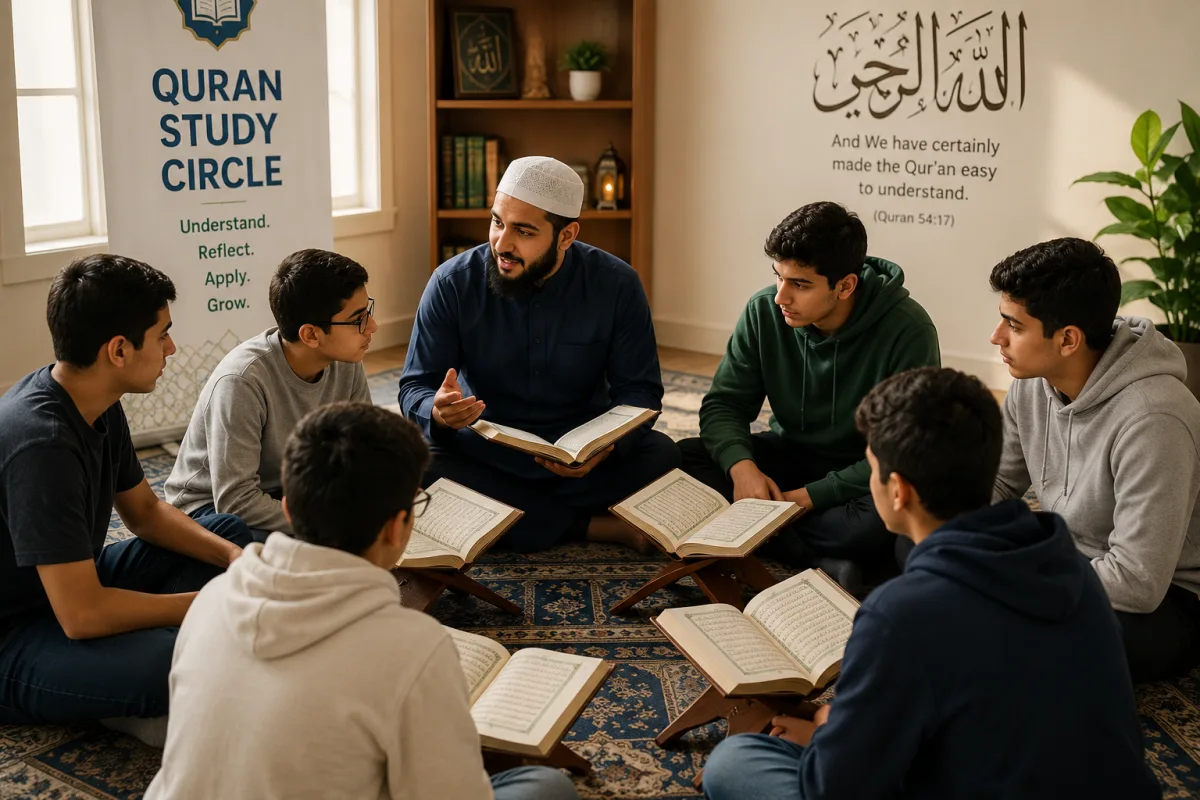
Allah describes His own Book as approachable when the intention is sincere: "And We have certainly made the Qur'an easy to remember. So is there any who will remember?" (Surah al-Qamar, 54:17). That verse is not a promise that memorization is effortless — it is an invitation. The ease is real, but it is granted along the way, to those who show up. What follows is an honest picture of showing up.
Reading time: about 11 minutes.
Reviewed by the Tayseerul Quran Teaching Team Qualified Quran teachers helping children and adults learn Quran reading, Tajweed, Noorani Qaida, Hifz, and Arabic through one-on-one online classes.
What You'll Learn
- The Doubt That Starts Every Adult Hifz Journey
- The First Few Months: Building the Habit Before the Memory
- Year One: Momentum, Setbacks, and the Real Rhythm of Sabaq
- The Middle Years: When Revision Becomes the Job
- Completion Is Slow, and It Is Real
- How to Read the Signs of Progress
- What Actually Makes the Difference
- A Teacher's Perspective
- Frequently Asked Questions
- Continue Learning
- Final Thoughts
- References
The Doubt That Starts Every Adult Hifz Journey
The first obstacle is rarely the Qur'an. It is the story you tell yourself before you begin. My memory isn't what it was. I only have twenty minutes a day. Children do this so easily and I am forty-three. These thoughts feel like facts, but they are mostly fear wearing the costume of realism.
Here is what an adult brings that a child does not: intention that is fully your own, discipline shaped by years of responsibility, and an understanding of why you want this. A seven-year-old memorizes because a teacher asks. You memorize because your soul asked. That difference is quiet, but over years it becomes decisive.
It is true that adult memory works differently. You may need more repetitions to fix a line, and you will forget faster in the early weeks. But adults compensate with comprehension, pattern recognition, and the ability to connect a verse to a meaning, a story, or a moment in your own life. Memory is not a fixed tank that drains with age; it is a muscle that responds to use. Most adults are simply out of practice, not out of capacity.
The doubt never fully disappears, and it does not need to. You do not wait for confidence to arrive before you start. You start, and confidence is what the starting produces. If you want a fuller picture of how the whole process is structured before committing, our guide on how to memorize Quran online lays out the mechanics from the first day.
The First Few Months: Building the Habit Before the Memory
In the beginning, the goal is not to memorize the Qur'an. The goal is to become a person who sits with the Qur'an every single day. Those are different targets, and confusing them is why many adults quit in week three.
A realistic early routine might be modest — a few lines of new memorization, called your Sabaq, taken slowly with a teacher who corrects every letter. If your recitation itself is still shaky, the first months may focus more on strengthening reading and Tajweed than on volume, because memorizing errors only teaches you to repeat them. Allah instructs, "And recite the Qur'an with measured recitation" (Surah al-Muzzammil, 73:4), and this measured, unhurried approach is exactly what protects an adult beginner from building on sand.
The habit is everything in this phase. Pick a fixed time — after Fajr is classic for a reason, because the mind is uncluttered and the day has not yet made its demands. Guard that slot the way you guard an appointment you cannot cancel. Some days you will memorize beautifully. Other days you will stare at three lines for twenty minutes and retain nothing. Both days count equally, because both days you showed up, and showing up is the skill you are truly building.
Expect the first plateau around week six to eight. The novelty fades, life crowds in, and the memorization feels heavier than it did. This is not failure; it is the normal moment where a hobby becomes a discipline. Adults who push gently through this window almost always stay for the long journey.
Year One: Momentum, Setbacks, and the Real Rhythm of Sabaq
By the time you cross into a steady first year, the three-part rhythm of Hifz becomes your daily life. You have Sabaq (the new lesson you are memorizing now), Sabqi (the recent portion from the last several days or weeks that is still fresh and needs daily reinforcement), and Manzil (the older, well-established portion that you revise on a longer rotation to keep it from slipping).
Getting these three into balance is the real work of year one. New adults often make the same mistake: they fall in love with Sabaq, race ahead adding new pages, and neglect Sabqi and Manzil — until one day they realize the surahs from two months ago have quietly evaporated. Memorizing the Qur'an is not filling a bucket; it is tending a garden. What you planted last month dies without watering, no matter how much new seed you scatter.
This is the year of setbacks, and you should welcome them as information rather than fear them as verdicts. You will travel and lose your rhythm. You will get sick, or a work crisis will swallow two weeks. You will hit a passage that simply will not stick — a run of similar-sounding verses (the mutashabihat) that trip you every time. A good teacher expects all of this and adjusts your load rather than shaming you for it.
The adults who succeed treat consistency as more important than speed. Half a page a day, held for a year, is roughly a juz and a half of solid new memorization plus the revision to keep it — and that is a genuinely strong year for someone with a full life. If you are weighing how much to attempt, our comparison of part-time versus full-time Hifz can help you set a target that survives contact with real life instead of collapsing under it.
The Middle Years: When Revision Becomes the Job
Somewhere after you have memorized a few ajza, a shift happens that no one warns beginners about: revision quietly becomes the main event, and new memorization becomes the smaller side of the desk.
This surprises people. You imagined Hifz as a long climb of adding pages. In reality, once you hold several ajza, keeping them takes real daily time, and that time grows as your Manzil grows. It is entirely normal for a student in the middle years to spend more of the session on revision than on new lines. This is not going backwards. This is what carrying the Qur'an actually means — the word Hafiz describes a guardian, and guarding is ongoing labour, not a finished trophy.
The emotional texture changes too. The early thrill of new surahs is gone, replaced by a steadier, less glamorous commitment. Some adults describe a strange grief here, a sense that the exciting part has passed. It has not; it has matured. The relationship with the Qur'an in these years becomes less like infatuation and more like a marriage — quieter, deeper, built on daily faithfulness rather than fireworks.
Structure is what carries you through. This is the stage where an intelligent, written revision plan stops being optional. Knowing exactly which portion you revise on which day removes the daily decision fatigue that erodes so many students. If you have never built one, our walkthrough of a practical Quran revision schedule shows how to rotate your Manzil so nothing is left unwatered for too long.
The middle years are also where the temptation to quit is subtlest. It rarely arrives as a dramatic decision. It arrives as a missed morning, then two, then a week, and then the Manzil grows heavy from neglect and facing it feels like facing a debt. The cure is never to let the gap open — and if it does, to return without self-punishment. The Qur'an does not resent your absence; it simply waits.
Completion Is Slow, and It Is Real
For a busy adult, completing the memorization of the entire Qur'an is usually measured in years, not months, and the honest range is wide — anywhere from three or four years to well beyond that, depending on your starting point, your daily time, and the seasons of your life. Anyone who promises a fixed, fast timeline to a working adult is selling something. The finish line is real, but it is reached by walking, not sprinting.
And "completion" itself deserves an honest definition. The day you recite the final page is not the day the work ends. A first full pass through memorization gives you the whole text in your heart, but it is often lightly held in places. The years that follow — sometimes called consolidation — are where the Manzil is revised again and again until the whole Qur'an sits firmly. Many huffaz will tell you they only felt they truly had the Qur'an a good while after they technically "finished."
This is why the journey is better understood as a change in who you are rather than a task you tick off. You are not trying to reach an event; you are becoming a person who carries the Qur'an and keeps carrying it. Framed that way, the slowness stops being discouraging. Every year you remain in the relationship is a year of success, whether or not you have "finished," because the point was never only the finishing.
If you are still deciding whether to begin at all, sometimes the clearest next step is simply to see the road mapped out end to end. Our overview of online Quran classes explains how a structured program supports adults across all of these stages, from first lesson to lifelong revision.
How to Read the Signs of Progress
Because completion is so far off, adults need nearer landmarks to know they are moving. Learn to read these, or the distance will discourage you unfairly.
- Your new lessons need fewer repetitions. The line that took forty repeats in month one takes fifteen in month ten. Your memory is training even when it feels stagnant.
- You catch your own mistakes. Early on, only the teacher hears the slip. Later, you feel the wrongness of a misplaced word before it fully leaves your mouth. That internal ear is deep progress.
- Verses surface outside class. A portion you memorized drifts into your mind while you drive or cook. The Qur'an is moving from a folder you open into a companion who speaks unprompted.
- Tajweed becomes automatic. The rules you once applied consciously now happen on their own. Fluency has quietly replaced effort.
- Revision feels lighter for old portions. A juz that once needed heavy attention now flows in a fraction of the time. It has moved from fragile to firm.
None of these show up on a certificate, and none of them arrive on a schedule. But if you look for them, you will see them, and they will keep you walking on the days the far-off finish line feels like a mirage.
What Actually Makes the Difference
Across the many adult journeys our teachers accompany, the students who go the distance are almost never the ones with the best memories. They are the ones with the best habits and the most honest relationship with their own limits.
Consistency beats intensity, every time. The person who does twenty focused minutes daily will pass the person who does three hours once a week and then vanishes — because the Qur'an is retained through frequent contact, not occasional heroics. A sustainable small load you never abandon is worth more than an ambitious plan you keep restarting.
Accountability is the second differentiator. A regular one-to-one session with a teacher who is expecting you does something willpower alone cannot: it turns a private good intention into a kept appointment. Left entirely to ourselves, most of us drift. A teacher who hears your Sabaq, corrects your Tajweed, and gently asks about the Manzil you skipped is not a luxury for adults — for many, it is the single load-bearing beam.
The third is mercy toward yourself. The students who quit are usually not the ones who fell behind, but the ones who fell behind and then decided that falling behind meant they were not cut out for this. Setbacks are part of the design. Return, adjust the load, keep the relationship alive. The Prophet ﷺ said, "The example of the one who knows the Qur'an by heart is like the one who has a tied camel. If he keeps it tied, he will control it, but if he releases it, it will run away" (Sahih al-Bukhari 5027). Notice the mercy inside that image: a camel that runs can be sought and tied again. Slipping is expected; the door back is always open. If you want the common worries answered plainly before you start, our Quran memorization FAQ gathers them in one place.
A Teacher's Perspective
From the teacher's chair, the pattern is remarkably consistent, and it is the opposite of what most nervous adults assume. The students who worry most about their memory are usually the ones who succeed, because that worry is really seriousness, and seriousness shows up as consistency.
What experienced teachers watch for is not raw talent. It is whether a student returns after a bad week. Talent is common and cheap; return is rare and priceless. A teacher can build almost anything on a student who keeps coming back — correct the Tajweed, rebalance the Sabaq and Manzil, rebuild a portion that slipped. What a teacher cannot do is memorize for the student who disappears. The whole craft of teaching adults is really the craft of keeping the relationship alive through the ordinary storms of adult life.
This is also why one-to-one instruction matters so much more for adults than group settings. Your errors are specific to you — a particular letter your tongue struggles with, a family of similar verses your memory keeps confusing, a life schedule no template fits. A dedicated teacher tailors the load to your week, not an idealized week, and catches the small mistakes before they harden into habits that take months to undo. That individual attention, sustained over years, is what quietly turns an anxious beginner into a hafiz.
On matters of ruling — how much you are obliged to revise, questions of intention, or anything touching the sacred boundaries of handling and reciting the text — a teacher will guide you in practice, but for a formal verdict you should always ask a qualified scholar. Good teachers know the edge of their role, and honesty about that edge is itself a sign of a trustworthy guide.
Frequently Asked Questions
Is it really possible to memorize the whole Qur'an as an adult?
Yes. Adults complete Hifz regularly, all over the world, while holding jobs and raising families. Adult memory needs more repetition than a child's and forgets faster at first, but it compensates with understanding, discipline, and genuine motivation. The limiting factor is almost never age or memory — it is consistency over years.
How long does it take a busy adult to memorize the Qur'an?
Honestly, usually several years, and the range is wide — often three or four years to considerably more, depending on your daily time, your starting level of reading and Tajweed, and the seasons of your life. Consolidating what you have memorized so it is firmly held continues even after the first full pass. Be wary of anyone promising a fast, fixed timeline to a working adult.
How much time do I need each day?
Less than most people fear to begin, but it must be daily. Even twenty to thirty focused minutes, held every day, outperforms long weekend sessions with gaps between them. As your memorized portion grows, revision time grows with it, so the daily commitment increases gradually over the years.
What if my Qur'an reading and Tajweed are still weak?
Then that is where you start, and it is time well spent. Memorizing from shaky reading only fixes mistakes into your heart. Many adults spend their first months strengthening reading — through Noorani Qaida and Tajweed — before or alongside light memorization, so that everything built afterward rests on a sound foundation.
What is the difference between Sabaq, Sabqi, and Manzil?
Sabaq is your new lesson, the portion you are memorizing right now. Sabqi is your recent memorization from the last days or weeks, still fresh and reinforced daily. Manzil is your older, well-established memorization, revised on a longer rotation to keep it firm. Balancing all three is the core discipline of Hifz.
I keep forgetting what I memorized. Am I doing something wrong?
Almost certainly not — forgetting is built into the process, which is exactly why revision exists. The Prophet ﷺ compared memorized Qur'an to a camel that runs off if untied (Sahih al-Bukhari 5027). The solution is not a better memory but a better revision schedule, so old portions are watered before they can slip away.
Do I really need a teacher, or can I memorize on my own?
You can memorize alone, but very few adults sustain it, and self-teaching risks locking in Tajweed errors you cannot hear yourself. A one-to-one teacher provides correction, a balanced daily load, and the accountability of a kept appointment — which for most adults is the difference between a hopeful start and a completed journey.
Continue Learning
- How to Memorize the Qur'an Online
- Quran Memorization FAQ
- Building a Quran Revision Schedule
- Part-Time vs Full-Time Hifz
- Online Quran Classes for Adults
Final Thoughts
The adult Hifz journey is not what the anxious beginner imagines. It is slower, gentler, and far more human. It is not a feat of memory performed by exceptional people; it is a relationship kept alive by ordinary people who simply refuse to stop showing up. The doubt you feel at the start is not a sign you should not begin — it is the ordinary threshold every traveller crosses.
You will have brilliant days and empty days, months of momentum and weeks of setback, and through all of it the Qur'an will be quietly reshaping you into someone who carries it. Allah made this Book easy to remember for those who turn toward it (Surah al-Qamar, 54:17). Your part is not to be gifted. Your part is to begin, and then to return, and to keep returning.
If your heart has been asking for this, that asking is itself the invitation. Do not wait for a more convenient life; it does not arrive. Start small, start supported, and let the years do their quiet work.
Begin your own Hifz journey with a dedicated teacher — book a free trial →
References
- Surah al-Qamar (54:17) — "And We have certainly made the Qur'an easy to remember. So is there any who will remember?"
- Surah al-Muzzammil (73:4) — "And recite the Qur'an with measured recitation."
- Sahih al-Bukhari 5027 — "The example of the one who knows the Qur'an by heart is like the one who has a tied camel. If he keeps it tied, he will control it, but if he releases it, it will run away."